
艾滋病毒感染者不同免疫反应中肠道微生物群的特征分析
Characterization of the gut microbiota in different immunological responses among PLWH.
作者信息
Guo Yanyan, Tang Gan, Wang Ziwei, Chu Qinshu, Zhang Xinhong, Xu Xuewei, Fan Yinguang
机构信息
Chuzhou Center for Disease Control and Prevention, Chuzhou, 239000, Anhui, China.
Department of Epidemiology and Biostatistics, School of Public Health, Anhui Medical University, Hefei, China.
出版信息
Sci Rep. 2025 Apr 24;15(1):14311. doi: 10.1038/s41598-025-98379-0.
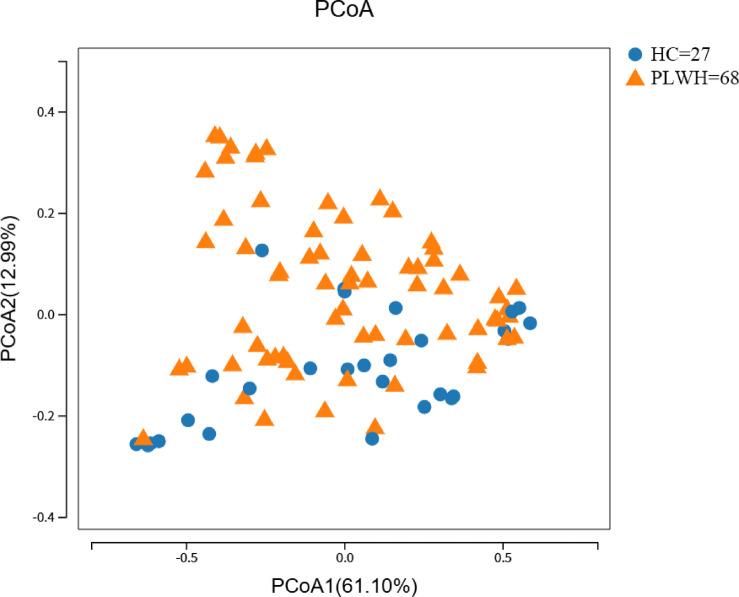
Despite gut microbial dysbiosis has been demonstrated in people living with HIV (PLWH), the association between gut microbial and inflammatory cytokines in PLWH with different immunoreaction to antiretroviral therapy (ART) is poorly understood. The purpose of this study is to explore between gut microbial and inflammatory cytokines in PLWH with different immunoreaction. 68 PLWH and 27 healthy controls(HCs) in Anhui Province were recruited from December 2021 to March 2022, including 35 immunological responders (IRs) (CD4T-cell count ≥ 350 cells/µL) and 33 immunological non-responders (INRs) (CD4T-cell count < 350 cells/µL) without comorbidities. Blood and stool samples were collected from all participants. Blood was used to detect microbial translocation biomarkers and inflammatory cytokines. Luminex Multifactor Detection Technology was performed to quantify plasma microbial translocation biomarkers and inflammation cytokines. Bacterial 16S rDNA sequencing was performed on stool samples. Microbiome sequencing revealed that the relative abundances of Fusobacteria, Actinobacteria, Verrucomicrobiaceae Acidaminococcaceae, Fusobacteriaceae and Megasphaera were greater, whereas Verrucomicrobia, Ruminococcaceae, Megamonas, Faecalibacterium, Roseburia and Dialister were more depleted in the HIV groups than those in the HCs (all P < 0.05). In the INRs group, the relative abundances of Actinomycetales, Micrococcaceae, Actinomyces, Intestinibacter, Rothia were greater (all P < 0.05), whereas Sutterellaceae, Parabacteroides, Veillonella, Butyricimonas resulted less abundant than in the IRs (all P < 0.05). TNF-ɑ are negatively correlated with the abundances of Dialiste (P = 0.022). CD54 are negatively correlated with Dialister and Subdoligranulum (P = 0.011). Recent and baseline CD4T cells counts are directly proportional to Butyricimonas and Parabacteroides, while are inversely proportional with Veillonella and Rothia (all P < 0.05). Dysbiosis of the gut microbial might be one of the factors leading to the different immunoreaction and therapeutic effects of ART.
尽管已证明艾滋病毒感染者(PLWH)存在肠道微生物失调,但对于接受抗逆转录病毒疗法(ART)后有不同免疫反应的PLWH,其肠道微生物与炎性细胞因子之间的关联仍知之甚少。本研究的目的是探索接受ART后有不同免疫反应的PLWH的肠道微生物与炎性细胞因子之间的关系。2021年12月至2022年3月,招募了安徽省的68名PLWH和27名健康对照者(HC),其中包括35名免疫反应者(IR)(CD4T细胞计数≥350个/µL)和33名免疫无反应者(INR)(CD4T细胞计数<350个/µL),且均无合并症。采集了所有参与者的血液和粪便样本。血液用于检测微生物易位生物标志物和炎性细胞因子。采用Luminex多因子检测技术对血浆微生物易位生物标志物和炎症细胞因子进行定量分析。对粪便样本进行细菌16S rDNA测序。微生物组测序显示,与HC相比,HIV组中梭杆菌属、放线菌门、疣微菌科、氨基酸球菌科、梭杆菌科和巨球形菌属的相对丰度更高,而疣微菌门、瘤胃球菌科、巨单胞菌属、粪杆菌属、罗斯氏菌属和戴阿利斯特菌属的相对丰度更低(所有P<0.05)。在INR组中,放线菌目、微球菌科、放线菌属、肠杆菌属、罗氏菌属的相对丰度更高(所有P<0.05),而萨特氏菌科、副拟杆菌属、韦荣球菌属、丁酸单胞菌属的丰度低于IR组(所有P<0.05)。TNF-α与戴阿利斯特菌属的丰度呈负相关(P=0.022)。CD54与戴阿利斯特菌属和Subdoligranulum呈负相关(P=0.011)。近期和基线CD4T细胞计数与丁酸单胞菌属和副拟杆菌属成正比,而与韦荣球菌属和罗氏菌属成反比(所有P<0.05)。肠道微生物失调可能是导致ART产生不同免疫反应和治疗效果的因素之一。




 Zotero 插件