Department of Radiation Oncology, University of Wuerzburg, Josef-Schneider-Str. 11, 97080, Wuerzburg, Germany.
Radiat Oncol. 2017 Dec 28;12(1):205. doi: 10.1186/s13014-017-0943-4.
The aim of this work is to validate the Dynamic Planning Module in terms of usability and acceptance in the treatment planning workflow.
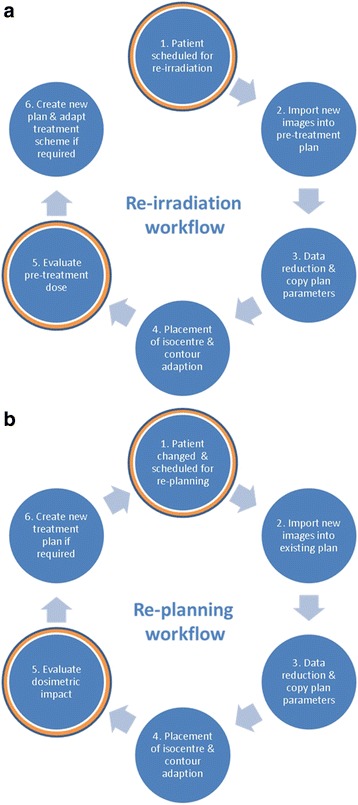
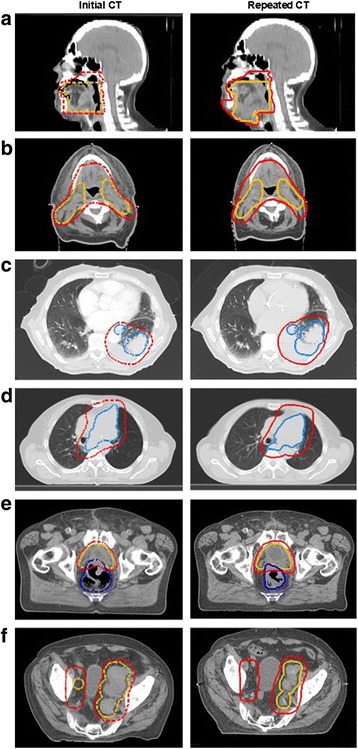
The Dynamic Planning Module was used for decision making whether a plan adaptation was necessary within one course of radiation therapy. The Module was also used for patients scheduled for re-irradiation to estimate the dose in the pretreated region and calculate the accumulated dose to critical organs at risk. During one year, 370 patients were scheduled for plan adaptation or re-irradiation. All patient cases were classified according to their treated body region. For a sub-group of 20 patients treated with RT for lung cancer, the dosimetric effect of plan adaptation during the main treatment course was evaluated in detail. Changes in tumor volume, frequency of re-planning and the time interval between treatment start and plan adaptation were assessed.
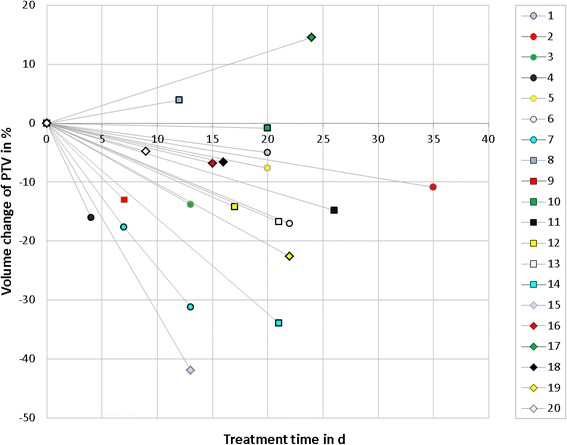
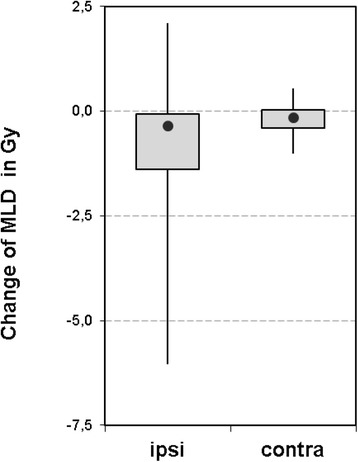
The Dynamic Planning Tool was used in 20% of treated patients per year for both approaches nearly equally (42% plan adaptation and 58% re-irradiation). Most cases were assessed for the thoracic body region (51%) followed by pelvis (21%) and head and neck cases (10%). The sub-group evaluation showed that unintended plan adaptation was performed in 38% of the scheduled cases. A median time span between first day of treatment and necessity of adaptation of 17 days (range 4-35 days) was observed. PTV changed by 12 ± 12% on average (maximum change 42%). PTV decreased in 18 of 20 cases due to tumor shrinkage and increased in 2 of 20 cases. Re-planning resulted in a reduction of the mean lung dose of the ipsilateral side in 15 of 20 cases.
The experience of one year showed high acceptance of the Dynamic Planning Module in our department for both physicians and medical physicists. The re-planning can potentially reduce the accumulated dose to the organs at risk and ensure a better target volume coverage. In the re-irradiation situation, the Dynamic Planning Tool was used to consider the pretreatment dose, to adapt the actual treatment schema more specifically and to review the accumulated dose.
本研究旨在验证动态规划模块在治疗计划流程中的可用性和可接受性。
在放射治疗过程中,使用动态规划模块来决定是否需要调整计划。该模块还用于计划再次放射治疗的患者,以估计预处理区域的剂量并计算危及器官的累积剂量。在一年中,有 370 名患者被安排进行计划调整或再次放射治疗。所有患者病例均根据治疗部位进行分类。对于 20 例接受肺癌放疗的患者亚组,详细评估了主治疗过程中计划调整的剂量学效果。评估了肿瘤体积变化、重新计划的频率以及治疗开始和计划调整之间的时间间隔。
该动态规划工具在每年接受治疗的患者中约有 20%(42%的计划调整和 58%的再次放射治疗)使用。大多数病例评估的是胸体区域(51%),其次是骨盆(21%)和头颈部病例(10%)。亚组评估显示,在计划的病例中有 38%需要进行意外的计划调整。首次治疗日与调整必要性之间的中位时间间隔为 17 天(范围 4-35 天)。平均而言,PTV 变化 12±12%(最大变化 42%)。由于肿瘤缩小,20 例中有 18 例 PTV 减少,20 例中有 2 例增加。重新计划导致 20 例中有 15 例同侧肺剂量平均降低。
一年的经验表明,该动态规划模块在我们科室的医生和医学物理师中得到了高度认可。重新计划有可能降低危及器官的累积剂量,并确保更好的靶区覆盖。在再次放射治疗的情况下,使用动态规划工具考虑预处理剂量,更具体地调整实际治疗方案,并审查累积剂量。