Xu Qiaohua, Huang Yuelong, Chen Biyun
Department of Chronic Disease Control and Prevention, Hunan Provincial Centre for Diseases Control and Prevention, Changsha, China.
BMJ Open. 2017 Dec 26;7(12):e015943. doi: 10.1136/bmjopen-2017-015943.
This study aims to develop assessment indicators of health education and promotion for non-communicable disease (NCD) demonstration districts in China and to identify significant factors associated with NCD health education and promotion work.
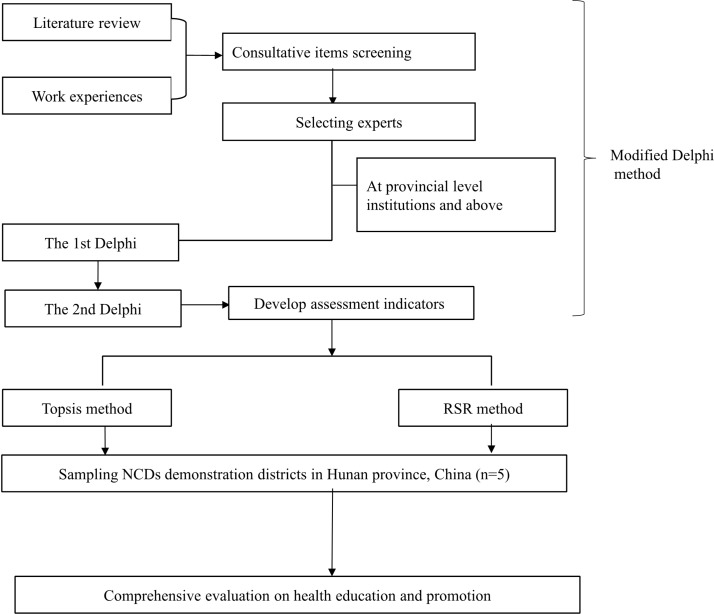
Three complementary techniques were used to conduct this study in Hunan Province, China, between late 2013 and 2015. The Delphi technique was used to develop weighted assessment indicators, followed by the rank sum ratio (RSR) to normalise the weights through rank conversion. Lastly, the technique for order of preference by similarity to ideal solution was conducted to assess five randomly selected NCD demonstration districts representing five different orientations in the province.
A total of 24 assessment indicators were constructed covering the following sections: organisational management, fund support, personnel supplies, health education and promotion, people's awareness of NCDs, management and control of patients with NCD, satisfaction with health education and promotion and health literacy of residents. Five districts were selected as samples for evaluation (Furong District, Ziyang District, Shaodong County, Shuangfeng County and Luxi County). Performance varied among the sites, with Furong District greatly surpassing the other sites, especially in fund support, media promotion, technical support for publicity materials, community promotion and supportive environment supplies. The latter four factors were also much greater in the second-ranked Luxi County site than those in the other sites (except Furong District).
There were gaps in health education and promotion work in NCD demonstration districts in Hunan Province. The districts that performed better had obvious advantages in fund support, media promotion, technical support, community promotion and supportive environment supplies. Our study provided both a methodological reference and an assessment indicator framework for similar future studies.
本研究旨在制定中国非传染性疾病(NCD)示范区健康教育与促进工作的评估指标,并确定与非传染性疾病健康教育与促进工作相关的重要因素。
2013年末至2015年期间,在中国湖南省采用三种互补技术开展本研究。运用德尔菲技术制定加权评估指标,随后采用秩和比(RSR)法通过秩转换对权重进行标准化。最后,采用逼近理想解排序法对代表该省五个不同方向的五个随机选取的非传染性疾病示范区进行评估。
共构建了24项评估指标,涵盖以下几个方面:组织管理、资金支持、人员配备、健康教育与促进、民众对非传染性疾病的认知、非传染性疾病患者管理与控制、对健康教育与促进的满意度以及居民健康素养。选取五个地区作为评估样本(芙蓉区、资阳区、邵东县、双峰县和泸溪县)。各地区表现存在差异,芙蓉区远超其他地区,尤其是在资金支持、媒体宣传、宣传材料技术支持、社区推广和支持性环境供应方面。排名第二的泸溪县在上述后四个因素方面也比其他地区(芙蓉区除外)表现更为突出。
湖南省非传染性疾病示范区的健康教育与促进工作存在差距。表现较好的地区在资金支持、媒体宣传、技术支持、社区推广和支持性环境供应方面具有明显优势。本研究为未来类似研究提供了方法学参考和评估指标框架。