Department of Clinical Laboratory, Xin Hua Hospital, Shanghai Jiao Tong University School of Medicine, Shanghai, China.
Department of Pathology, Johns Hopkins Hospital, Johns Hopkins University School of Medicine, Baltimore, MD, USA.
Eur J Clin Microbiol Infect Dis. 2018 Feb;37(2):293-299. doi: 10.1007/s10096-017-3131-4. Epub 2017 Dec 27.
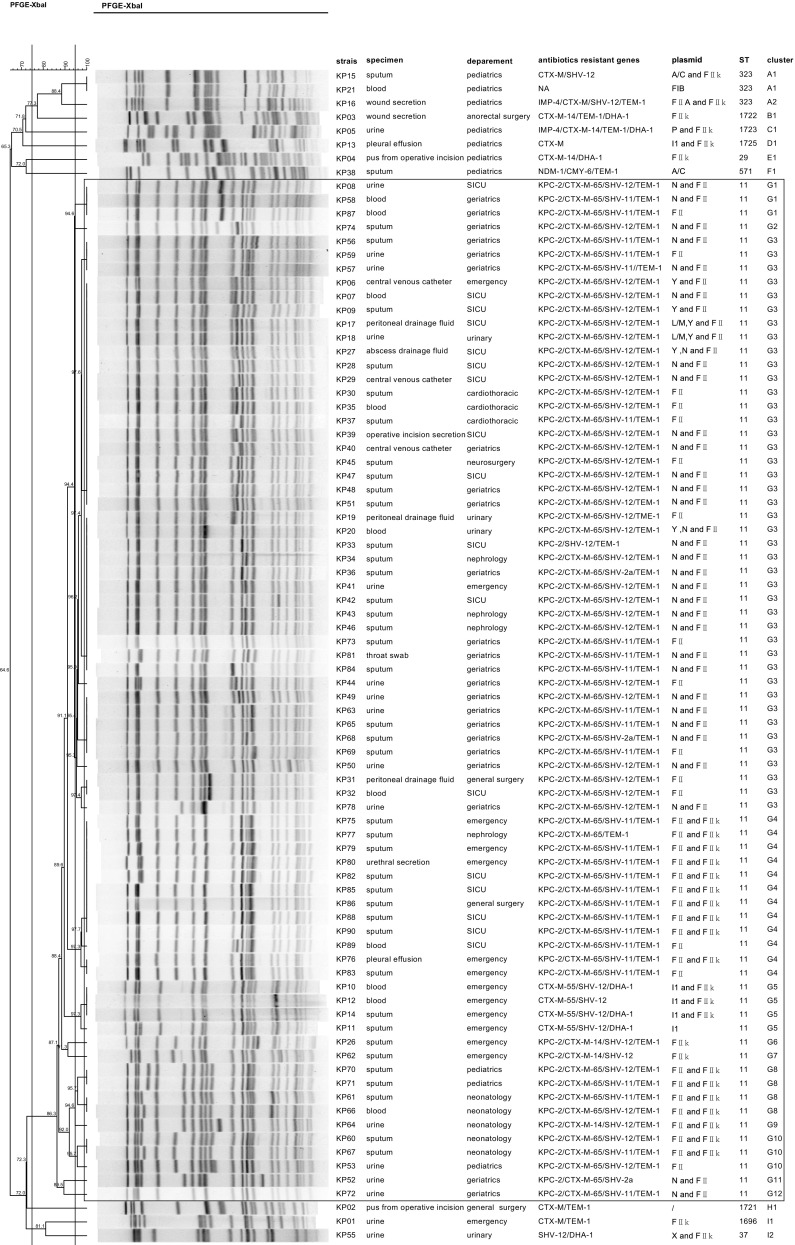
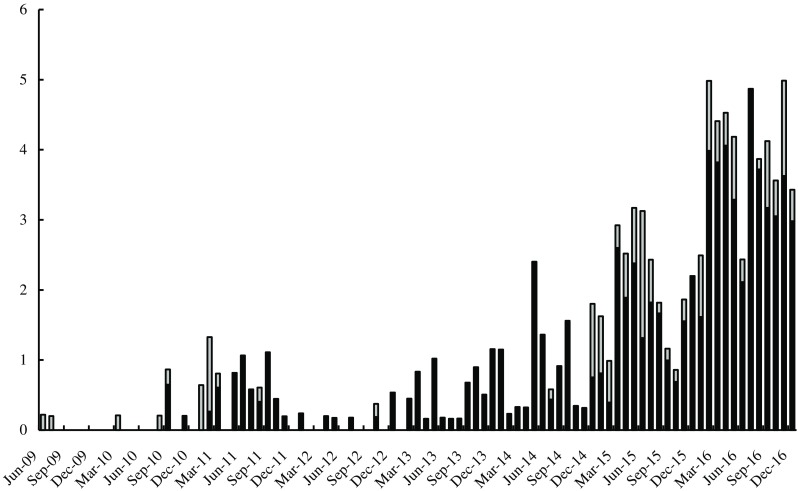
The aim of this study was to investigate the characteristics of carbapenem-resistant Klebsiella pneumoniae (CRKP) collected during an outbreak in a Chinese teaching hospital and to provide insights into the prevention and control of nosocomial infection. We collected unique CRKP clinical isolates from 2009 to 2013. Antibiotic-resistant genes were identified by polymerase chain reaction (PCR) and sequencing. The isolates were typed using pulsed-field gel electrophoresis (PFGE) and multilocus sequence typing (MLST). Plasmids were classified using a PCR-based incompatibility/replicon typing method and a replicon sequence typing method. Conjugation experiments were performed to evaluate the transferability of carbapenem-resistant genes. Whole genome sequencing (WGS) was conducted to further investigate the genetic background of the isolates. Infection control practices were reviewed throughout the study period. Klebsiella pneumoniae sequence type (ST) 11 emerged in 2010 and acquired the bla gene by 2011. From 2011 to 2013, ST11 KPC-2-producing CRKP (G type) prevailed as the most common CRKP in our hospital, causing a prolonged outbreak. The majority of these CRKP strains possess an IncFII plasmid, with Tn1721-bla -ΔTn3-IS26 bearing the genetic structure for bla . Infection prevention control measures available at the time contained the initial outbreak, but had no effect on the spread of CRKP later. This study demonstrated the seriousness concerning the spread of KPC-2-producing ST11 CRKP in a Chinese hospital, indicating that current prevention and control strategies for carbapenem-resistant Enterobacteriaceae (CRE) nosocomial infection need to be investigated and adjusted.
本研究旨在调查中国某教学医院爆发的碳青霉烯类耐药肺炎克雷伯菌(CRKP)的特征,为医院感染的预防和控制提供参考。我们收集了 2009 年至 2013 年期间发生的独特的 CRKP 临床分离株。通过聚合酶链反应(PCR)和测序鉴定抗生素耐药基因。采用脉冲场凝胶电泳(PFGE)和多位点序列分型(MLST)对分离株进行分型。采用基于 PCR 的不相容/复制子分型方法和复制子序列分型方法对质粒进行分类。通过接合实验评估碳青霉烯类耐药基因的可转移性。进行全基因组测序(WGS)以进一步研究分离株的遗传背景。整个研究期间回顾了感染控制措施。肺炎克雷伯菌序列型(ST)11 于 2010 年出现,并于 2011 年获得 bla 基因。2011 年至 2013 年,ST11 产 KPC-2 的 CRKP(G 型)成为我院最常见的 CRKP,导致长时间爆发。这些 CRKP 菌株大多数携带 IncFII 质粒,Tn1721-bla -ΔTn3-IS26 具有 bla 的遗传结构。当时可用的感染预防控制措施遏制了最初的爆发,但对 CRKP 的传播没有影响。本研究表明,中国医院 ST11 产 KPC-2 的 CRKP 传播的严重性,表明目前针对碳青霉烯类耐药肠杆菌科(CRE)医院感染的预防和控制策略需要进行调查和调整。