Department of Hematology, University Hospital Heidelberg, Heidelberg, Germany.
Max-Eder-Group Experimental Therapies for Hematologic Malignancies, German Cancer Research Center (DKFZ), Heidelberg, Germany.
Cancer Med. 2018 Feb;7(2):307-316. doi: 10.1002/cam4.1283. Epub 2017 Dec 28.
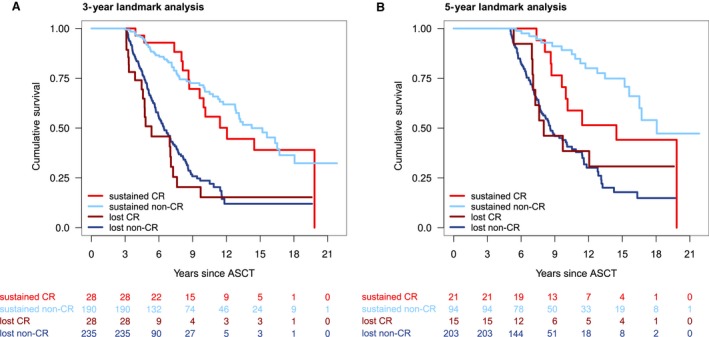
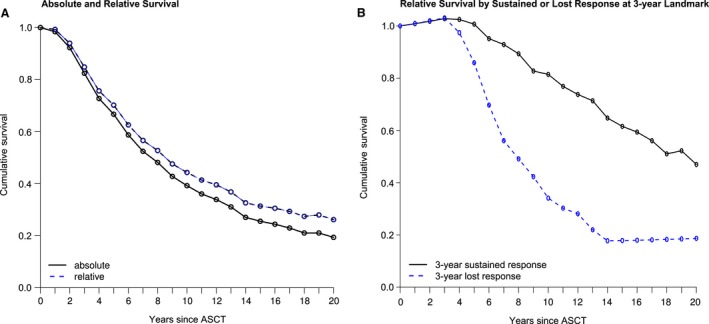
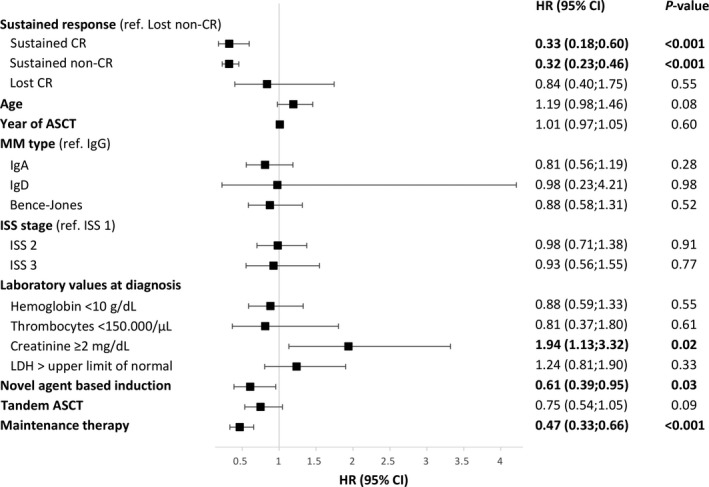
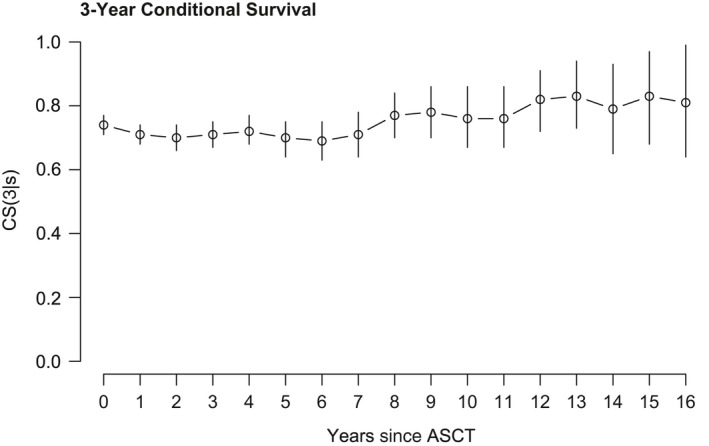
The widespread use of high-dose therapy and autologous stem cell transplantation (ASCT) as well as the introduction of novel agents have significantly improved outcomes in multiple myeloma (MM) enabling long-term survival. We here analyze factors influencing survival in 865 newly diagnosed MM patients who underwent first-line ASCT at our center between 1993 and 2014. Relative survival and conditional survival were assessed to further characterize long-term survivors. Achievement of complete response (CR) post-ASCT was associated with prolonged progression-free survival (PFS) in the whole cohort and with significantly superior overall survival (OS) in the subgroup of patients receiving novel agent-based induction therapy. Landmark analyses performed at 1, 3, and 5 years post-ASCT revealed that sustainment of any response had a highly significant influence on survival with no significant differences between sustained CR and sustained inferior responses. Furthermore, outcome was independently improved by administration of maintenance therapy. A subset of patients did experience long-term survival >15 years. However, conditional survival demonstrated a persistent risk of myeloma-associated death and cumulative relative survival curves did not show development of a clear plateau, even in prognostically advantageous groups. In conclusion, in this large retrospective study, sustained response after first-line ASCT was found to be a major prognostic factor for OS independent of depth of sustained response. Administration of maintenance therapy further improved outcome, supporting the hypothesis that interventions to prolong responses achieved post-ASCT may be essential to reach long-term survival, especially in the setting of persisting residual disease.
高剂量治疗和自体干细胞移植(ASCT)的广泛应用以及新型药物的引入显著改善了多发性骨髓瘤(MM)的预后,使患者能够长期生存。我们在此分析了 865 例新诊断的 MM 患者的生存影响因素,这些患者于 1993 年至 2014 年在我们中心接受了一线 ASCT。我们进一步评估了相对生存率和条件生存率,以更准确地描述长期幸存者。ASCT 后获得完全缓解(CR)与整个队列的无进展生存期(PFS)延长相关,与接受新型药物诱导治疗亚组的显著总生存期(OS)改善相关。ASCT 后 1、3 和 5 年的里程碑分析表明,任何缓解的维持对生存具有显著影响,持续 CR 与持续较差缓解之间没有显著差异。此外,维持治疗的应用也改善了预后。有一部分患者的生存时间超过了 15 年。然而,条件生存率仍显示出骨髓瘤相关死亡的持续风险,累积相对生存率曲线甚至在预后有利的组中也未显示出明显的平台期。总之,在这项大型回顾性研究中,ASCT 一线治疗后的持续缓解被认为是 OS 的主要预后因素,与持续缓解的深度无关。维持治疗的应用进一步改善了预后,支持了这样一种假设,即延长 ASCT 后获得的缓解的干预措施对于实现长期生存至关重要,特别是在残留疾病持续存在的情况下。