Department of Artificial Intelligence and Cognitive Engineering, University of Groningen, Nijenborgh 9, 9747 AG Groningen, The Netherlands.
Eur J Neurosci. 2018 Oct;48(8):2759-2769. doi: 10.1111/ejn.13817. Epub 2018 Jan 29.
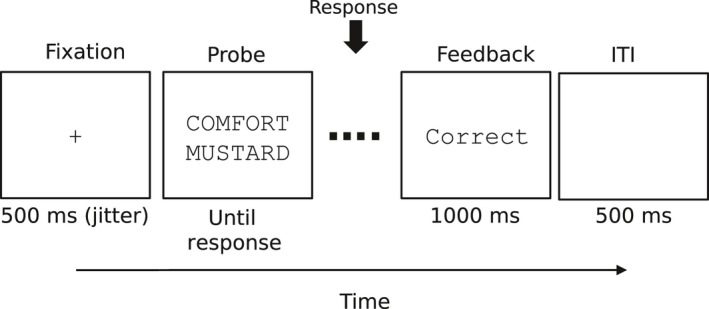
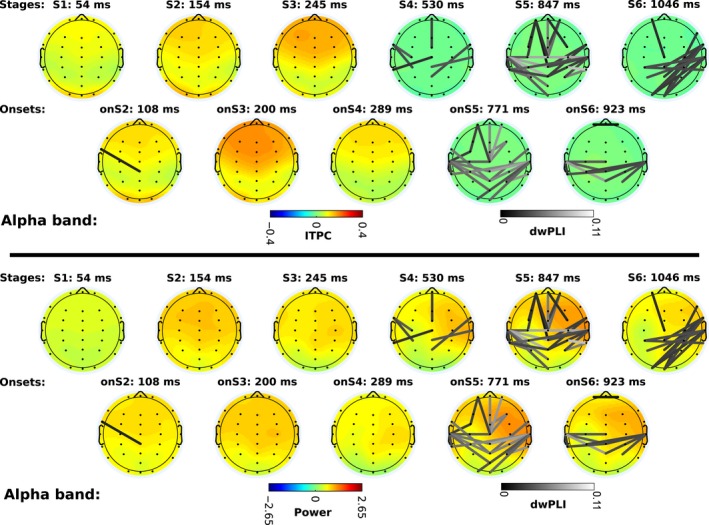
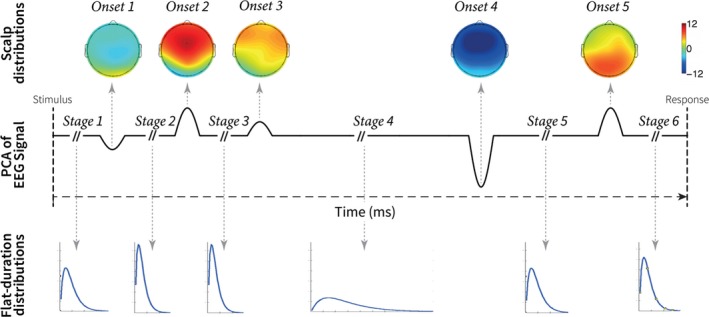
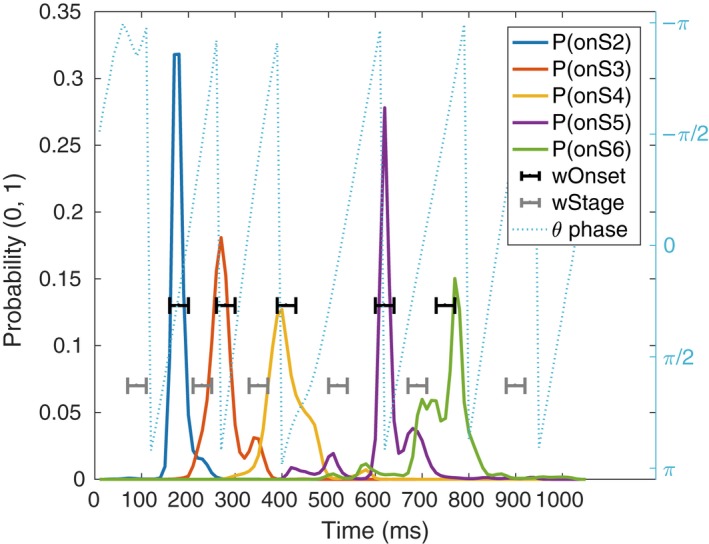
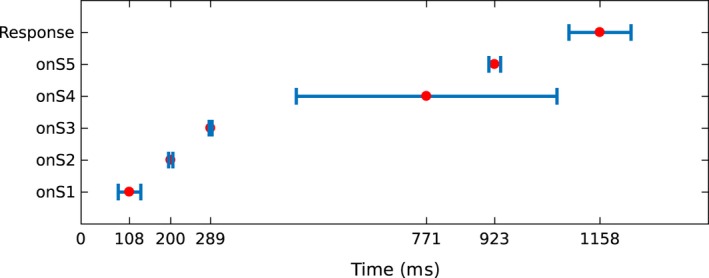
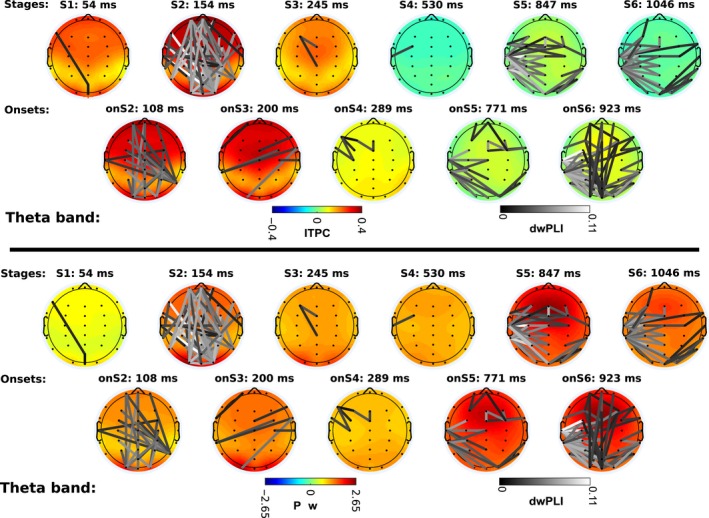
Numerous studies seek to understand the role of oscillatory synchronization in cognition. This problem is particularly challenging in the context of complex cognitive behavior, which consists of a sequence of processing steps with uncertain duration. In this study, we analyzed oscillatory connectivity measures in time windows that previous computational models had associated with a specific sequence of processing steps in an associative memory recognition task (visual encoding, familiarity, memory retrieval, decision making, and motor response). The timing of these processing steps was estimated on a single-trial basis with a novel hidden semi-Markov model multivariate pattern analysis (HSMM-MVPA) method. We show that different processing stages are associated with specific patterns of oscillatory connectivity. Visual encoding is characterized by a dense network connecting frontal, posterior, and temporal areas as well as frontal and occipital phase locking in the 4-9 Hz theta band. Familiarity is associated with frontal phase locking in the 9-14 Hz alpha band. Decision making is associated with frontal and temporo-central interhemispheric connections in the alpha band. During decision making, a second network in the theta band that connects left-temporal, central, and occipital areas bears similarity to the neural signature for preparing a motor response. A similar theta band network is also present during the motor response, with additionally alpha band connectivity between right-temporal and posterior areas. This demonstrates that the processing stages discovered with the HSMM-MVPA method are indeed linked to distinct synchronization patterns, leading to a closer understanding of the functional role of oscillations in cognition.
许多研究旨在理解振荡同步在认知中的作用。在复杂认知行为的背景下,这个问题尤其具有挑战性,因为复杂认知行为由一系列具有不确定持续时间的处理步骤组成。在这项研究中,我们分析了在时间窗口中的振荡连通性测量值,这些时间窗口与关联记忆识别任务(视觉编码、熟悉度、记忆检索、决策和运动反应)中特定的处理步骤序列相关联。这些处理步骤的时间由一种新的隐藏半马尔可夫模型多变量模式分析(HSMM-MVPA)方法在单次试验的基础上进行估计。我们表明,不同的处理阶段与特定的振荡连通模式相关联。视觉编码的特征是一个密集的网络,连接额、顶和颞叶区域,以及额和枕叶在 4-9 Hz theta 波段的相位锁定。熟悉度与 9-14 Hz alpha 波段的额相位锁定相关。决策与 alpha 波段的额和颞叶中央半球间连接有关。在决策过程中,第二个连接左颞叶、中央和枕叶区域的 theta 波段网络与准备运动反应的神经特征相似。在运动反应过程中也存在类似的 theta 波段网络,并且右颞叶和后叶区域之间存在 alpha 波段连接。这表明,HSMM-MVPA 方法发现的处理阶段确实与不同的同步模式相关联,从而更深入地了解了振荡在认知中的功能作用。