Division of Translational Epidemiology, New York State Psychiatric Institute, New York, New York, USA.
Department of Psychiatry, Vagelos College of Physicians & Surgeons, Columbia University, New York, New York, USA.
Psychophysiology. 2022 Oct;59(10):e14080. doi: 10.1111/psyp.14080. Epub 2022 Apr 27.
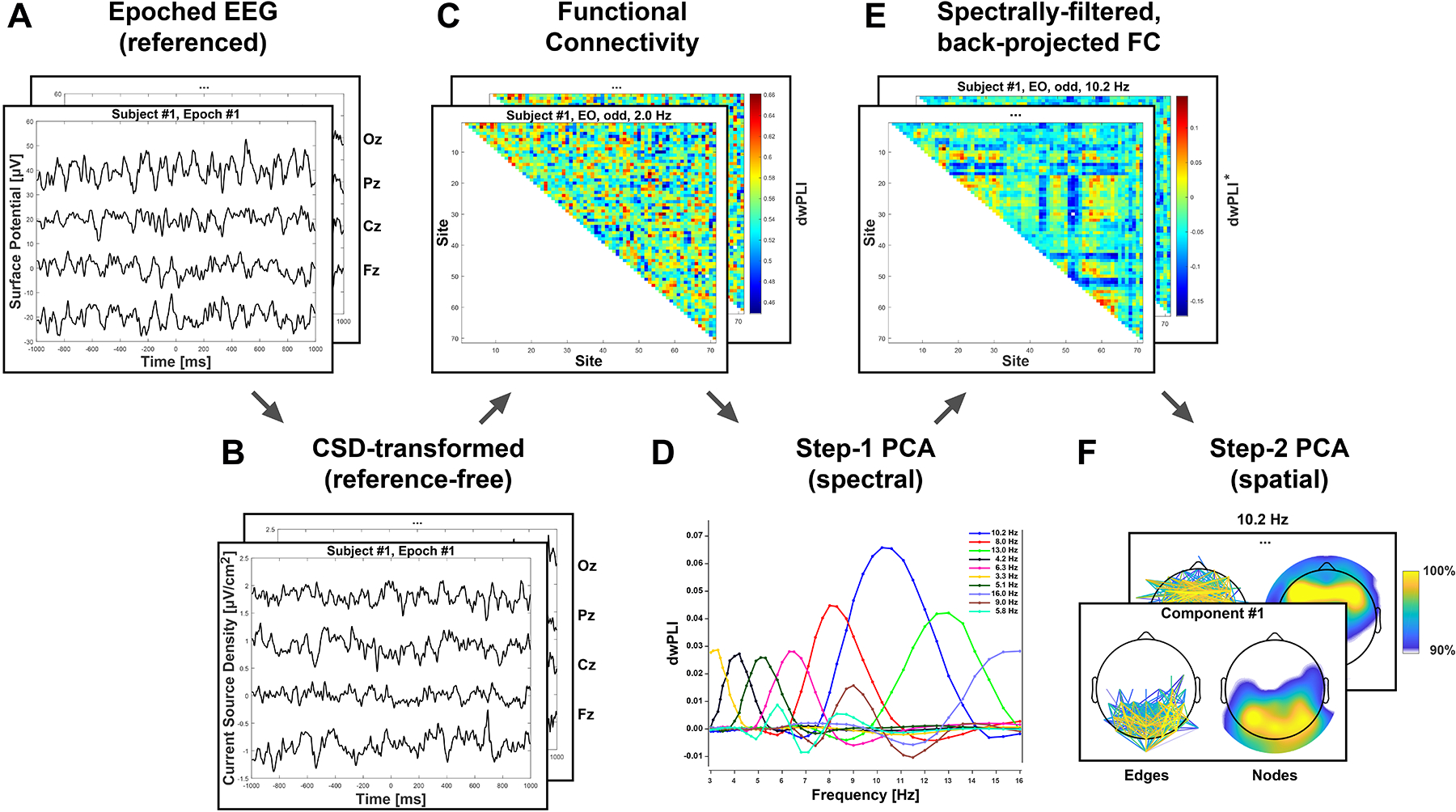
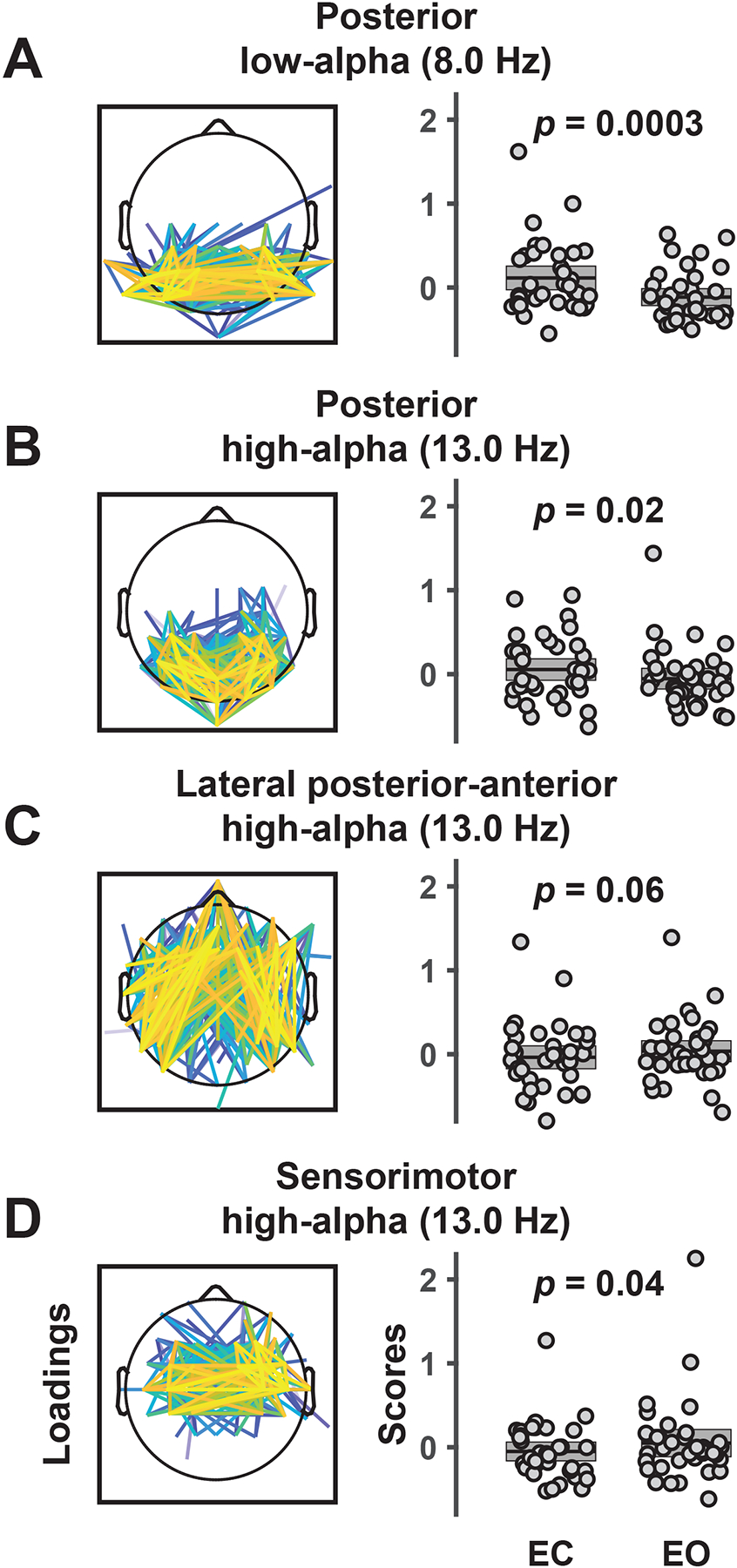
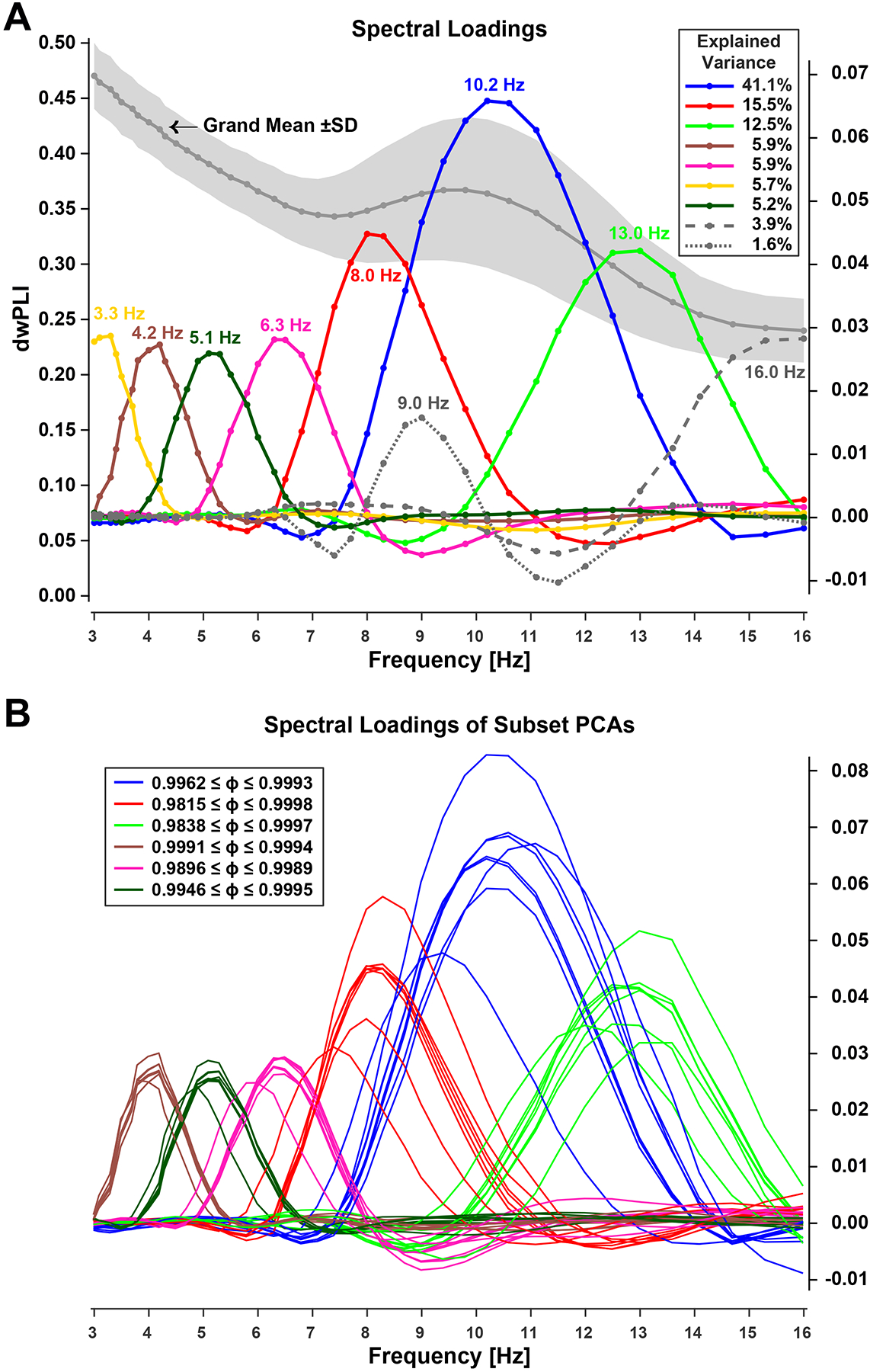
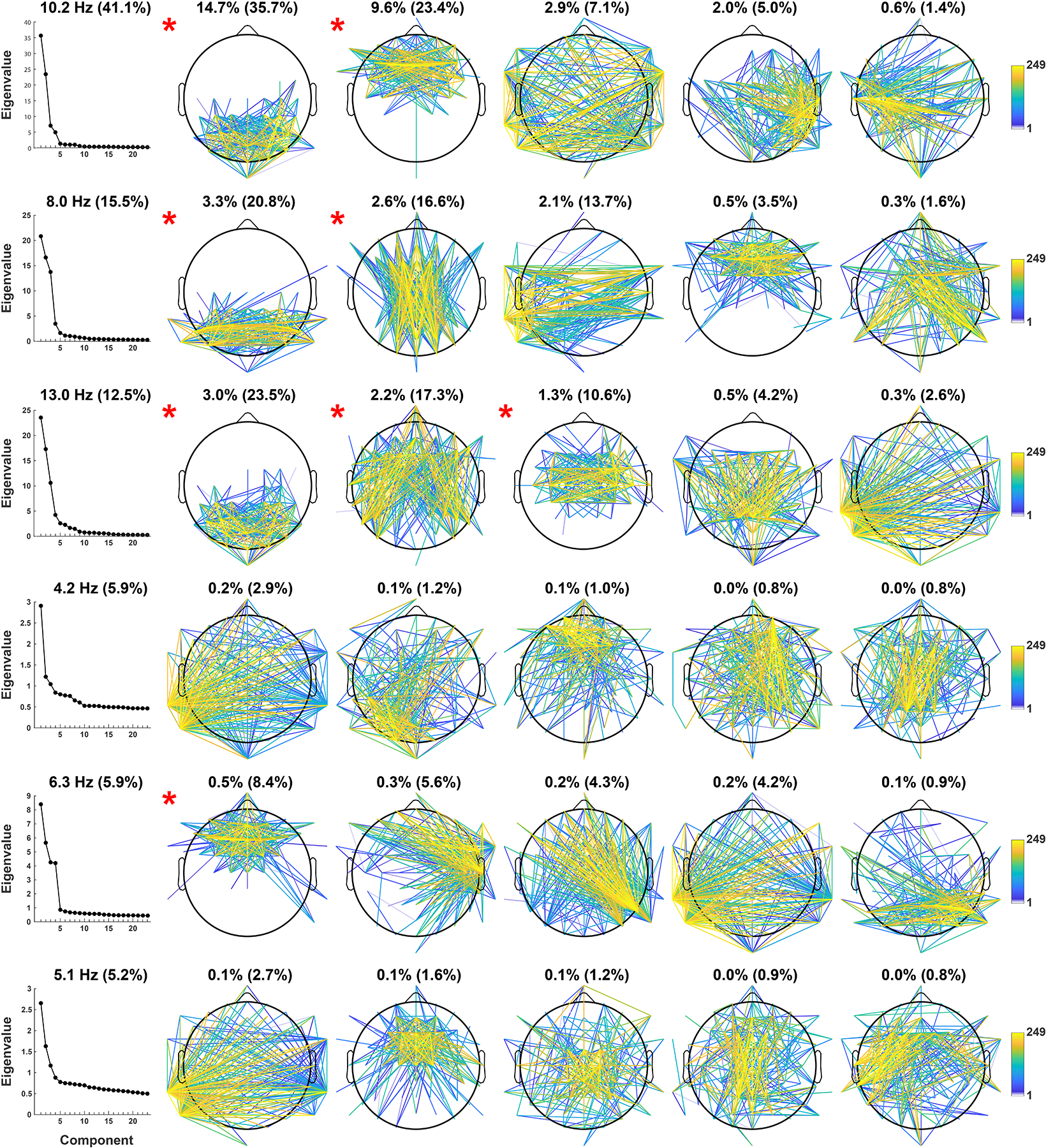
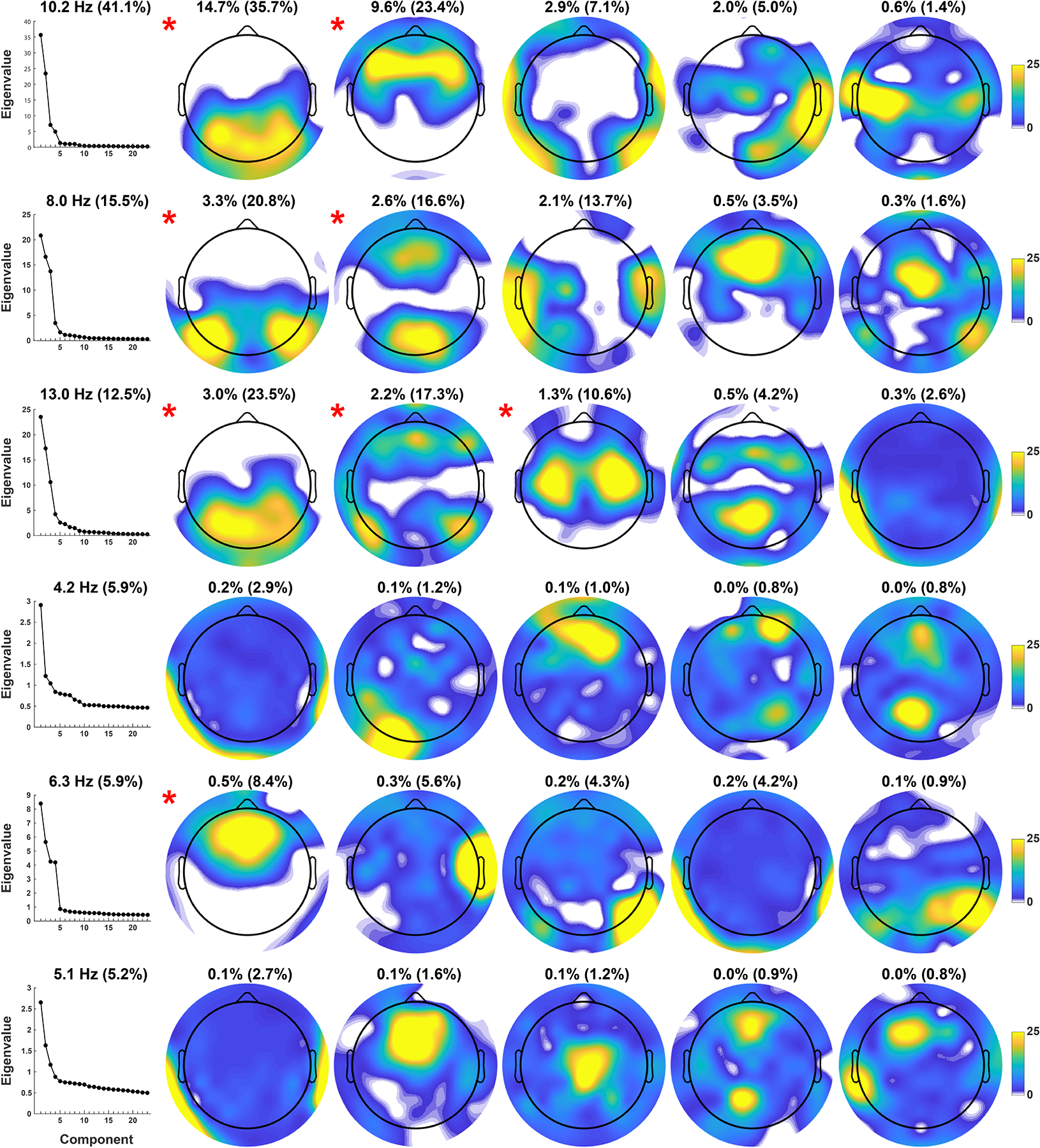
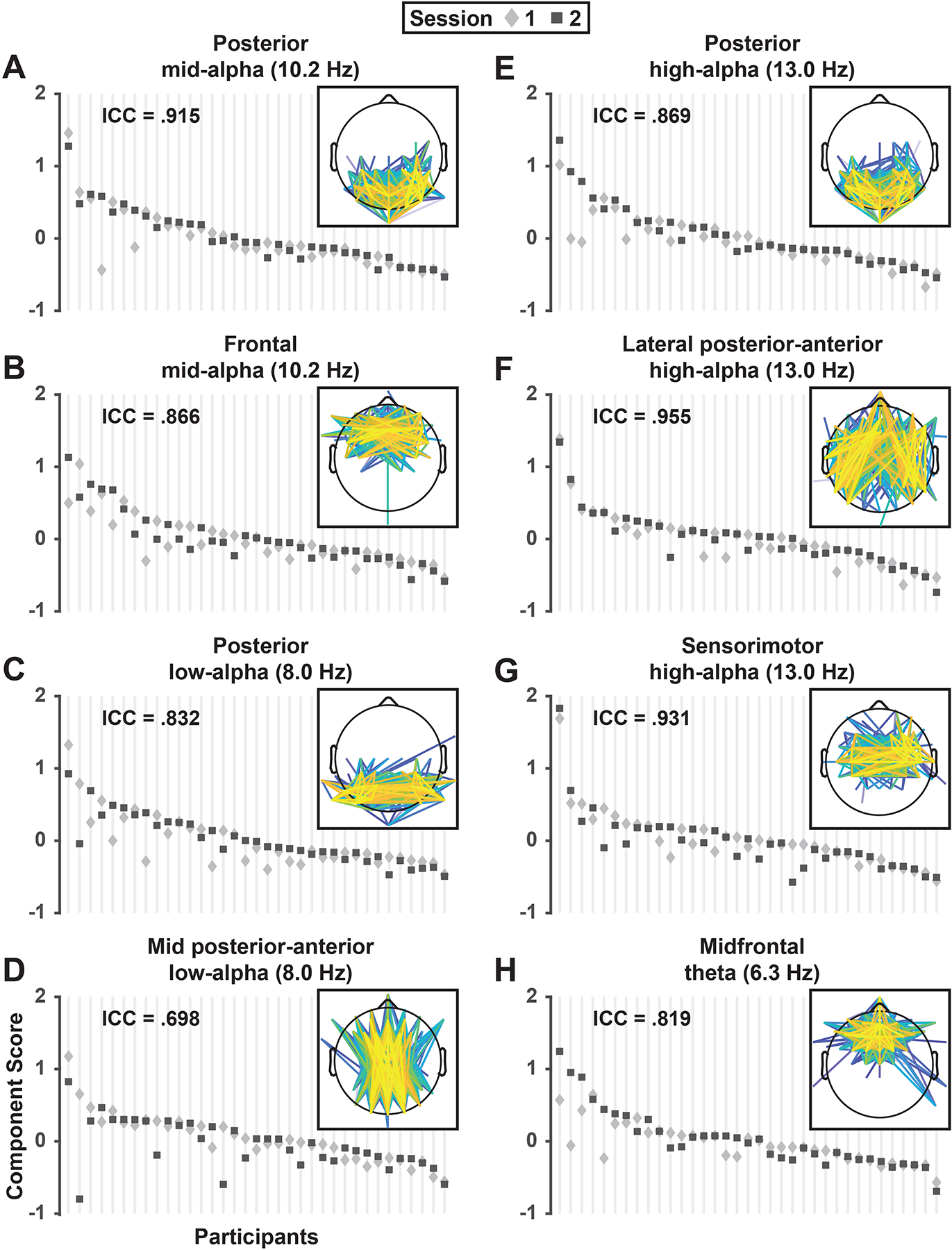
Although conventional averaging across predefined frequency bands reduces the complexity of EEG functional connectivity (FC), it obscures the identification of resting-state brain networks (RSN) and impedes accurate estimation of FC reliability. Extending prior work, we combined scalp current source density (CSD; spherical spline surface Laplacian) and spectral-spatial PCA to identify FC components. Phase-based FC was estimated via debiased-weighted phase-locking index from CSD-transformed resting EEGs (71 sensors, 8 min, eyes open/closed, 35 healthy adults, 1-week retest). Spectral PCA extracted six robust alpha and theta components (86.6% variance). Subsequent spatial PCA for each spectral component revealed seven robust regionally focused (posterior, central, and frontal) and long-range (posterior-anterior) alpha components (peaks at 8, 10, and 13 Hz) and a midfrontal theta (6 Hz) component, accounting for 37.0% of FC variance. These spatial FC components were consistent with well-known networks (e.g., default mode, visual, and sensorimotor), and four were sensitive to eyes open/closed conditions. Most FC components had good-to-excellent internal consistency (odd/even epochs, eyes open/closed) and test-retest reliability (ICCs ≥ .8). Moreover, the FC component structure was generally present in subsamples (session × odd/even epoch, or smaller subgroups [n = 7-10]), as indicated by high similarity of component loadings across PCA solutions. Apart from systematically reducing FC dimensionality, our approach avoids arbitrary thresholds and allows quantification of meaningful and reliable network components that may prove to be of high relevance for basic and clinical research applications.
虽然在预定义的频带内进行常规平均可以降低 EEG 功能连接 (FC) 的复杂性,但它会掩盖静息态脑网络 (RSN) 的识别,并阻碍 FC 可靠性的准确估计。在先前工作的基础上,我们结合头皮电流源密度 (CSD; 球形样条表面拉普拉斯) 和谱-空间 PCA 来识别 FC 成分。通过从 CSD 变换的静息 EEG(71 个传感器,8 分钟,睁眼/闭眼,35 个健康成年人,1 周复测) 中估计基于相位的 FC,使用无偏加权锁相指数。谱 PCA 提取了六个稳健的 alpha 和 theta 成分(86.6%的方差)。随后对每个谱分量进行空间 PCA 揭示了七个稳健的区域聚焦(后、中、前)和远程(后前)alpha 分量(峰值在 8、10 和 13 Hz)和一个中额叶 theta(6 Hz)分量,占 FC 方差的 37.0%。这些空间 FC 成分与已知的网络(如默认模式、视觉和感觉运动网络)一致,其中四个对睁眼/闭眼条件敏感。大多数 FC 成分具有良好到优秀的内部一致性(奇数/偶数时段,睁眼/闭眼)和测试-复测可靠性(ICC ≥.8)。此外,FC 成分结构通常存在于子样本中(会话×奇数/偶数时段,或更小的子组[n=7-10]),这表明在 PCA 解决方案中,成分负荷的高度相似性。除了系统地降低 FC 的维数外,我们的方法还避免了任意的阈值,并允许对有意义和可靠的网络成分进行量化,这些成分可能对基础和临床研究应用具有重要意义。