Koo Kevin, Brackett Charles D, Eisenberg Ellen H, Kieffer Kelly A, Hyams Elias S
Section of Urology, Department of Surgery, Dartmouth-Hitchcock Medical Center, Lebanon, New Hampshire, United States of America.
Section of General Internal Medicine, Department of Medicine, Dartmouth-Hitchcock Medical Center, Lebanon, New Hampshire, United States of America.
PLoS One. 2017 Dec 28;12(12):e0190357. doi: 10.1371/journal.pone.0190357. eCollection 2017.
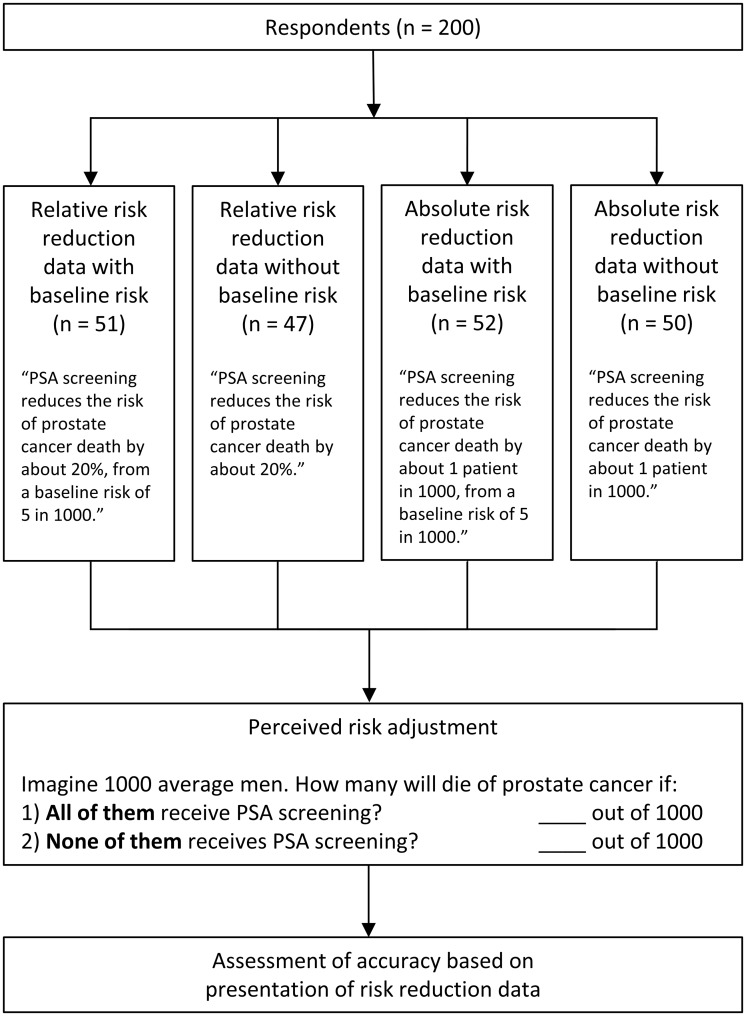
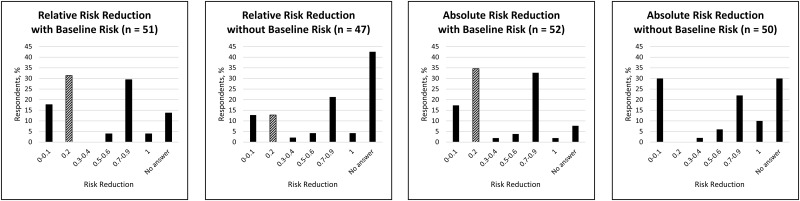
Prostate-specific antigen (PSA) screening for prostate cancer in men of average risk remains controversial. Patients' ability to incorporate risk reduction data into their decision-making may depend on their numeracy. We assessed the impact of patients' numeracy on their understanding of the risk reduction benefits of PSA screening. Men attending a general internal medicine clinic were invited to complete a survey. Four versions of the survey each included a three-item numeracy test and PSA risk reduction data, framed one of four ways: absolute (ARR) versus relative risk reduction (RRR), with or without baseline risk (BR). Respondents were asked to adjust their perceived risk of prostate-cancer mortality using the data presented. Accuracy of risk reduction was evaluated relative to how risk data were framed. Among a total of 200 respondents, a majority incorrectly answered one or more of the numeracy items. Overall accuracy of risk adjustment was only 20%. Accuracy varied with data framing: when presented with RRR, respondents were 13% accurate without BR and 31% accurate with BR; when presented with ARR, they were 0% accurate without BR and 35% accurate with BR. Including BR data significantly improved accuracy for both RRR (P = 0.03) and ARR groups (P < 0.01). Accuracy was significantly related to numeracy; numeracy scores of 0, 1, 2, and 3 were associated with accuracy rates of six, five, nine, and 36 percent, respectively (P < 0.01). Overall, numeracy was significantly associated with the accuracy of interpreting quantitative benefits of PSA screening. Alternative methods of communicating risk may facilitate shared decision-making in the use of PSA screening for early detection of prostate cancer.
对平均风险男性进行前列腺癌的前列腺特异性抗原(PSA)筛查仍存在争议。患者将风险降低数据纳入决策的能力可能取决于他们的计算能力。我们评估了患者的计算能力对其对PSA筛查降低风险益处理解的影响。邀请到普通内科门诊就诊的男性完成一项调查。该调查的四个版本均包含一个三项计算测试和PSA风险降低数据,以四种方式之一构建框架:绝对风险降低率(ARR)与相对风险降低率(RRR),有或无基线风险(BR)。要求受访者根据所提供的数据调整他们感知到的前列腺癌死亡风险。根据风险数据的构建方式评估风险降低的准确性。在总共200名受访者中,大多数人答错了一个或多个计算项目。风险调整的总体准确率仅为20%。准确率随数据框架而变化:当呈现RRR时,受访者在无BR时的准确率为13%,有BR时为31%;当呈现ARR时,他们在无BR时的准确率为0%,有BR时为35%。纳入BR数据显著提高了RRR组(P = 0.03)和ARR组(P < 0.01)的准确率。准确率与计算能力显著相关;计算得分0、1、2和3分别与准确率6%、5%、9%和36%相关(P < 0.01)。总体而言,计算能力与解释PSA筛查定量益处的准确性显著相关。传达风险的替代方法可能有助于在使用PSA筛查早期发现前列腺癌时促进共同决策。