Umeda Yasuyuki, Ishida Fujimaro, Tsuji Masanori, Furukawa Kazuhiro, Shiba Masato, Yasuda Ryuta, Toma Naoki, Sakaida Hiroshi, Suzuki Hidenori
Department of Neurosurgery, Mie University Graduate School of Medicine, Tsu, Mie, Japan.
Department of Neurosurgery, Mie Chuo Medical Center, Tsu, Mie, Japan.
PLoS One. 2017 Dec 28;12(12):e0190222. doi: 10.1371/journal.pone.0190222. eCollection 2017.
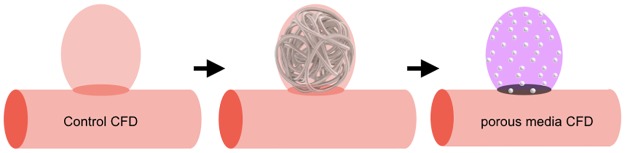
This study aimed to predict recurrence after coil embolization of unruptured cerebral aneurysms with computational fluid dynamics (CFD) using porous media modeling (porous media CFD).
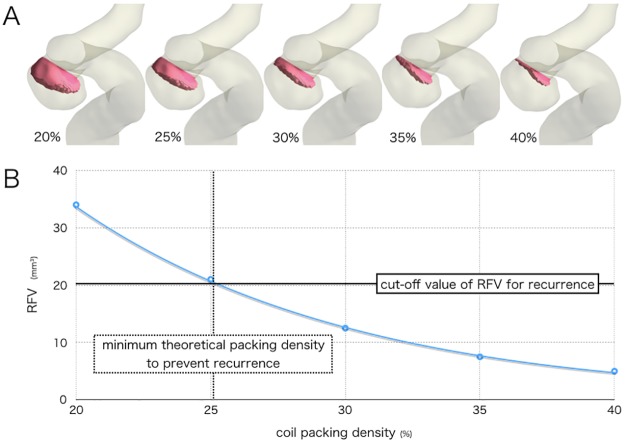
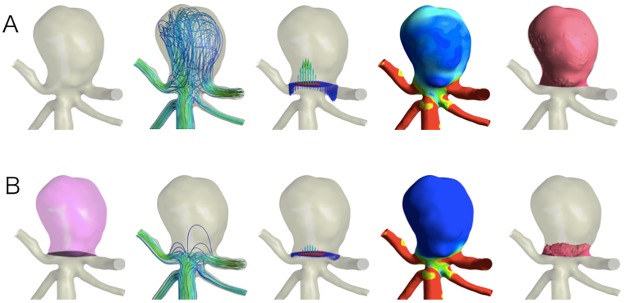
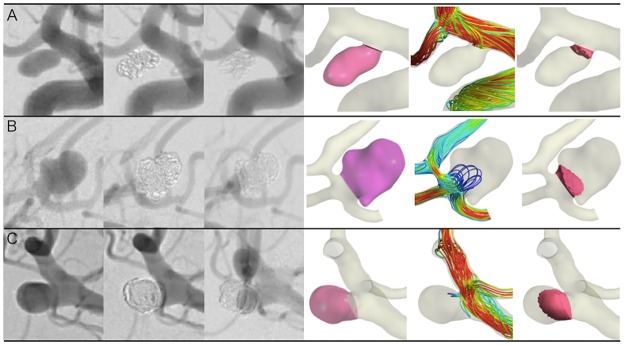
A total of 37 unruptured cerebral aneurysms treated with coiling were analyzed using follow-up angiograms, simulated CFD prior to coiling (control CFD), and porous media CFD. Coiled aneurysms were classified into stable or recurrence groups according to follow-up angiogram findings. Morphological parameters, coil packing density, and hemodynamic variables were evaluated for their correlations with aneurysmal recurrence. We also calculated residual flow volumes (RFVs), a novel hemodynamic parameter used to quantify the residual aneurysm volume after simulated coiling, which has a mean fluid domain > 1.0 cm/s.
Follow-up angiograms showed 24 aneurysms in the stable group and 13 in the recurrence group. Mann-Whitney U test demonstrated that maximum size, dome volume, neck width, neck area, and coil packing density were significantly different between the two groups (P < 0.05). Among the hemodynamic parameters, aneurysms in the recurrence group had significantly larger inflow and outflow areas in the control CFD and larger RFVs in the porous media CFD. Multivariate logistic regression analyses demonstrated that RFV was the only independently significant factor (odds ratio, 1.06; 95% confidence interval, 1.01-1.11; P = 0.016).
The study findings suggest that RFV collected under porous media modeling predicts the recurrence of coiled aneurysms.
本研究旨在使用多孔介质建模的计算流体动力学(CFD)(多孔介质CFD)预测未破裂脑动脉瘤弹簧圈栓塞术后的复发情况。
共分析了37例接受弹簧圈栓塞治疗的未破裂脑动脉瘤,使用随访血管造影、弹簧圈栓塞术前的模拟CFD(对照CFD)和多孔介质CFD。根据随访血管造影结果,将栓塞后的动脉瘤分为稳定组或复发组。评估形态学参数、弹簧圈填充密度和血流动力学变量与动脉瘤复发的相关性。我们还计算了残余血流量(RFV),这是一种用于量化模拟弹簧圈栓塞后残余动脉瘤体积的新型血流动力学参数,其平均流体域>1.0 cm/s。
随访血管造影显示,稳定组有24例动脉瘤,复发组有13例。曼-惠特尼U检验表明,两组之间的最大尺寸、瘤顶体积、颈部宽度、颈部面积和弹簧圈填充密度存在显著差异(P<0.05)。在血流动力学参数中,复发组的动脉瘤在对照CFD中的流入和流出面积显著更大,在多孔介质CFD中的RFV更大。多因素逻辑回归分析表明,RFV是唯一具有独立显著性的因素(比值比,1.06;95%置信区间,1.01-1.11;P=0.016)。
研究结果表明,在多孔介质建模下收集的RFV可预测弹簧圈栓塞动脉瘤的复发情况。