Department of Obstetrics and Gynecology, Oregon Health and Science University, Portland, OR, USA.
Department of Reproductive Health and Research, World Health Organization, Geneva, Switzerland.
Glob Health Sci Pract. 2017 Dec 28;5(4):581-591. doi: 10.9745/GHSP-D-17-00243.
The association between increased risk of HIV acquisition and use of progestin-only injectables (POIs) is controversial. We sought to compare the competing risks of maternal mortality and HIV acquisition with use of POIs using updated data on this association and considering an expanded number of African countries.
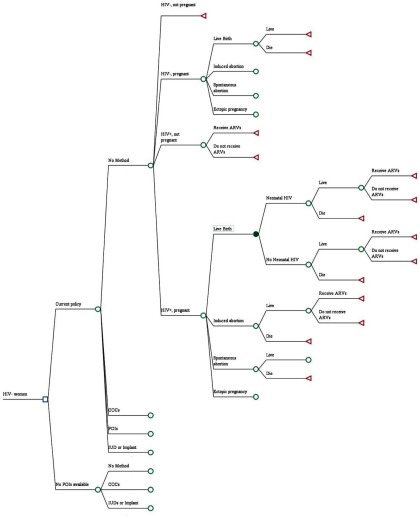
We designed a decision-analytic model to compare the benefits and risks of POIs on the competing risks of maternal mortality and HIV acquisition on life expectancy for women in 9 African countries. For the purposes of this analysis, we assumed that POIs were associated with an increased risk of HIV acquisition (hazards ratio of 1.4). Our primary outcome was life-years and the population was women of reproductive age (15-49 years) in these countries, who did not have HIV infection and were not currently planning a pregnancy. Probabilities for each variable included in the model, such as HIV incidence, access to antiretroviral therapy, and contraceptive prevalence, were obtained from the literature. Univariate and multivariate sensitivity analyses were performed to check model assumptions and explore how uncertainty in estimates would affect the model results.
In all countries, discontinuation of POIs without replacement with an equally effective contraceptive method would result in decreased life expectancy due to a significant increase in maternal deaths. While the removal of POIs from the market would result in the prevention of some new cases of HIV, the life-years gained from this are mitigated due to the marked increase in neonatal HIV cases and maternal mortality with associated life-years lost. In all countries, except South Africa, typical-use contraceptive failure rates with POIs would need to exceed 39%, and more than half of women currently using POIs would have to switch to another effective method, for the removal of POIs to demonstrate an increase in total life-years.
Women living in sub-Saharan Africa cope with both high rates of HIV infection and high rates of pregnancy-related maternal death relative to the rest of the world. Based on the most current estimates, our model suggests that removal of POI contraception from the market without effective and acceptable contraception replacement would have a net negative effect on maternal health, life expectancy, and mortality under a variety of scenarios.
孕激素避孕针(POI)使用与 HIV 感染风险增加之间的关联存在争议。我们旨在利用该关联的最新数据,并考虑到更多的非洲国家,比较 POI 使用与孕产妇死亡率和 HIV 感染的竞争风险。
我们设计了一个决策分析模型,以比较 POI 在 9 个非洲国家孕产妇死亡率和 HIV 感染竞争风险对女性预期寿命的影响,同时考虑到更广泛的国家。在本分析中,我们假设 POI 与 HIV 感染风险增加相关(风险比为 1.4)。我们的主要结果是生命年数,研究人群为这些国家的育龄妇女(15-49 岁),她们没有感染 HIV 且目前没有计划怀孕。模型中包含的每个变量的概率,如 HIV 发病率、抗逆转录病毒治疗的获得以及避孕方法的流行率,都来自文献。进行了单变量和多变量敏感性分析,以检查模型假设并探讨估计值的不确定性如何影响模型结果。
在所有国家中,停止使用 POI 而不使用同样有效的避孕方法,将导致孕产妇死亡率显著增加,从而导致预期寿命缩短。虽然从市场上撤出 POI 将预防一些新的 HIV 病例,但由于新生儿 HIV 病例和孕产妇死亡率的明显增加以及相关的生命年损失,从这方面获得的生命年数会减少。在所有国家中,除南非外,POI 的典型使用失败率需要超过 39%,并且需要超过一半目前使用 POI 的女性转而使用另一种有效的方法,以便 POI 的撤出能够增加总生命年数。
与世界其他地区相比,生活在撒哈拉以南非洲的妇女面临着高 HIV 感染率和高妊娠相关孕产妇死亡率的双重负担。根据最新的估计,我们的模型表明,在各种情况下,如果不提供有效且可接受的避孕方法替代物,从市场上撤出 POI 避孕方法将对孕产妇健康、预期寿命和死亡率产生净负面影响。