Division of Brain Sciences, Charing Cross Hospital Campus, Imperial College London, London, W6 8RF, United Kingdom.
Speech Science Program, School of Rehabilitation Sciences, Faculty of Health Sciences, Universiti Kebangsaan Malaysia, 50300 Kuala Lumpur, Malaysia.
Proc Natl Acad Sci U S A. 2018 Jan 16;115(3):E536-E545. doi: 10.1073/pnas.1715617115. Epub 2017 Dec 28.
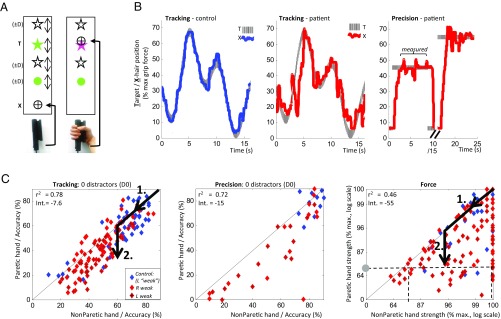
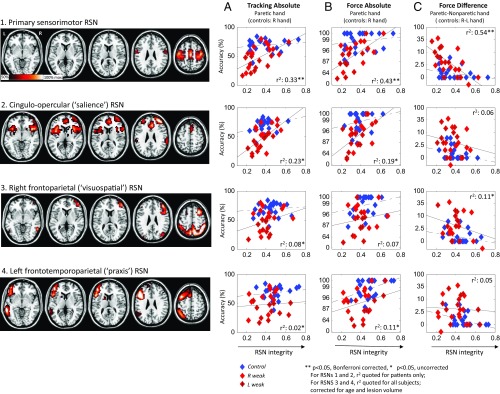
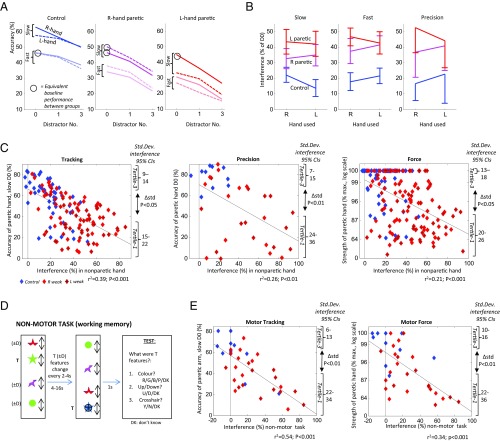
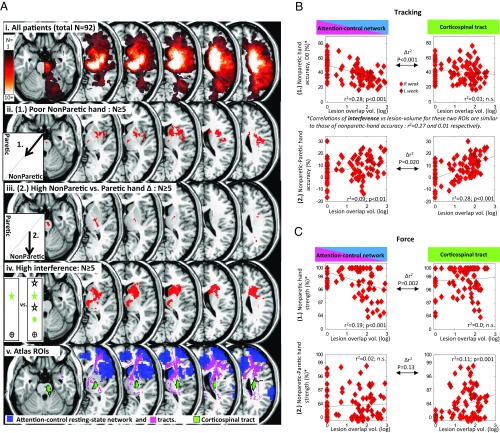
Attention control (or executive control) is a higher cognitive function involved in response selection and inhibition, through close interactions with the motor system. Here, we tested whether influences of attention control are also seen on lower level motor functions of dexterity and strength-by examining relationships between attention control and motor performance in healthy-aged and hemiparetic-stroke subjects ( = 93 and 167, respectively). Subjects undertook simple-tracking, precision-hold, and maximum force-generation tasks, with each hand. Performance across all tasks correlated strongly with attention control (measured as distractor resistance), independently of factors such as baseline performance, hand use, lesion size, mood, fatigue, or whether distraction was tested during motor or nonmotor cognitive tasks. Critically, asymmetric dissociations occurred in all tasks, in that severe motor impairment coexisted with normal (or impaired) attention control whereas normal motor performance was never associated with impaired attention control (below a task-dependent threshold). This implies that dexterity and force generation require intact attention control. Subsequently, we examined how motor and attention-control performance mapped to lesion location and cerebral functional connectivity. One component of motor performance (common to both arms), as well as attention control, correlated with the anatomical and functional integrity of a cingulo-opercular "salience" network. Independently of this, motor performance difference between arms correlated negatively with the integrity of the primary sensorimotor network and corticospinal tract. These results suggest that the salience network, and its attention-control function, are necessary for virtually all volitional motor acts while its damage contributes significantly to the cardinal motor deficits of stroke.
注意控制(或执行控制)是一种涉及反应选择和抑制的高级认知功能,通过与运动系统的紧密交互来实现。在这里,我们通过检查注意力控制与健康老年人和偏瘫性中风患者的运动表现之间的关系(分别为 93 人和 167 人),来测试注意力控制是否对灵巧性和力量等较低水平的运动功能也有影响。受试者分别用双手进行简单跟踪、精确保持和最大力量生成任务。所有任务的表现都与注意力控制(以分心抑制为衡量标准)密切相关,独立于基线表现、手的使用、损伤大小、情绪、疲劳或在运动或非运动认知任务中是否进行分心测试等因素。关键的是,在所有任务中都出现了不对称的分离,即严重的运动障碍与正常(或受损)的注意力控制共存,而正常的运动表现从未与受损的注意力控制相关(低于任务相关的阈值)。这意味着灵巧性和力量生成需要健全的注意力控制。随后,我们检查了运动和注意力控制表现如何映射到损伤部位和大脑功能连接。一个运动表现的组成部分(两个手臂共有)以及注意力控制与扣带回-顶叶“突显”网络的解剖和功能完整性相关。独立于此,手臂之间的运动表现差异与主要感觉运动网络和皮质脊髓束的完整性呈负相关。这些结果表明,突显网络及其注意力控制功能对于几乎所有自主运动行为都是必要的,而其损伤对中风的主要运动缺陷有重要贡献。