von Zur-Mühlen Bengt, Yamamoto Shinji, Wadström Jonas
Department of Surgical Sciences, Uppsala University Hopsital, Uppsala, Sweden.
Department of Surgical Sciences, Uppsala University Hospital, Uppsala, Sweden.
Ann Transplant. 2017 Dec 29;22:773-779. doi: 10.12659/aot.906129.
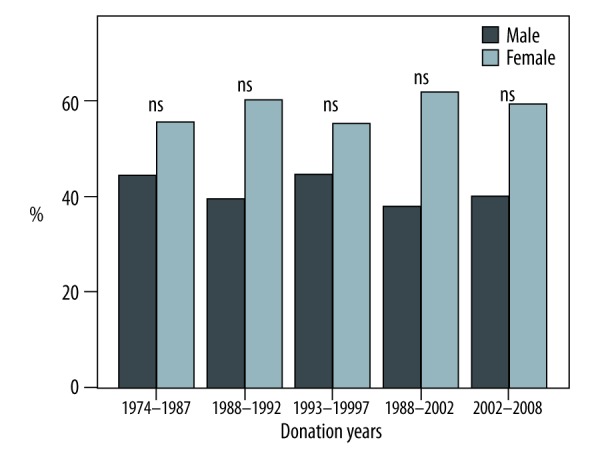
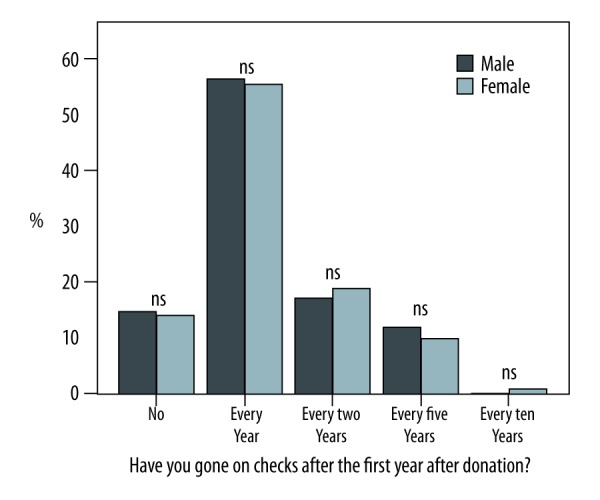
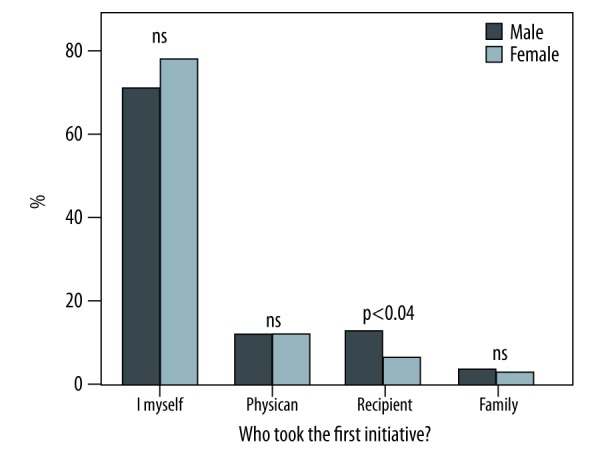
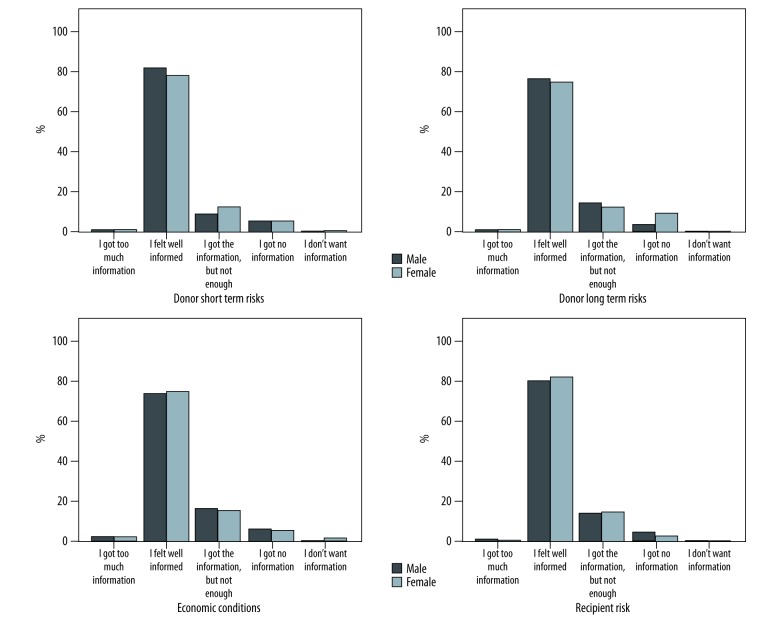
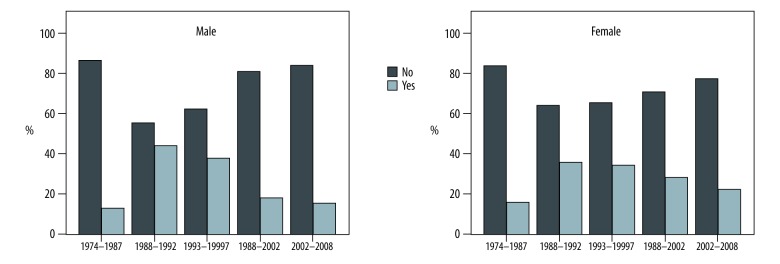
BACKGROUND We sought to study gender differences and differences over time with respect to demographics, relation to recipient, donor motives, and experiences of live kidney donation. MATERIAL AND METHODS In all, 455 consecutive live kidney donors, representing all of the donors at our center between 1974 and 2008 were considered for this study. There were 28 deceased donors and 14 donors who had moved abroad, leaving 413 donors; 387 (94%) agreed to participate in this study. A questionnaire was sent and the answers was analyzed for gender differences and, where relevant, for changes over time. RESULTS In all sub-periods, female donors made up the majority (55-62%), except for sibling donors (45%) and child-to-parent donors (40%). No significant gender differences were seen in perceived information given before donation. For males, it was more common that the recipient took the initiative to donate. For females, the motivation for donating was more frequently to help the recipient and because others wanted them to donate. For males, it was more common to feel a moral obligation. Post-operatively, females more frequently felt sad and experienced nausea, and more frequently felt that the donation had a positive impact on their lifes. With the introduction of minimally invasive surgical techniques, donors experienced fewer problems from the operation, with no gender difference. CONCLUSIONS Females donate more frequently than males, a difference that did not change over time. Only a few gender differences were seen in donor motives and the donation experience; however, these differences may be relevant to address the gender imbalance in kidney donations.
背景 我们试图研究活体肾捐献在人口统计学特征、与受者的关系、捐献者动机以及捐献经历方面的性别差异和随时间的变化。
材料与方法 本研究纳入了1974年至2008年间在我们中心的所有455例连续活体肾捐献者。其中有28例已故捐献者和14例已移居国外的捐献者,剩余413例捐献者;387例(94%)同意参与本研究。发放了一份问卷,并分析答案以探讨性别差异以及在相关情况下随时间的变化。
结果 在所有子时期中,除了同胞捐献者(45%)和子女向父母的捐献者(40%)外,女性捐献者占多数(55 - 62%)。在捐献前获得的信息感知方面未发现显著性别差异。对于男性,受者主动提出捐献更为常见。对于女性,捐献的动机更常是为了帮助受者以及因为其他人希望她们捐献。对于男性,更常感到有道德义务。术后,女性更常感到悲伤和经历恶心,并且更常觉得捐献对她们的生活有积极影响。随着微创外科技术的引入,捐献者手术相关问题减少,且无性别差异。
结论 女性比男性更频繁地进行捐献,这一差异并未随时间改变。在捐献者动机和捐献经历方面仅发现了一些性别差异;然而,这些差异可能与解决肾捐献中的性别失衡问题相关。