Singh Mahendra, Pathak Amitesh, Khan Aamir Laique, Srivastava Amit, Negi Devendra
Department of Anaesthesiology, Dr. Ram Manohar Lohia Institute of Medical Sciences, Lucknow, Uttar Pradesh, India.
Anesth Essays Res. 2017 Oct-Dec;11(4):1035-1039. doi: 10.4103/aer.AER_67_17.
Epidural anesthesia has been well established as a safe and effective technique not only for perioperative anesthesia but also for postoperative analgesia. Various adjuvants have been added to local anesthetic agent in an effort to prolong this duration.
The aim of this study was to compare and evaluate the anesthesia and analgesic property of ropivacaine to its combination with clonidine for lower limb orthopedic surgery under epidural.
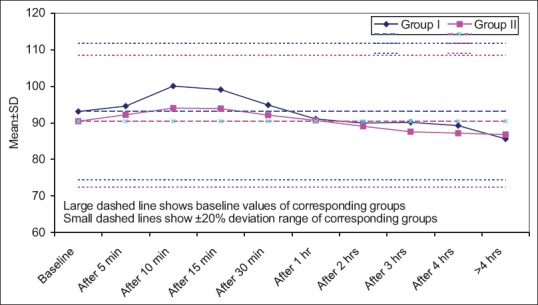
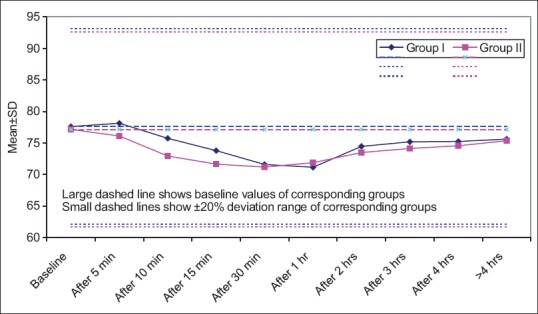
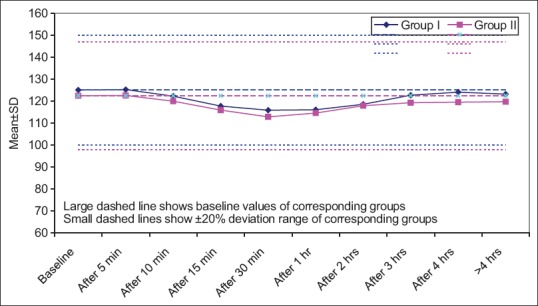
In a prospective, randomized, double-blind study, eighty adult patients undergoing lower limb surgeries received either 0.75% ropivacaine or 75 μg clonidine with 0.75% ropivacaine through epidural route. Patients were compared for hemodynamic variability, quality of motor and sensory block, intra- and post-operative analgesia, and the side effects associated.
Data analysis was done by Student's paired -test, Chi-square test, and Mann-Whitney test. < 0.05 was considered statistically significant.
The time taken for onset of the motor as well as the sensory block was significantly shorter in ropivacaine with clonidine group as compared to ropivacaine alone group. Mean duration of analgesia was significantly higher in patients who received clonidine as an adjunct ( < 0.001). There was no significant difference observed in the incidence of hemodynamic changes or side effects.
The study demonstrated that use of clonidine as an adjuvant to ropivacaine through epidural route provides a hemodynamically stable, faster, and prolonged epidural block and a longer analgesic effect as compared to ropivacaine alone.
硬膜外麻醉已被公认为一种安全有效的技术,不仅用于围手术期麻醉,也用于术后镇痛。人们已在局部麻醉剂中添加了各种佐剂以延长其作用时间。
本研究的目的是比较和评估罗哌卡因及其与可乐定联合用于下肢骨科手术硬膜外麻醉时的麻醉和镇痛特性。
在一项前瞻性、随机、双盲研究中,80例接受下肢手术的成年患者通过硬膜外途径接受0.75%罗哌卡因或75μg可乐定与0.75%罗哌卡因。比较患者的血流动力学变异性、运动和感觉阻滞质量、术中和术后镇痛情况以及相关副作用。
数据分析采用学生配对t检验、卡方检验和曼-惠特尼检验。P<0.05被认为具有统计学意义。
与单独使用罗哌卡因组相比,罗哌卡因与可乐定组运动和感觉阻滞的起效时间明显更短。接受可乐定作为佐剂的患者平均镇痛持续时间明显更长(P<0.001)。血流动力学变化或副作用的发生率没有显著差异。
该研究表明,与单独使用罗哌卡因相比,通过硬膜外途径将可乐定作为罗哌卡因的佐剂可提供血流动力学稳定、起效更快且持续时间更长的硬膜外阻滞以及更长的镇痛效果。