Wang Zhi, Chen Qiang, Guo Hao, Li Zhishan, Zhang Jinfeng, Lv Lei, Guo Yongqing
Department of Anesthesiology, Shanxi Provincial People's Hospital, Taiyuan, Shanxi 030000, P.R. China.
Exp Ther Med. 2017 Dec;14(6):5851-5856. doi: 10.3892/etm.2017.5265. Epub 2017 Oct 4.
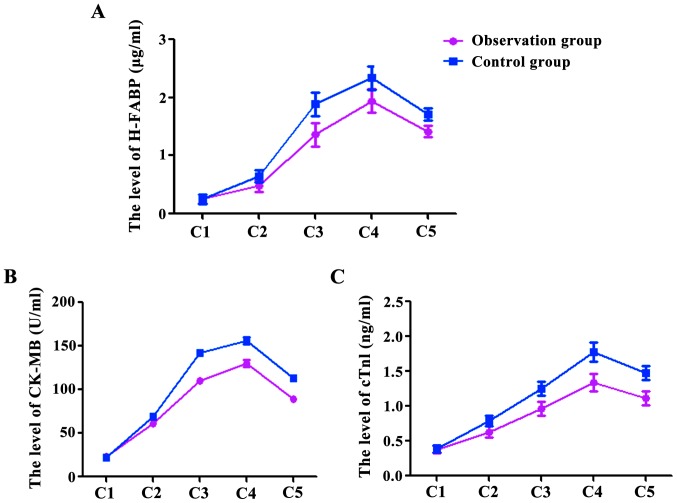
This study investigated the effects of dexmedetomidine on heart-type fatty acid binding protein (H-FABP), creatine kinase isoenzymes (CK-MB), and troponin I (cTnI) levels, neurological function and near-term prognosis in patients undergoing heart valve replacement. Patients undergoing heart valve replacement were randomly allocated to remifentanil anesthesia (control group, n=48) or dexmedetomidine anesthesia (observation group, n=48). Hemodynamic parameters were measured before anesthesia induction (T1), 1 min after intubation (T2), 10 min after start of surgery (T3), and on completion of surgery (T4). Levels of plasma H-FABP, CK-MB and cTnI were measured 10 min before anesthesia induction (C1), 10 min after start of surgery (C2), on completion of surgery (C3), 6 h after surgery (C4), and 24 h after surgery (C5). S100β protein and serum neuron-specific enolase (NSE) were detected 10 min before anesthesia induction (C1), and 24 h after surgery (C5). Neurological and cardiac function was evaluated 24 h after surgery. Incidence of cardiovascular adverse events was recorded for 1 year of follow-up. There were no significant differences in the average heart rate between the two groups during the perioperative period. The mean arterial pressure in the observation group was significantly lower than control group (P<0.05). Levels of H-FABP, CK-MB and cTnI at C2, C3, C4 and C5, were significantly higher than C1, but significantly lower in the observation versus control group (P<0.05). Twenty-four hours after surgery, levels of S100β and NSE in both groups were higher than those before induction (P<0.05), but significantly lower in the observation versus control group (P<0.05). Twenty-four hours after surgery, neurological function scores were better, and myocardial contractility and arrhythmia scores significantly lower in the observation versus control group (P<0.05 for all). After follow-up for 1 year, incidence of cardiovascular adverse events was significantly lower in the observation versus control group (P<0.05). Dexmedetomidine anesthesia can effectively maintain hemodynamic stability, reduce myocardial injury and the occurrence of cognitive dysfunction, and improve prognosis in patients undergoing heart valve replacement.
本研究探讨了右美托咪定对心脏瓣膜置换术患者心脏型脂肪酸结合蛋白(H-FABP)、肌酸激酶同工酶(CK-MB)和肌钙蛋白I(cTnI)水平、神经功能及近期预后的影响。将接受心脏瓣膜置换术的患者随机分为瑞芬太尼麻醉组(对照组,n = 48)和右美托咪定麻醉组(观察组,n = 48)。于麻醉诱导前(T1)、气管插管后1分钟(T2)、手术开始后10分钟(T3)及手术结束时(T4)测量血流动力学参数。于麻醉诱导前10分钟(C1)、手术开始后10分钟(C2)、手术结束时(C3)、术后6小时(C4)及术后24小时(C5)测定血浆H-FABP、CK-MB和cTnI水平。于麻醉诱导前10分钟(C1)及术后24小时(C5)检测S100β蛋白和血清神经元特异性烯醇化酶(NSE)。术后24小时评估神经和心脏功能。记录随访1年的心血管不良事件发生率。围手术期两组平均心率无显著差异。观察组平均动脉压显著低于对照组(P < 0.05)。C2、C3、C4和C5时H-FABP、CK-MB和cTnI水平显著高于C1,但观察组低于对照组(P < 0.05)。术后24小时,两组S100β和NSE水平均高于诱导前(P < 0.05),但观察组低于对照组(P < 0.05)。术后24小时,观察组神经功能评分更好,心肌收缩力和心律失常评分显著低于对照组(均P < 0.05)。随访1年后,观察组心血管不良事件发生率显著低于对照组(P < 0.05)。右美托咪定麻醉可有效维持血流动力学稳定,减少心肌损伤及认知功能障碍的发生,并改善心脏瓣膜置换术患者的预后。