Wei Ying, Gao Jiaqi, Qin Lingling, Xu Yunling, Shi Haoxia, Qu Lingxia, Liu Yongqiao, Xu Tunhai, Liu Tonghua
School of Chinese Pharmacy, Beijing University of Chinese Medicine, Beijing, Chaoyang 100102, P.R. China.
Health Cultivation Key Laboratory of The Ministry of Education, Beijing University of Chinese Medicine, Beijing, Chaoyang 100029, P.R. China.
Exp Ther Med. 2017 Dec;14(6):6052-6058. doi: 10.3892/etm.2017.5314. Epub 2017 Oct 16.
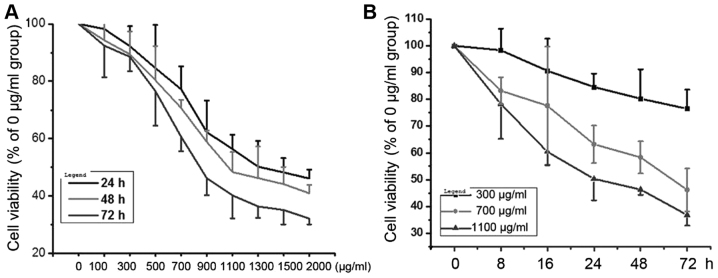
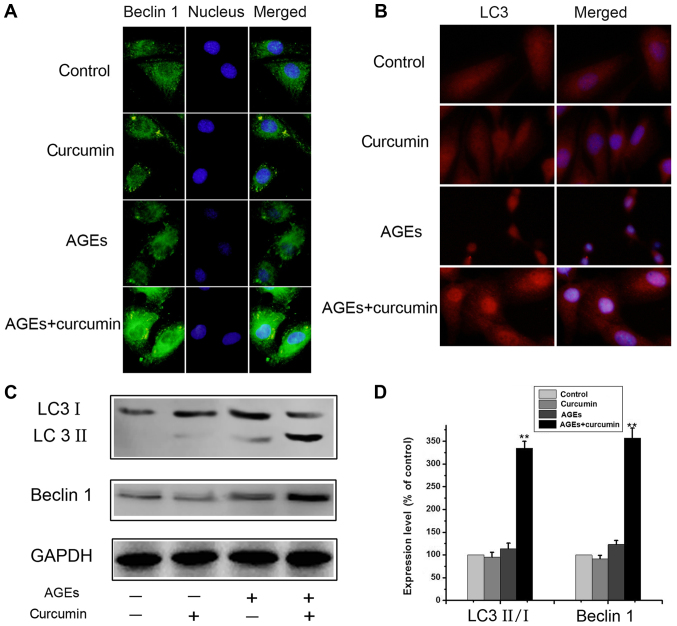
Renal tubular cell apoptosis and tubular dysfunction is an important process underlying diabetic nephropathy (DN). Understanding the mechanisms underlying renal tubular epithelial cell survival is important for the prevention of kidney damage associated with glucotoxicity. Curcumin has been demonstrated to possess potent anti-apoptotic properties. However, the roles of curcumin in renal epithelial cells are yet to be defined. The present study investigated advanced glycation or glycoxidation end-product (AGE)-induced toxicity in renal tubular epithelial cells via several complementary assays, including cell viability, cell apoptosis and cell autophagy in the NRK-52E rat kidney tubular epithelial cell line. The extent of apoptosis was significantly increased in the NRK-52E cells following treatment with AGEs. The results also indicated that curcumin reversed this effect by promoting autophagy through the phosphoinositide 3-kinase/AKT serine/threonine kinase signaling pathway. These conclusions suggested that curcumin exerts a renoprotective effect in the presence of AGEs, at least in part by activating autophagy in NRK-52E cells. Collectively, these findings indicate that curcumin not only exerts renoprotective effects, however may also act as a novel therapeutic strategy for the treatment of diabetic nephropathy.
肾小管细胞凋亡和肾小管功能障碍是糖尿病肾病(DN)的一个重要潜在过程。了解肾小管上皮细胞存活的机制对于预防与糖毒性相关的肾损伤很重要。姜黄素已被证明具有强大的抗凋亡特性。然而,姜黄素在肾上皮细胞中的作用尚未明确。本研究通过几种互补试验,包括NRK - 52E大鼠肾小管上皮细胞系中的细胞活力、细胞凋亡和细胞自噬,研究了晚期糖基化或糖氧化终产物(AGE)诱导的肾小管上皮细胞毒性。用AGEs处理后,NRK - 52E细胞中的凋亡程度显著增加。结果还表明,姜黄素通过磷酸肌醇3 -激酶/AKT丝氨酸/苏氨酸激酶信号通路促进自噬来逆转这种作用。这些结论表明,姜黄素在存在AGEs的情况下发挥肾脏保护作用,至少部分是通过激活NRK - 52E细胞中的自噬。总的来说,这些发现表明姜黄素不仅具有肾脏保护作用,还可能作为治疗糖尿病肾病的一种新的治疗策略。