Zhu Jia-Jun, Zhao Qian, Qu Hui-Juan, Li Xiao-Mei, Chen Qing-Jie, Liu Fen, Chen Bang-Dang, Yang Yi-Ning
Department of Cardiology, First Affiliated Hospital of Xinjiang Medical University, Urumqi, China.
Xinjiang Key Laboratory of Cardiovascular Disease Research, Urumqi, China.
Oncotarget. 2017 Nov 11;8(62):105809-105818. doi: 10.18632/oncotarget.22401. eCollection 2017 Dec 1.
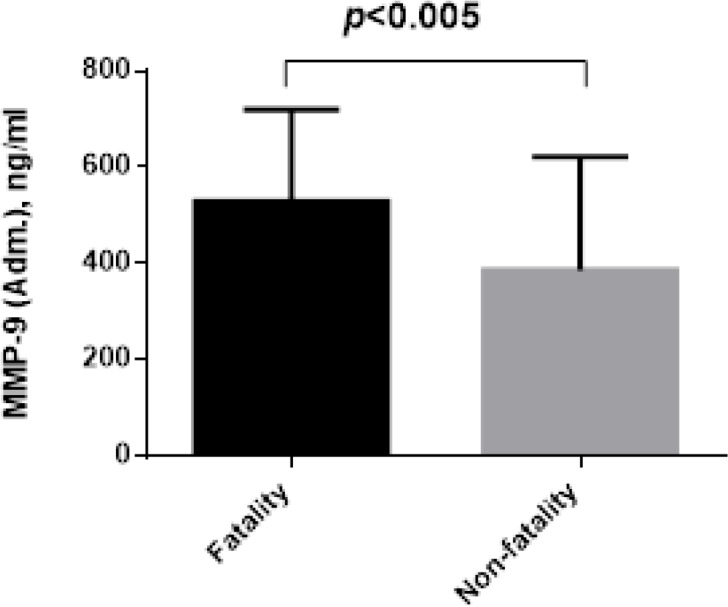
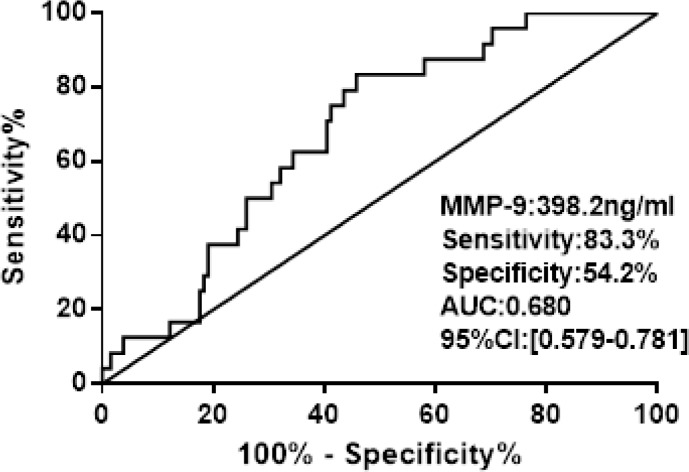
The aim of the present study was to investigate the predictive value of the plasma matrix metalloproteinase-9 (MMP-9) level at admission for in-hospital mortality in patients who received emergency percutaneous coronary intervention (PCI) following AMI. A single blood sample was collected at admission from 155 consecutive AMI patients who underwent emergent PCI. The plasma levels of MMP-9 value (528.9±191.6 ng/ml) were significantly higher in the patients who died (n=24) than in the survivors (385.4±236.0 ng/ml) during 14 days of hospitalization (=0.005). The age, left ventricle wall motion score index (WMIS), Global Registry of Acute Coronary Events (GRACE) score and B-type natriuretic peptide (BNP) levels and GENSINI score at admission were significantly different between the patients who died and those who survived (<0.001, =0.004, <0.001 and <0.001, respectively). Cut-off concentrations for prediction of death was identified from receiver operator characteristic (ROC) curves. Using the cut-off value (MMP-9 level 398.2 ng/ml) to stratify the patients into two groups, the group with higher MMP-9 levels had a greater rate of in-hospital mortality than the lower level group (<0.001). With the exception of the GRACE score, among all biomarkers measured, in stepwise multiple logistic regressions, only the MMP-9 level predicted the risk of in-hospital death after adjustment for all other risk factors (odds ratio 5.02, 95% CI 1.44 to 17.55). In conclusion, a higher MMP-9 level is an independent predictor of in-hospital death in AMI patients who received emergency PCI.
本研究旨在探讨急性心肌梗死(AMI)后接受急诊经皮冠状动脉介入治疗(PCI)患者入院时血浆基质金属蛋白酶-9(MMP-9)水平对院内死亡的预测价值。从155例连续接受急诊PCI的AMI患者入院时采集一份血样。在住院14天内死亡的患者(n = 24)血浆MMP-9水平值(528.9±191.6 ng/ml)显著高于存活患者(385.4±236.0 ng/ml)(P = 0.005)。死亡患者与存活患者入院时的年龄、左心室壁运动评分指数(WMIS)、急性冠状动脉事件全球注册(GRACE)评分、B型利钠肽(BNP)水平及GENSINI评分存在显著差异(分别为P<0.001、P = 0.004、P<0.001和P<0.001)。通过受试者工作特征(ROC)曲线确定死亡预测的临界浓度。使用临界值(MMP-9水平398.2 ng/ml)将患者分为两组,MMP-9水平较高组的院内死亡率高于较低水平组(P<0.001)。在所有测量的生物标志物中,除GRACE评分外,在逐步多元逻辑回归中,调整所有其他危险因素后,只有MMP-9水平可预测院内死亡风险(比值比5.02,95%可信区间1.44至17.55)。总之,较高的MMP-9水平是接受急诊PCI的AMI患者院内死亡的独立预测因素。