Laboratory of Structural Biology, Institute of Biological Sciences, Federal University of Para, Belem, PA 66075-110, Brazil.
Department of Pharmacology, Ribeirao Preto Medical School, University of Sao Paulo, Ribeirao Preto, SP 14049-900, Brazil.
Biomolecules. 2021 Apr 16;11(4):585. doi: 10.3390/biom11040585.
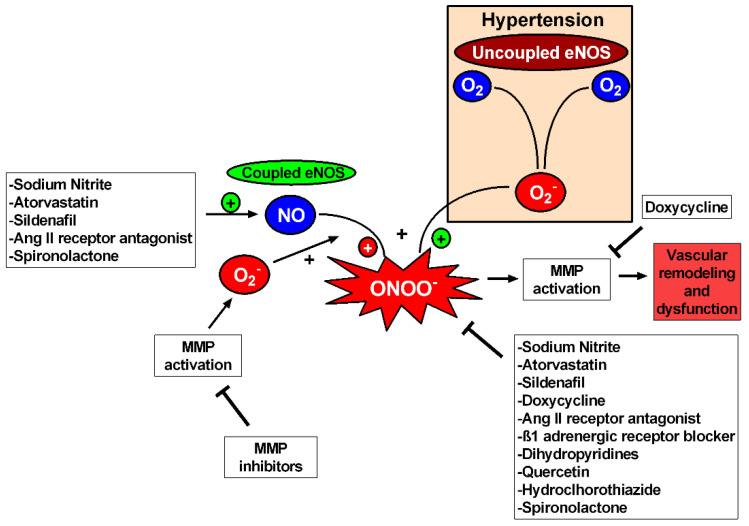
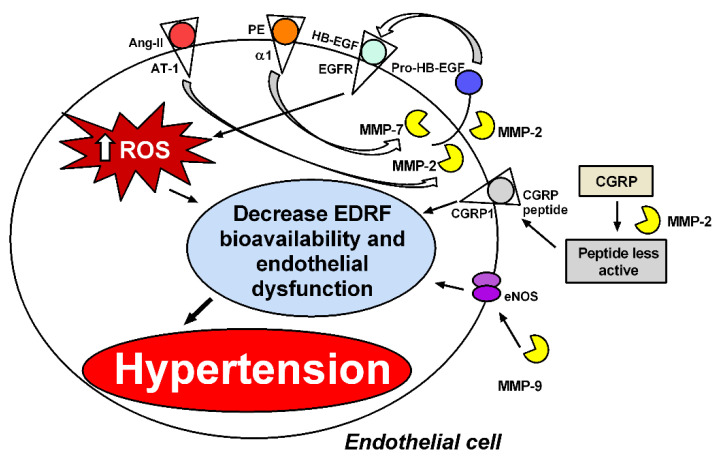
Various pathophysiological mechanisms have been implicated in hypertension, but those resulting in vascular dysfunction and remodeling are critical and may help to identify critical pharmacological targets. This mini-review article focuses on central mechanisms contributing to the vascular dysfunction and remodeling of hypertension, increased oxidative stress and impaired nitric oxide (NO) bioavailability, which enhance vascular matrix metalloproteinase (MMP) activity. The relationship between NO, MMP and oxidative stress culminating in the vascular alterations of hypertension is examined. While the alterations of hypertension are not fully attributable to these pathophysiological mechanisms, there is strong evidence that such mechanisms play critical roles in increasing vascular MMP expression and activity, thus resulting in abnormal degradation of extracellular matrix components, receptors, peptides, and intracellular proteins involved in the regulation of vascular function and structure. Imbalanced vascular MMP activity promotes vasoconstriction and impairs vasodilation, stimulating vascular smooth muscle cells (VSMC) to switch from contractile to synthetic phenotypes, thus facilitating cell growth or migration, which is associated with the deposition of extracellular matrix components. Finally, the protective effects of MMP inhibitors, antioxidants and drugs that enhance vascular NO activity are briefly discussed. Newly emerging therapies that address these essential mechanisms may offer significant advantages to prevent vascular remodeling in hypertensive patients.
各种病理生理机制与高血压有关,但导致血管功能障碍和重构的机制至关重要,可能有助于确定关键的药理靶点。这篇迷你综述文章重点介绍了导致高血压血管功能障碍和重构的中枢机制,包括氧化应激和一氧化氮(NO)生物利用度降低,这会增强血管基质金属蛋白酶(MMP)的活性。文章还探讨了 NO、MMP 和氧化应激之间的关系,这些因素共同导致了高血压的血管改变。虽然高血压的改变不能完全归因于这些病理生理机制,但有强有力的证据表明,这些机制在增加血管 MMP 的表达和活性方面发挥着关键作用,从而导致细胞外基质成分、受体、肽和参与调节血管功能和结构的细胞内蛋白的异常降解。血管 MMP 活性失衡会促进血管收缩和血管舒张受损,刺激血管平滑肌细胞(VSMC)从收缩型向合成型表型转变,从而促进细胞生长或迁移,这与细胞外基质成分的沉积有关。最后,简要讨论了 MMP 抑制剂、抗氧化剂和增强血管 NO 活性的药物的保护作用。针对这些关键机制的新兴治疗方法可能为预防高血压患者的血管重构提供显著优势。