Department of Social and Environmental Health Research, London School of Hygiene and Tropical Medicine, London, UK.
Department of Social Science, UCL Institute of Education, University College London, London, UK.
J Int AIDS Soc. 2017 Dec;20(4). doi: 10.1002/jia2.25029.
Prevalence of HIV among young women in South Africa remains extremely high. Adolescent peer groups have been found to be an important influence on a range of health behaviours. The characteristics of young women's friendships might influence their sexual health and HIV risk via connections to sexual partners, norms around sexual initiation and condom use, or provision of social support. We investigated associations between young women's friendships and their Herpes Simplex Virus Type 2 (HSV-2) and HIV infection status in rural South Africa.
Our study is a cross-sectional, egocentric network analysis. In 2011 to 2012, we tested 13- to 20-year-old young women for HIV and HSV-2, and collected descriptions of five friendships for each. We generated summary measures describing friend socio-demographic characteristics and the number of friends perceived to have had sex. We used logistic regression to analyse associations between friend characteristics and participant HIV and HSV-2 infection, excluding likely perinatal HIV infections.
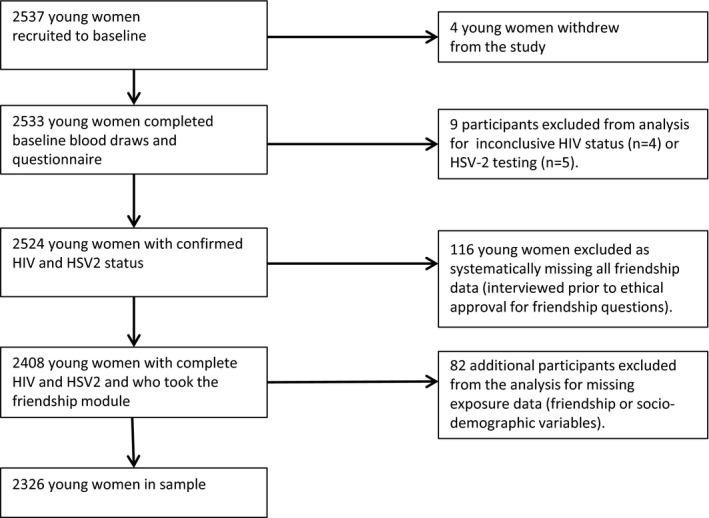
There were 2326 participants included in the study sample, among whom HIV and HSV-2 prevalence were 3.3% and 4.6% respectively. Adjusted for participant and friend socio-demographic characteristics, each additional friend at least one year older than the participant was associated with raised odds of HIV (odds ratio (OR) = 1.37, 95% CI 1.03 to 1.82) and HSV-2 (adjusted OR=1.41, 95% CI 1.18 to 1.69). Each additional friend perceived to have ever had sex also raised the odds of HIV (OR = 1.29, 95% CI 1.03 to 1.63) and HSV-2 (OR=1.18, 95% CI 1.03 to 1.35).
We found good evidence that a greater number of older friends and friends perceived to have had sex were associated with increased risk for HSV-2 and HIV infection among young women.
The characteristics of young women's friendships could contribute to their risk of HIV infection. The extent to which policies or programmes influence age-mixing and young women's normative environments should be considered.
南非年轻女性中的艾滋病毒感染率仍然极高。青少年群体已被发现对一系列健康行为有重要影响。年轻女性友谊的特征可能会通过与性伴侣的联系、性初体验和使用避孕套的规范,或提供社会支持,影响她们的性健康和艾滋病毒风险。我们调查了南非农村年轻女性的友谊与其单纯疱疹病毒 2 型(HSV-2)和艾滋病毒感染状况之间的关系。
我们的研究是一项横断面、以自我为中心的网络分析。在 2011 年至 2012 年期间,我们对 13 至 20 岁的年轻女性进行了艾滋病毒和 HSV-2 检测,并收集了她们对五个友谊的描述。我们生成了描述朋友社会人口特征和感知有过性行为的朋友数量的综合指标。我们使用逻辑回归分析了朋友特征与参与者艾滋病毒和 HSV-2 感染之间的关系,排除了可能的围产期艾滋病毒感染。
共有 2326 名参与者纳入研究样本,其中 HIV 和 HSV-2 的感染率分别为 3.3%和 4.6%。调整参与者和朋友的社会人口特征后,与参与者年龄相差至少一年的每个朋友都与 HIV(优势比(OR)=1.37,95%可信区间 1.03 至 1.82)和 HSV-2(调整 OR=1.41,95%可信区间 1.18 至 1.69)感染的几率增加有关。每个被感知有过性行为的朋友数量的增加也会增加 HIV(OR=1.29,95%可信区间 1.03 至 1.63)和 HSV-2(OR=1.18,95%可信区间 1.03 至 1.35)感染的几率。
我们发现有充分证据表明,更多的年长朋友和被感知有过性行为的朋友与年轻女性的 HSV-2 和艾滋病毒感染风险增加有关。
年轻女性友谊的特征可能会影响她们感染艾滋病毒的风险。应该考虑政策或方案在多大程度上影响年龄混合和年轻女性的规范环境。