Department of Infectious Disease Epidemiology, Imperial College London, London, United Kingdom.
PLoS One. 2013 Aug 7;8(8):e70447. doi: 10.1371/journal.pone.0070447. eCollection 2013.
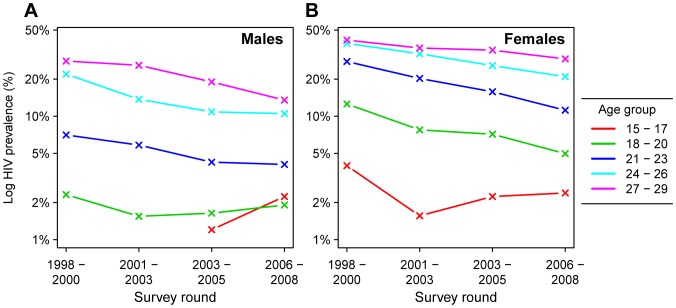
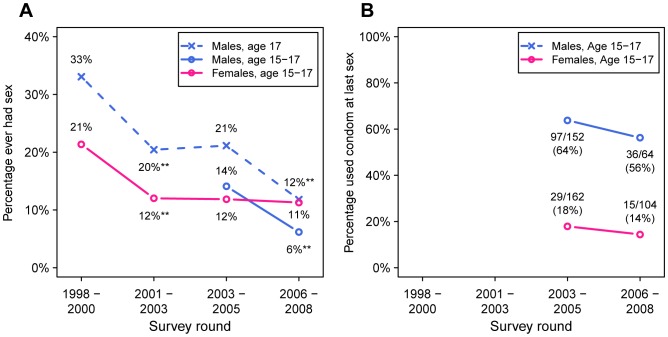
Recent data from the Manicaland HIV/STD Prevention Project, a general-population open HIV cohort study, suggested that between 2004 and 2007 HIV prevalence amongst males aged 15-17 years in eastern Zimbabwe increased from 1.20% to 2.23%, and in females remained unchanged at 2.23% to 2.39%, while prevalence continued to decline in the rest of the adult population. We assess whether the more likely source of the increase in adolescent HIV prevalence is recent sexual HIV acquisition, or the aging of long-term survivors of perinatal HIV acquisition that occurred during the early growth of the epidemic. Using data collected between August 2006 and November 2008, we investigated associations between adolescent HIV and (1) maternal orphanhood and maternal HIV status, (2) reported sexual behaviour, and (3) reporting recurring sickness or chronic illness, suggesting infected adolescents might be in a late stage of HIV infection. HIV-infected adolescent males were more likely to be maternal orphans (RR = 2.97, p<0.001) and both HIV-infected adolescent males and females were more likely to be maternal orphans or have an HIV-infected mother (male RR = 1.83, p<0.001; female RR = 16.6, p<0.001). None of 22 HIV-infected adolescent males and only three of 23 HIV-infected females reported ever having had sex. HIV-infected adolescents were 60% more likely to report illness than HIV-infected young adults. Taken together, all three hypotheses suggest that recent increases in adolescent HIV prevalence in eastern Zimbabwe are more likely attributable to long-term survival of mother-to-child transmission rather than increases in risky sexual behaviour. HIV prevalence in adolescents and young adults cannot be used as a surrogate for recent HIV incidence, and health systems should prepare for increasing numbers of long-term infected adolescents.
最近,曼尼卡兰艾滋病毒/性传播疾病预防项目(一项针对普通人群的艾滋病毒开放性队列研究)的数据显示,2004 年至 2007 年间,津巴布韦东部 15-17 岁男性的艾滋病毒流行率从 1.20%上升至 2.23%,而女性的流行率则保持在 2.23%至 2.39%不变,与此同时,其他成年人的艾滋病毒流行率继续下降。我们评估了青少年艾滋病毒流行率上升的更可能原因是最近的性途径艾滋病毒感染,还是因母婴传播感染艾滋病毒而长期存活下来的人群的老龄化,这种情况发生在疫情早期。我们利用 2006 年 8 月至 2008 年 11 月间收集的数据,调查了青少年艾滋病毒与(1)母亲早逝和母亲艾滋病毒状况、(2)报告的性行为、以及(3)报告反复患病或慢性病之间的关联,表明受感染的青少年可能处于艾滋病毒感染的晚期。感染艾滋病毒的青少年男性更有可能是母亲早逝者(RR=2.97,p<0.001),感染艾滋病毒的青少年男性和女性更有可能是母亲早逝者或其母亲感染艾滋病毒(男性 RR=1.83,p<0.001;女性 RR=16.6,p<0.001)。22 名感染艾滋病毒的青少年男性中没有一人报告曾有过性行为,而 23 名感染艾滋病毒的女性中只有三人报告曾有过性行为。感染艾滋病毒的青少年报告患病的可能性比感染艾滋病毒的年轻人高出 60%。总的来说,所有三个假设都表明,津巴布韦东部青少年艾滋病毒流行率的最近上升更可能归因于母婴传播的长期存活,而不是性行为风险的增加。青少年和年轻人的艾滋病毒流行率不能作为近期艾滋病毒发病率的替代指标,卫生系统应做好准备,应对越来越多的长期受感染的青少年。