Max Planck Institute of Molecular Cell Biology and Genetics, Dresden, Germany.
Harvard Medical School, Boston, United States.
Elife. 2017 Dec 29;6:e28307. doi: 10.7554/eLife.28307.
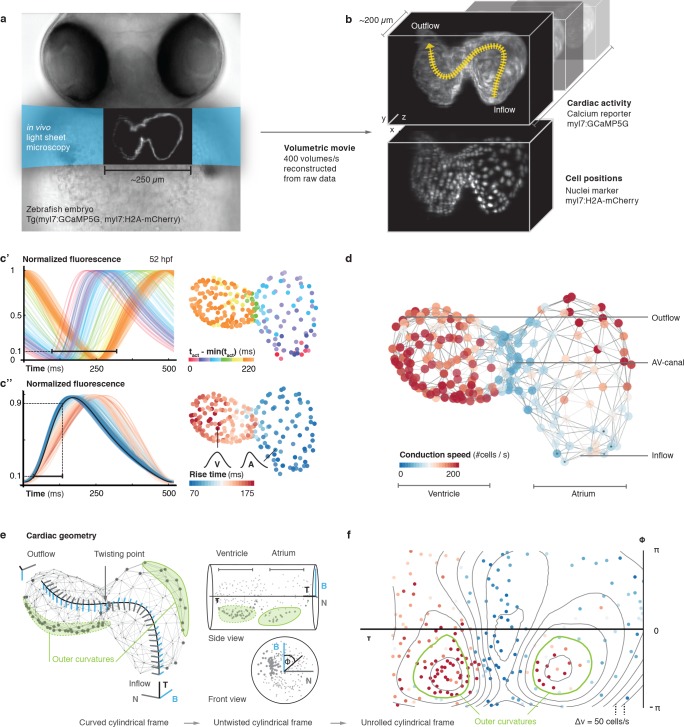
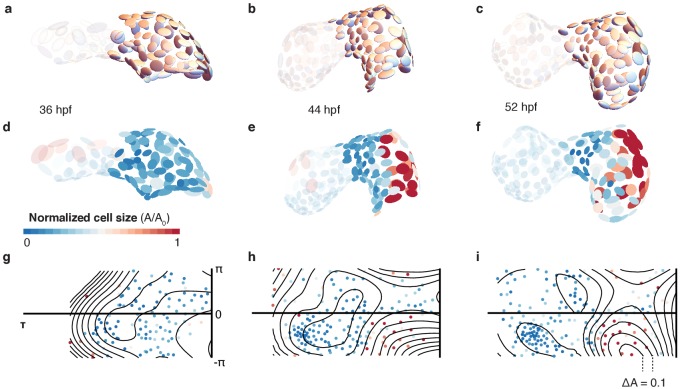
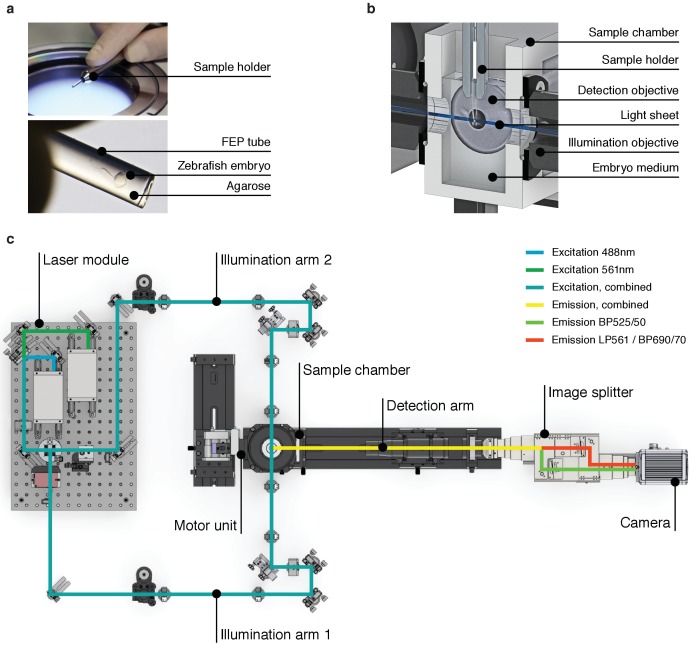
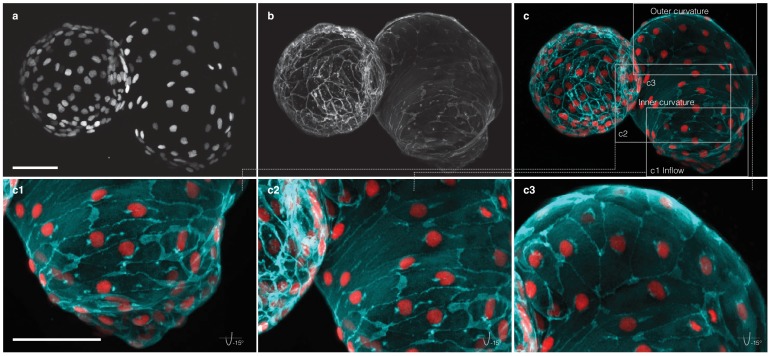
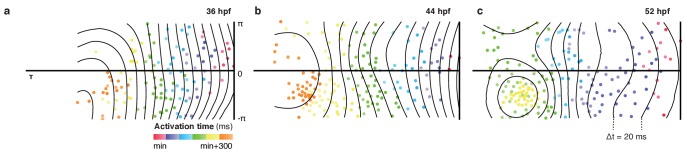
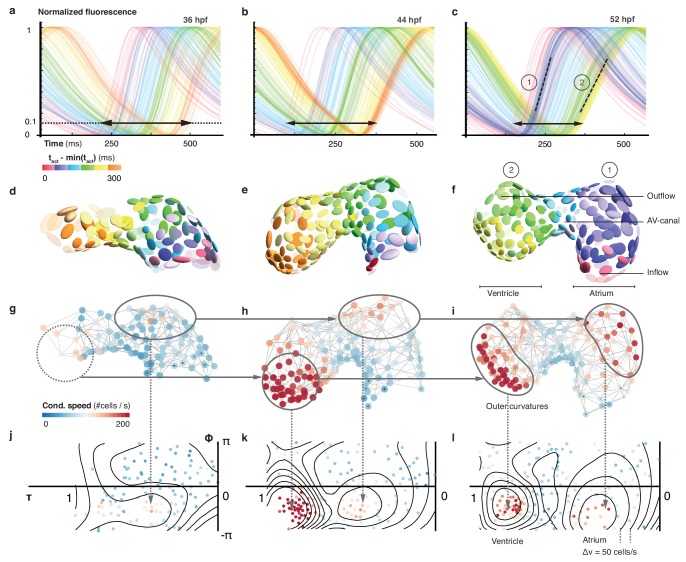
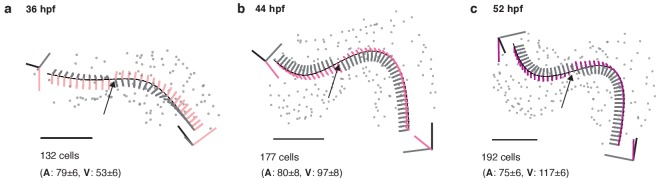
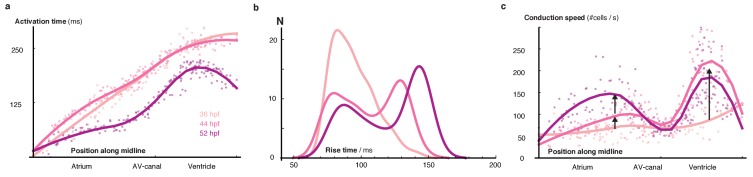
Organogenesis depends on orchestrated interactions between individual cells and morphogenetically relevant cues at the tissue level. This is true for the heart, whose function critically relies on well-ordered communication between neighboring cells, which is established and fine-tuned during embryonic development. For an integrated understanding of the development of structure and function, we need to move from isolated snap-shot observations of either microscopic or macroscopic parameters to simultaneous and, ideally continuous, cell-to-organ scale imaging. We introduce cell-accurate three-dimensional Ca-mapping of all cells in the entire electro-mechanically uncoupled heart during the looping stage of live embryonic zebrafish, using high-speed light sheet microscopy and tailored image processing and analysis. We show how myocardial region-specific heterogeneity in cell function emerges during early development and how structural patterning goes hand-in-hand with functional maturation of the entire heart. Our method opens the way to systematic, scale-bridging, studies of vertebrate organogenesis by cell-accurate structure-function mapping across entire organs.
器官发生依赖于个体细胞之间的协调相互作用和组织水平上与形态发生相关的线索。心脏就是如此,其功能严重依赖于相邻细胞之间有序的通讯,这种通讯在胚胎发育过程中建立并精细调整。为了综合理解结构和功能的发育,我们需要将对微观或宏观参数的孤立快照观察转变为同时进行的、理想情况下是连续的、从细胞到器官尺度的成像。我们使用高速光片显微镜和定制的图像处理和分析,在活体斑马鱼胚胎的心脏环化阶段,对整个电机械解耦心脏中的所有细胞进行精确到细胞的三维 Ca 映射。我们展示了在早期发育过程中,心肌区域特异性细胞功能异质性是如何出现的,以及结构模式是如何与整个心脏的功能成熟齐头并进的。我们的方法为通过跨越整个器官的精确到细胞的结构-功能映射对脊椎动物器官发生进行系统的、跨尺度的研究开辟了道路。