Cummings P J, Olszewicz J, Obom K M
Center for Biotechnology Education, Krieger School of Arts and Sciences, Johns Hopkins University;
Center for Biotechnology Education, Krieger School of Arts and Sciences, Johns Hopkins University.
J Vis Exp. 2017 Dec 14(130):55979. doi: 10.3791/55979.
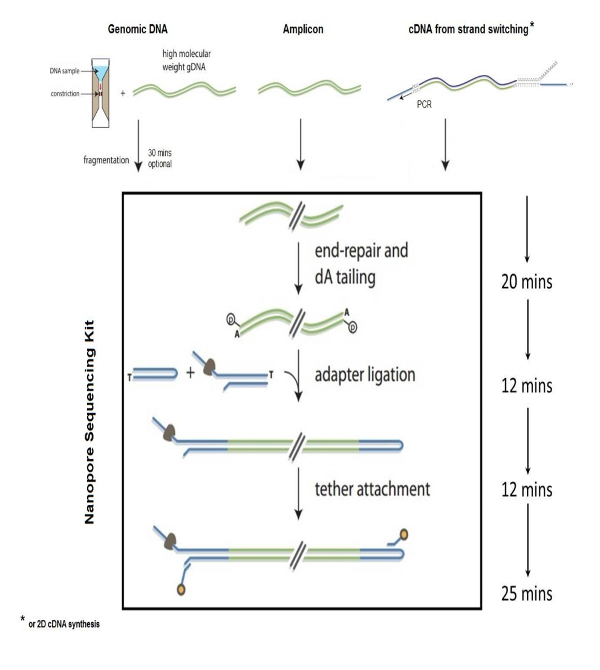
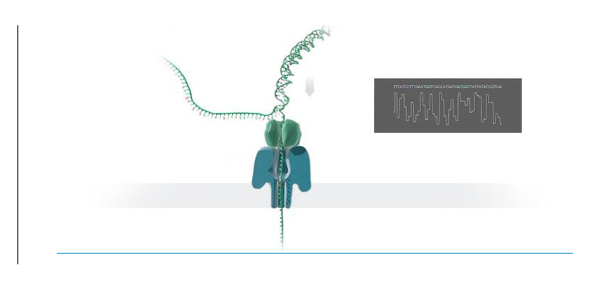
This article describes the steps for construction of a DNA library from soil, preparation and use of the nanopore flow cell, and analysis of the DNA sequences identified using computer software. Nanopore DNA sequencing is a flexible technique that allows for rapid microbial genome sequencing to identify bacterial and viral species, to characterize bacterial strains, and to detect genetic mutations that confer resistance to antibiotics. The advantages of nanopore sequencing (NS) for life sciences include its low complexity, reduced cost, and rapid real-time sequencing of purified genomic DNA, PCR amplicons, cDNA samples, or RNA. NS is an example of "strand sequencing" which involves sequencing DNA by guiding a single stranded DNA molecule through a nanopore that is inserted into a synthetic polymer membrane. The membrane has an electrical current applied across it, so as the individual bases pass through the nanopore the electrical current is disrupted to varying degrees by the four nucleotide bases. The identification of each nucleotide occurs by detecting the characteristic modulation of the electrical current by the different bases as they pass through the nanopore. The NS system consists of a handheld, USB powered portable device and a disposable flow cell that contains a nanopore array. The portable device plugs into a standard laptop computer that reads and records the DNA sequence using computer software.
本文介绍了从土壤构建DNA文库的步骤、纳米孔流动槽的制备和使用,以及使用计算机软件对鉴定出的DNA序列进行分析。纳米孔DNA测序是一项灵活的技术,可实现快速微生物基因组测序,以识别细菌和病毒种类、鉴定细菌菌株,并检测赋予抗生素抗性的基因突变。纳米孔测序(NS)在生命科学领域的优势包括其低复杂性、成本降低,以及对纯化的基因组DNA、PCR扩增子、cDNA样本或RNA进行快速实时测序。NS是“单链测序”的一个例子,它通过引导单链DNA分子穿过插入合成聚合物膜的纳米孔来对DNA进行测序。膜上施加有电流,因此当单个碱基穿过纳米孔时,电流会被四种核苷酸碱基不同程度地干扰。通过检测不同碱基穿过纳米孔时电流的特征性调制来识别每个核苷酸。NS系统由一个手持式、由USB供电的便携式设备和一个包含纳米孔阵列的一次性流动槽组成。该便携式设备插入一台标准笔记本电脑,电脑使用计算机软件读取并记录DNA序列。