McLaughlin Heather P, Cherney Blake, Hakovirta Janetta R, Priestley Rachael A, Conley Andrew, Carter Andrew, Hodge David, Pillai Segaran P, Weigel Linda M, Kersh Gilbert J, Sue David
Laboratory Preparedness and Response Branch, National Center for Emerging and Zoonotic Infectious Diseases, Centers for Disease Control and Prevention, Atlanta, GA, United States of America.
Rickettsial Zoonoses Branch, National Center for Emerging and Zoonotic Infectious Diseases, Centers for Disease Control and Prevention, Atlanta, GA, United States of America.
PLoS One. 2017 Dec 29;12(12):e0189910. doi: 10.1371/journal.pone.0189910. eCollection 2017.
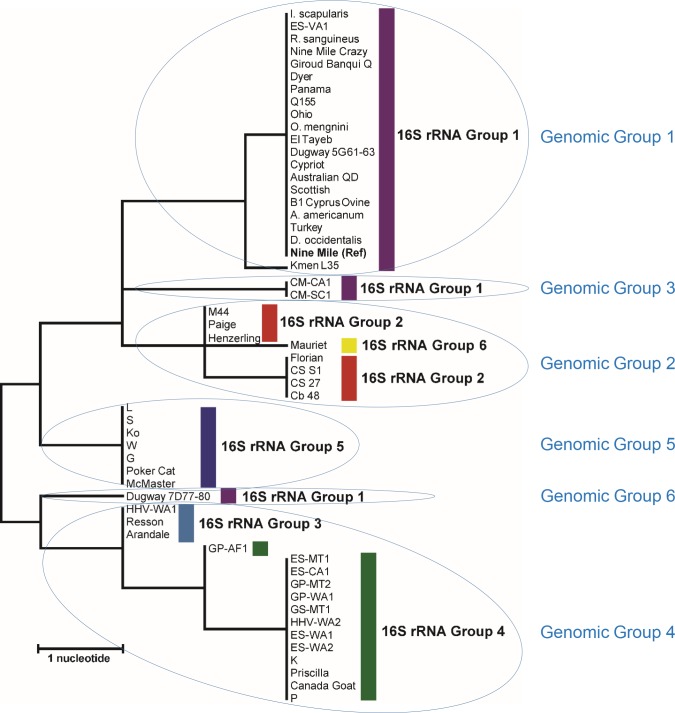
Coxiella burnetii is a human pathogen that causes the serious zoonotic disease Q fever. It is ubiquitous in the environment and due to its wide host range, long-range dispersal potential and classification as a bioterrorism agent, this microorganism is considered an HHS Select Agent. In the event of an outbreak or intentional release, laboratory strain typing methods can contribute to epidemiological investigations, law enforcement investigation and the public health response by providing critical information about the relatedness between C. burnetii isolates collected from different sources. Laboratory cultivation of C. burnetii is both time-consuming and challenging. Availability of strain collections is often limited and while several strain typing methods have been described over the years, a true gold-standard method is still elusive. Building upon epidemiological knowledge from limited, historical strain collections and typing data is essential to more accurately infer C. burnetii phylogeny. Harmonization of auspicious high-resolution laboratory typing techniques is critical to support epidemiological and law enforcement investigation. The single nucleotide polymorphism (SNP) -based genotyping approach offers simplicity, rapidity and robustness. Herein, we demonstrate SNPs identified within 16S rRNA gene sequences can differentiate C. burnetii strains. Using this method, 55 isolates were assigned to six groups based on six polymorphisms. These 16S rRNA SNP-based genotyping results were largely congruent with those obtained by analyzing restriction-endonuclease (RE)-digested DNA separated by SDS-PAGE and by the high-resolution approach based on SNPs within multispacer sequence typing (MST) loci. The SNPs identified within the 16S rRNA gene can be used as targets for the development of additional SNP-based genotyping assays for C. burnetii.
伯纳特柯克斯体是一种可引发严重人畜共患病Q热的人类病原体。它在环境中无处不在,由于其宿主范围广泛、具备远距离传播潜力且被列为生物恐怖主义制剂,这种微生物被视为美国卫生与公众服务部(HHS)选定的病原体。在发生疫情或故意释放事件时,实验室菌株分型方法可为流行病学调查、执法调查及公共卫生应对提供帮助,通过提供有关从不同来源收集的伯纳特柯克斯体分离株之间亲缘关系的关键信息。伯纳特柯克斯体的实验室培养既耗时又具有挑战性。菌株库的可用性往往有限,尽管多年来已描述了多种菌株分型方法,但真正的金标准方法仍难以捉摸。基于有限的历史菌株库和分型数据的流行病学知识对于更准确地推断伯纳特柯克斯体系统发育至关重要。协调有利的高分辨率实验室分型技术对于支持流行病学和执法调查至关重要。基于单核苷酸多态性(SNP)的基因分型方法具有简单、快速和稳健的特点。在此,我们证明在16S rRNA基因序列中鉴定出的SNP可区分伯纳特柯克斯体菌株。使用该方法,55个分离株基于6个多态性被分为6组。这些基于16S rRNA SNP的基因分型结果与通过分析经SDS-PAGE分离的限制性内切酶(RE)消化的DNA以及基于多间隔序列分型(MST)位点内SNP的高分辨率方法获得的结果基本一致。在16S rRNA基因中鉴定出的SNP可作为开发更多基于SNP的伯纳特柯克斯体基因分型检测方法的靶点。