Department of Pharmacology, University of Iowa Carver College of Medicine, Iowa City, IA, USA.
Department of Internal Medicine, University of Iowa Carver College of Medicine, Iowa City, IA, USA.
Mol Metab. 2018 Feb;8:1-12. doi: 10.1016/j.molmet.2017.12.006. Epub 2017 Dec 18.
The autonomic nervous system is critically involved in mediating the control by leptin of many physiological processes. Here, we examined the role of the leptin receptor (LepR) in proopiomelanocortin (POMC) and agouti-related peptide (AgRP) neurons in mediating the effects of leptin on regional sympathetic and parasympathetic nerve activity.
We analyzed how deletion of the LepR in POMC neurons (POMC/LepR mice) or AgRP neurons (AgRP/LepR mice) affects the ability of leptin to increase sympathetic and parasympathetic nerve activity. We also studied mice lacking the catalytic p110α or p110β subunits of phosphatidylinositol-3 kinase (PI3K) in POMC neurons.
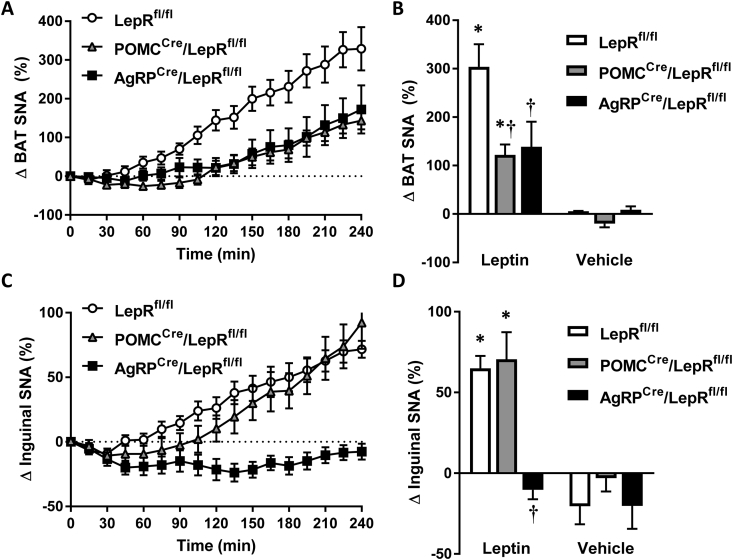
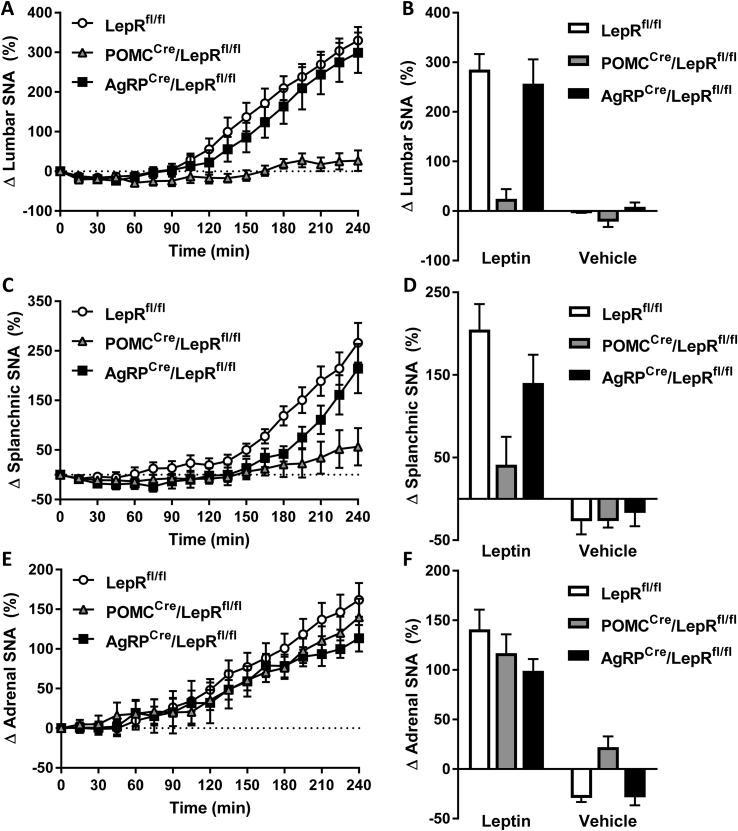
Leptin-evoked increase in sympathetic nerve activity subserving thermogenic brown adipose tissue was partially blunted in mice lacking the LepR in either POMC or AgRP neurons. On the other hand, loss of the LepR in AgRP, but not POMC, neurons interfered with leptin-induced sympathetic nerve activation to the inguinal fat depot. The increase in hepatic sympathetic traffic induced by leptin was also reduced in mice lacking the LepR in AgRP, but not POMC, neurons whereas LepR deletion in either AgRP or POMC neurons attenuated the hepatic parasympathetic nerve activation evoked by leptin. Interestingly, the renal, lumbar and splanchnic sympathetic nerve activation caused by leptin were significantly blunted in POMC/LepR mice, but not in AgRP/LepR mice. However, loss of the LepR in POMC or AgRP neurons did not interfere with the ability of leptin to increase sympathetic traffic to the adrenal gland. Furthermore, ablation of the p110α, but not the p110β, isoform of PI3K from POMC neurons eliminated the leptin-elicited renal sympathetic nerve activation. Finally, we show trans-synaptic retrograde tracing of both POMC and AgRP neurons from the kidneys.
POMC and AgRP neurons are differentially involved in mediating the effects of leptin on autonomic nerve activity subserving various tissues and organs.
自主神经系统在介导瘦素对许多生理过程的控制中起着至关重要的作用。在这里,我们研究了瘦素受体(LepR)在 proopiomelanocortin(POMC)和 agouti 相关肽(AgRP)神经元中对瘦素影响区域交感和副交感神经活动的作用。
我们分析了 POMC 神经元(POMC/LepR 小鼠)或 AgRP 神经元(AgRP/LepR 小鼠)中 LepR 的缺失如何影响瘦素增加交感和副交感神经活动的能力。我们还研究了 POMC 神经元中缺乏磷脂酰肌醇-3 激酶(PI3K)的催化 p110α 或 p110β 亚单位的小鼠。
瘦素诱导的棕色脂肪组织产热相关的交感神经活动增加在 LepR 缺失的 POMC 或 AgRP 神经元的小鼠中部分减弱。另一方面,AgRP 神经元中 LepR 的缺失干扰了瘦素诱导的腹股沟脂肪库的交感神经激活,但 POMC 神经元中 LepR 的缺失则没有。瘦素诱导的肝交感神经活动增加也在 AgRP,但不是 POMC,神经元中 LepR 缺失的小鼠中减少,而 LepR 在 AgRP 或 POMC 神经元中的缺失则减弱了瘦素引起的肝副交感神经激活。有趣的是,POMC/LepR 小鼠的肾脏、腰部和内脏交感神经激活明显减弱,但 AgRP/LepR 小鼠则没有。然而,POMC 或 AgRP 神经元中 LepR 的缺失并不干扰瘦素增加肾上腺交感神经活动的能力。此外,从 POMC 神经元中消除 p110α,而不是 p110β,PI3K 的同工酶消除了瘦素引起的肾脏交感神经激活。最后,我们显示了来自肾脏的 POMC 和 AgRP 神经元的顺行逆行示踪。
POMC 和 AgRP 神经元在介导瘦素对各种组织和器官的自主神经活动的影响方面存在差异。