Mariappan Lavanya, Jiang Xue Yan, Jackson Josie, Drew Yvette
Northern Centre for Cancer Care, Freeman Hospital.
Northern Institute for Cancer Research, Newcastle University, Newcastle-upon-Tyne, UK.
Int J Womens Health. 2017 Dec 15;9:913-924. doi: 10.2147/IJWH.S151194. eCollection 2017.
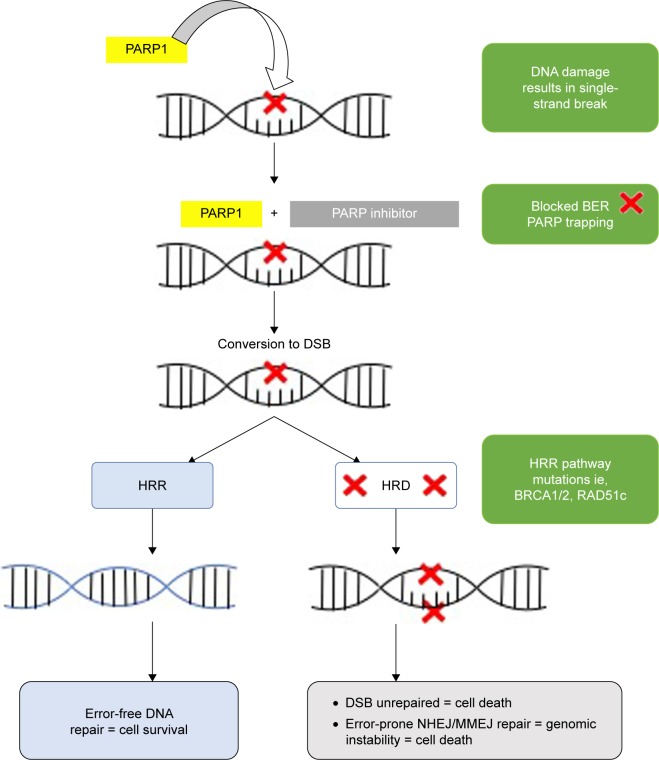
Poly(ADP-ribose) polymerase (PARP) inhibitors (PARPi) are an exciting class of anticancer drugs, which have revolutionized the management of BRCA mutant/homologous recombination-deficient recurrent high-grade serous ovarian cancer (HGSOC). With three PARPi now approved by the US Food and Drug Administration, olaparib (Lynparza™), niraparib (Zejula™), and rucaparib (Rubraca™) in 2014 (and 2017 for the tablet formulation), 2016, and 2017, respectively, these drugs have now entered routine clinical practice. The marked single-agent efficacy of PARPi either as maintenance following response to platinum-based chemotherapy or as up-front treatment in these indications is based on the well-known concept of synthetic lethality. PARPi themselves work by blocking the repair of single-strand DNA breaks by the base excision/single-strand break repair pathway and can also be directly cytotoxic by the mechanism of PARP trapping. The greatest benefit in terms of progression-free survival, in all three PARPi maintenance registration studies, was seen in women with platinum-sensitive BRCA mutation-associated HGSOC. However, it is clear that non-BRCA HGSOC can benefit from PARPi and the ongoing challenge of biomarker driven studies is how best to define these patients. PARPi are well tolerated, but more information is needed to assess the longer-term/later onset toxicities as these agents are investigated in the first-line setting. The future direction and challenges for PARPi will be to continue to expand beyond BRCA and ovarian cancer by identifying molecular or functional signatures of response; to see if the durable responses in ovarian cancer can be improved and efficacy can be achieved in other cancer sub-types by combining with novel targeted agents. This review summarizes the development of PARPi as a class in ovarian cancer with particular focus on the PARPi rucaparib.
聚(ADP - 核糖)聚合酶(PARP)抑制剂(PARPi)是一类令人振奋的抗癌药物,它彻底改变了BRCA突变/同源重组缺陷型复发性高级别浆液性卵巢癌(HGSOC)的治疗方式。目前已有三种PARPi被美国食品药品监督管理局批准,分别是奥拉帕利(Lynparza™)于2014年获批(其片剂剂型于2017年获批),尼拉帕利(Zejula™)于2016年获批,鲁卡帕利(Rubraca™)于2017年获批,这些药物现已进入常规临床实践。PARPi无论是作为铂类化疗有效后的维持治疗,还是在这些适应症中作为一线治疗,其显著的单药疗效都基于著名的合成致死概念。PARPi本身通过碱基切除/单链断裂修复途径阻断单链DNA断裂的修复发挥作用,并且还可通过PARP捕获机制直接产生细胞毒性。在所有三项PARPi维持治疗注册研究中,无进展生存期获益最大的是铂敏感的BRCA突变相关HGSOC女性患者。然而,很明显非BRCA HGSOC也可从PARPi中获益,生物标志物驱动研究面临的持续挑战是如何最好地界定这些患者。PARPi耐受性良好,但随着这些药物在一线治疗中的研究,需要更多信息来评估其长期/迟发性毒性。PARPi未来的方向和挑战将是通过识别反应的分子或功能特征,继续超越BRCA和卵巢癌进行拓展;研究是否可以改善卵巢癌的持久反应,并通过与新型靶向药物联合在其他癌症亚型中实现疗效。本综述总结了PARPi作为一类药物在卵巢癌中的发展,特别关注PARPi鲁卡帕利。