Chen Jionghuang, Wang Shaowen, Jia Shengnan, Ding Guoping, Jiang Guixing, Cao Liping
Department of General Surgery, Sir Run Run Shaw Hospital, the affiliated hospital of Zhejiang University School of Medicine, Hangzhou, China.
J Cancer. 2018 Jan 1;9(1):21-31. doi: 10.7150/jca.21749. eCollection 2018.
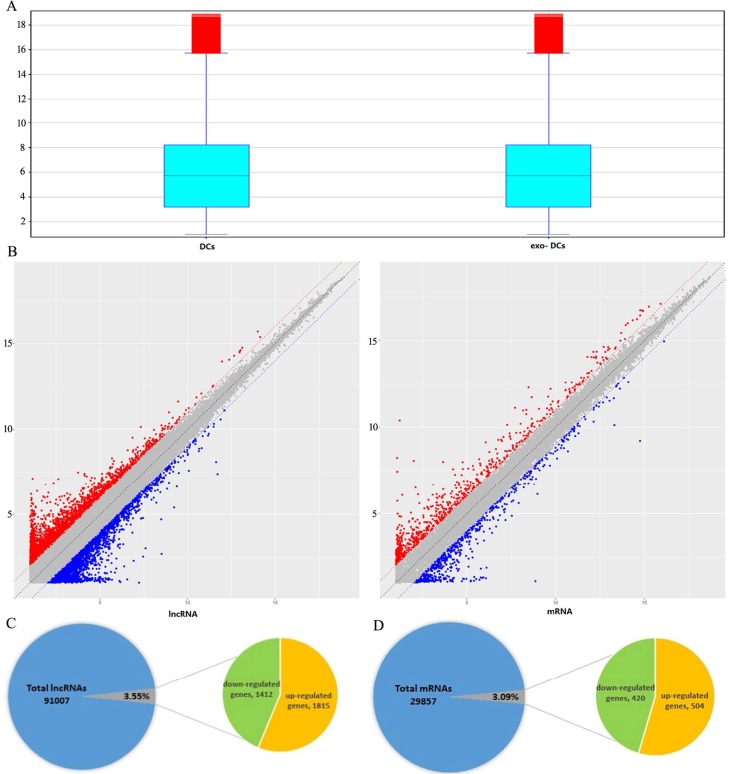
Pancreatic cancer is a devastating disease with a low five-year survival rate. Dendritic cells (DCs), which are the most potent antigen-presenting cells in the human body, play a pivotal role in the immune response. However, few studies have investigated the role of pancreatic cancer-derived exosomes (PEXs) in DC-meditated immune escape. The expression profiles of long noncoding RNAs (lncRNAs) and mRNAs of PEX-treated dendritic cells are unknown. We used integrated lncRNA and mRNA microarrays to determine the expression profiles of PEX-treated DCs and normal DCs derived from five healthy donors. Gene Ontology (GO), KEGG, and cancer genomics analyses were performed to identify significant functions, pathways, and the associations of differentially expressed mRNAs. A coexpression network was constructed to identify the correlation between differentially expressed lncRNAs and mRNAs and further validated using real-time quantitative PCR in twenty healthy donors. The AnnoLnc program was used to perform an annotation analysis of lncRNAs. We identified 3,227 and 924 differentially expressed lncRNAs and mRNAs, respectively, in PEX-treated DCs. GO and pathway analysis revealed differentially expressed mRNAs involved in many critical biological processes and molecular functions. Cancer genomics analysis revealed that 36 of the most differentially expressed mRNAs were involved in a pancreatic cancer network and were associated with many critical mutated genes such as TP53, KRAS, SMAD4, and CDKN2A. LncRNAs such as ENST00000560647 and mRNAs such as legumain (lgmn) were differentially expressed in PEX-treated DCs, and the data were validated using RT-qPCR. To our knowledge, this is the first study to detect the differential expression of lncRNAs and mRNAs associated with PEX-treated DCs. LncRNAs such as ENST00000560647 and mRNAs such as lgmn might play a critical role in immune escape of DCs treated with PEX. Further investigation is required to validate the functions and associations of these RNAs.
胰腺癌是一种具有低五年生存率的毁灭性疾病。树突状细胞(DCs)是人体中最有效的抗原呈递细胞,在免疫反应中起关键作用。然而,很少有研究调查胰腺癌来源的外泌体(PEXs)在DC介导的免疫逃逸中的作用。PEX处理的树突状细胞的长链非编码RNA(lncRNAs)和mRNA的表达谱尚不清楚。我们使用整合的lncRNA和mRNA微阵列来确定PEX处理的DCs和来自五名健康供体的正常DCs的表达谱。进行基因本体论(GO)、KEGG和癌症基因组学分析以识别差异表达mRNA的重要功能、途径和关联。构建共表达网络以识别差异表达的lncRNAs和mRNAs之间的相关性,并在20名健康供体中使用实时定量PCR进一步验证。使用AnnoLnc程序对lncRNAs进行注释分析。我们在PEX处理的DCs中分别鉴定出3227个和924个差异表达的lncRNAs和mRNAs。GO和途径分析揭示了差异表达的mRNA参与许多关键的生物学过程和分子功能。癌症基因组学分析表明,36个差异最大的mRNA参与了胰腺癌网络,并与许多关键的突变基因如TP53、KRAS、SMAD4和CDKN2A相关。ENST00000560647等lncRNAs和legumain(lgmn)等mRNAs在PEX处理的DCs中差异表达,并且数据使用RT-qPCR进行了验证。据我们所知,这是第一项检测与PEX处理的DCs相关的lncRNAs和mRNAs差异表达的研究。ENST00000560647等lncRNAs和lgmn等mRNAs可能在PEX处理的DCs的免疫逃逸中起关键作用。需要进一步研究来验证这些RNA的功能和关联。