Yi Xingyang, Lin Jing, Wang Chun, Huang Ruyue, Han Zhao, Li Jie
Department of Neurology, People's Hospital of Deyang City, Deyang 618000, Sichuan, China.
Department of Neurology, The Third Affiliated Hospital of Wenzhou Medical University, Wenzhou 325200, Zhejiang, China.
Oncotarget. 2017 Nov 7;8(63):106258-106269. doi: 10.18632/oncotarget.22293. eCollection 2017 Dec 5.
To investigate the association of clinical outcomes with platelet function-guided modification in antiplatelet therapy in patients with ischemic stroke.
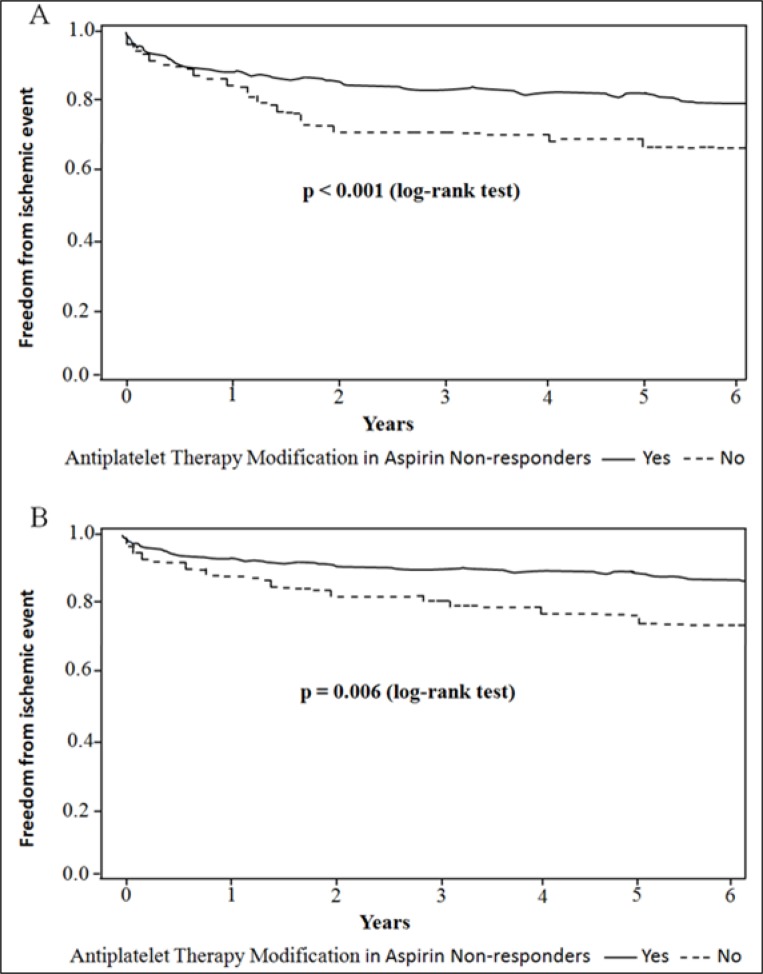
Among 812 patients, 223 patients had aspirin nonresponse, 204 patients was modified in antiplatelet therapy after platelet function testing. Mean follow-up period was 4.8 ± 1.7 years (ranged from 1 to 6.4 years). The incidence rates of ischemic events, death, or bleeding events were not significantly different between the patients with and without antiplatelet therapy modification. However, in patients with aspirin nonresponse, antiplatelet therapy modification was associated with decreased ischemic events (hazard ratio, 0.67; 95% confidence interval [CI], 0.62-0.97; = 0.01) and ischemic stroke (hazard ratio, 0.70; 95% CI, 0.63-0.98; = 0.03) compared with no modification in antiplatelet therapy.
In patients with aspirin nonresponse, platelet function-guided modification in antiplatelet therapy after an ischemic stroke was associated with significantly lower rate of ischemic events. The platelet function testing may be useful to guide antiplatelet therapy modification.
This is a retrospective, multicentre study. From August 2010 to December 2014, 812 patients with ischemic stroke underwent platelet function testing using platelet aggregation. Antiplatelet therapy modification was defined as any change in antiplatelet therapy after testing, including increasing aspirin dosage, adding an additional antiplatelet agent to aspirin, or switching to a more potent antiplatelet agent. The primary outcome was ischemic events. Secondary outcomes included death and bleeding events. Clinical outcomes were compared between patients with and without antiplatelet therapy modification using univariate and propensity score-adjusted analyses.
探讨缺血性脑卒中患者抗血小板治疗中临床结局与血小板功能指导下治疗调整之间的关联。
812例患者中,223例对阿司匹林无反应,204例在血小板功能检测后调整了抗血小板治疗。平均随访期为4.8±1.7年(范围为1至6.4年)。抗血小板治疗调整组与未调整组患者的缺血事件、死亡或出血事件发生率无显著差异。然而,在对阿司匹林无反应的患者中,与未调整抗血小板治疗相比,抗血小板治疗调整与缺血事件减少(风险比,0.67;95%置信区间[CI],0.62 - 0.97;P = 0.01)和缺血性卒中减少(风险比,0.70;95%CI,0.63 - 0.98;P = 0.03)相关。
在对阿司匹林无反应的缺血性脑卒中患者中,血小板功能指导下的抗血小板治疗调整与缺血事件发生率显著降低相关。血小板功能检测可能有助于指导抗血小板治疗调整。
这是一项回顾性多中心研究。2010年8月至2014年12月,812例缺血性脑卒中患者采用血小板聚集法进行血小板功能检测。抗血小板治疗调整定义为检测后抗血小板治疗的任何改变,包括增加阿司匹林剂量、在阿司匹林基础上加用另一种抗血小板药物或换用更强效的抗血小板药物。主要结局为缺血事件。次要结局包括死亡和出血事件。采用单因素分析和倾向评分调整分析比较抗血小板治疗调整组与未调整组患者的临床结局。