Poulson Rebecca L, Luttrell Page M, Slusher Morgan J, Wilcox Benjamin R, Niles Lawrence J, Dey Amanda D, Berghaus Roy D, Krauss Scott, Webster Robert G, Stallknecht David E
Southeastern Cooperative Wildlife Disease Study, College of Veterinary Medicine, Department of Population Health, The University of Georgia, 589 D. W. Brooks Drive, Athens, GA 30602, USA.
Conserve Wildlife Foundation of New Jersey, PO Box 420, Trenton, NJ 08609, USA.
R Soc Open Sci. 2017 Nov 15;4(11):171420. doi: 10.1098/rsos.171420. eCollection 2017 Nov.
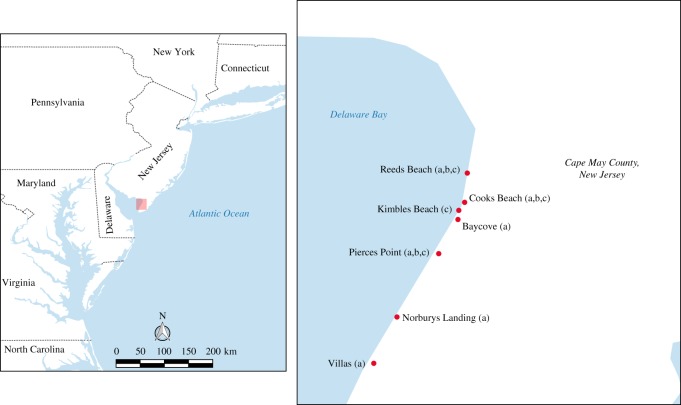
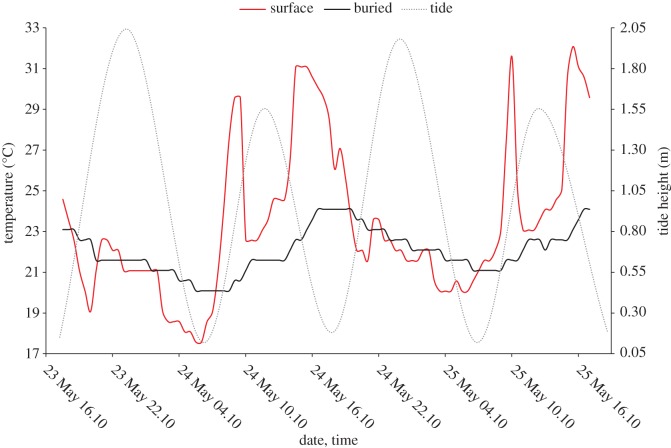
Delaware (DE) Bay, in the northeastern USA, has long been recognized as a hotspot for avian influenza A virus (IAV); every spring, this coastal region serves as a brief stopover site for thousands of long-distance migrating shorebirds, en route to breeding grounds in the Arctic. During these stopovers, IAV has been consistently recovered from ruddy turnstones () that are likely to become infected as they feed by probing sand and cobble in search of food. In May 2010-2012, we successfully isolated 19 IAV from environmental samples (sand, = 18; horseshoe crab eggs, = 1) obtained from DE Bay sites. Two of these viruses were subjected to laboratory conditions similar to those in the DE Bay spring-time environment, and remained infectious for 7 days. Here, through the recovery of IAV from environmental samples, temperature monitoring at and below the sand surface and simulated laboratory trials, we provide evidence that the beach environment may enable localized transmission and short-term maintenance of IAV in this unique ecosystem.
美国东北部的特拉华湾长期以来一直被认为是甲型流感病毒(IAV)的热点地区;每年春天,这个沿海地区是数千只长途迁徙滨鸟前往北极繁殖地途中的短暂停留地。在这些停留期间,人们一直从赤翻石鹬身上分离出IAV,它们在通过探测沙子和卵石寻找食物时可能会被感染。在2010 - 2012年5月,我们成功地从特拉华湾地区采集的环境样本(沙子,n = 18;鲎卵,n = 1)中分离出19株IAV。其中两种病毒在类似于特拉华湾春季环境的实验室条件下,7天内仍具有传染性。在这里,通过从环境样本中分离出IAV、对沙面及以下温度进行监测以及模拟实验室试验,我们提供了证据表明海滩环境可能使IAV在这个独特的生态系统中实现局部传播和短期维持。