Department of Medicinal Chemistry, University of Utah, Salt Lake City, Utah, USA.
Department of Pharmacology and Toxicology, University of Utah, Salt Lake City, Utah, USA.
Nat Chem Biol. 2018 Feb;14(2):179-185. doi: 10.1038/nchembio.2537. Epub 2018 Jan 1.
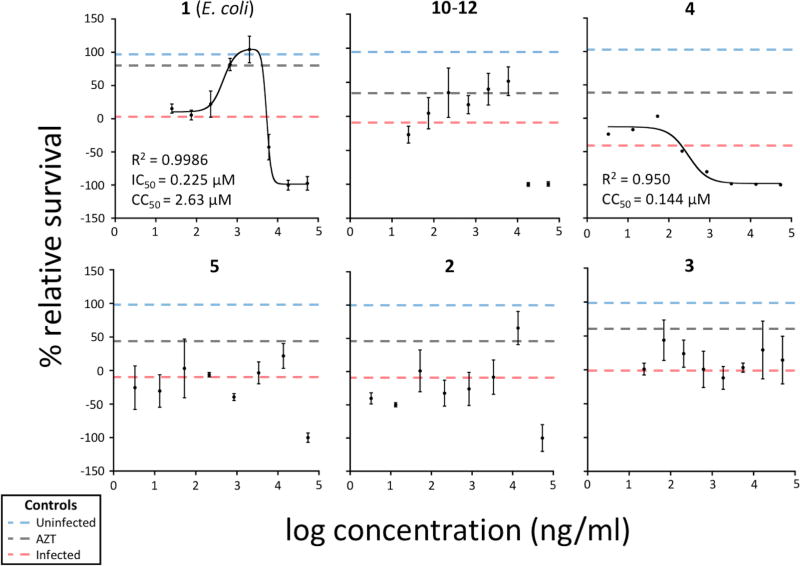
Chemistry drives many biological interactions between the microbiota and host animals, yet it is often challenging to identify the chemicals involved. This poses a problem, as such small molecules are excellent sources of potential pharmaceuticals, pretested by nature for animal compatibility. We discovered anti-HIV compounds from small, marine tunicates from the Eastern Fields of Papua New Guinea. Tunicates are a reservoir for new bioactive chemicals, yet their small size often impedes identification or even detection of the chemicals within. We solved this problem by combining chemistry, metagenomics, and synthetic biology to directly identify and synthesize the natural products. We show that these anti-HIV compounds, the divamides, are a novel family of lanthipeptides produced by symbiotic bacteria living in the tunicate. Neighboring animal colonies contain structurally related divamides that differ starkly in their biological properties, suggesting a role for biosynthetic plasticity in a native context wherein biological interactions take place.
化学驱动着微生物群和宿主动物之间的许多生物相互作用,但识别相关化学物质通常具有挑战性。这是一个问题,因为这些小分子是潜在药物的极好来源,它们已经过自然界对动物相容性的预先测试。我们从巴布亚新几内亚东部海域的小型海洋被囊动物中发现了抗 HIV 化合物。被囊动物是新的生物活性化学物质的储存库,但它们的体积小通常会阻碍对其内部化学物质的识别甚至检测。我们通过将化学、宏基因组学和合成生物学相结合来直接识别和合成天然产物,解决了这个问题。我们表明,这些抗 HIV 化合物 divamides 是一类由生活在被囊动物中的共生细菌产生的新型硫肽。邻近的动物群体含有结构相关的 divamides,它们在生物特性上有很大的差异,这表明在发生生物相互作用的自然环境中,生物合成可塑性起着作用。