Ridgeway Kathleen, Dulli Lisa S, Murray Kate R, Silverstein Hannah, Dal Santo Leila, Olsen Patrick, Darrow de Mora Danielle, McCarraher Donna R
Global Health, Population, & Nutrition, Durham, NC, United States of America.
Maternal and Child Health, Gillings School of Global Public Health, University of North Carolina at Chapel Hill, NC, United States of America.
PLoS One. 2018 Jan 2;13(1):e0189770. doi: 10.1371/journal.pone.0189770. eCollection 2018.
Globally, an estimated 30% of new HIV infections occur among adolescents (15-24 years), most of whom reside in sub-Saharan Africa. Moreover, HIV-related mortality increased by 50% between 2005 and 2012 for adolescents 10-19 years while it decreased by 30% for all other age groups. Efforts to achieve and maintain optimal adherence to antiretroviral therapy are essential to ensuring viral suppression, good long-term health outcomes, and survival for young people. Evidence-based strategies to improve adherence among adolescents living with HIV are therefore a critical part of the response to the epidemic.
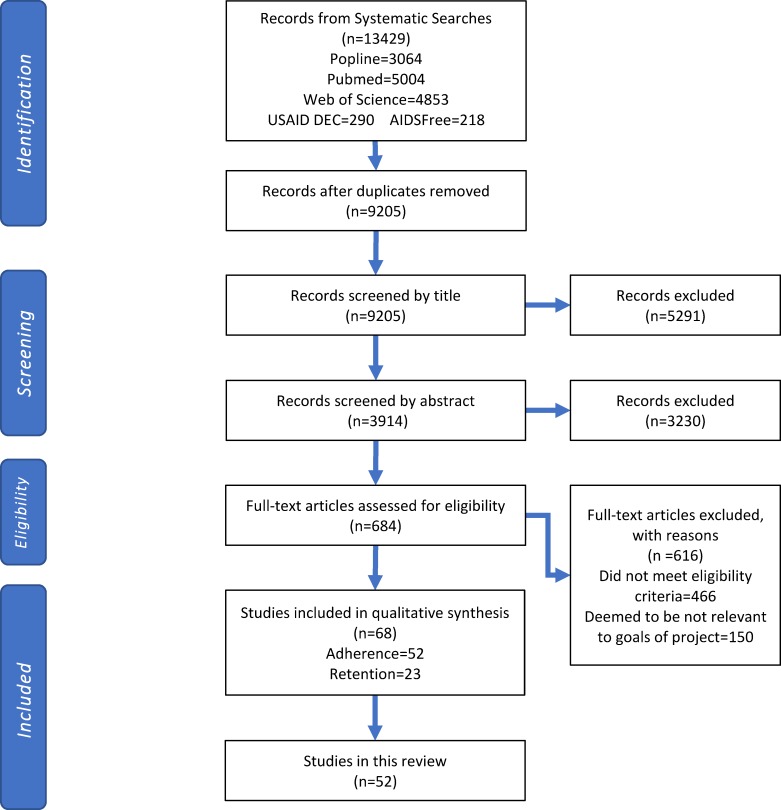
We conducted a systematic review of the peer-reviewed and grey literature published between 2010 and 2015 to identify interventions designed to improve antiretroviral adherence among adults and adolescents in low- and middle-income countries. We systematically searched PubMed, Web of Science, Popline, the AIDSFree Resource Library, and the USAID Development Experience Clearinghouse to identify relevant publications and used the NIH NHLBI Quality Assessment Tools to assess the quality and risk of bias of each study.
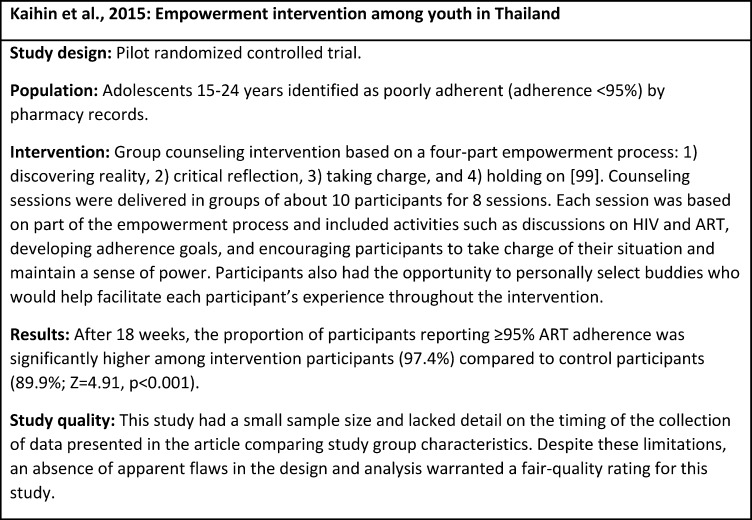
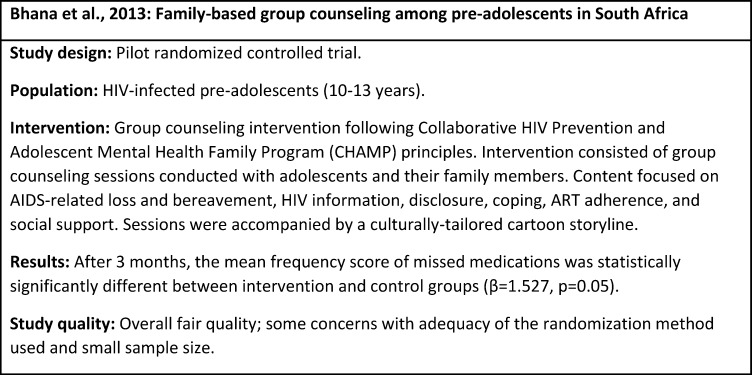
We identified 52 peer-reviewed journal articles describing 51 distinct interventions out of a total of 13,429 potentially relevant publications. Forty-three interventions were conducted among adults, six included adults and adolescents, and two were conducted among adolescents only. All studies were conducted in low- and middle-income countries, most of these (n = 32) in sub-Saharan Africa. Individual or group adherence counseling (n = 12), mobile health (mHealth) interventions (n = 13), and community- and home-based care (n = 12) were the most common types of interventions reported. Methodological challenges plagued many studies, limiting the strength of the available evidence. However, task shifting, community-based adherence support, mHealth platforms, and group adherence counseling emerged as strategies used in adult populations that show promise for adaptation and testing among adolescents.
Despite the sizeable body of evidence for adults, few studies were high quality and no single intervention strategy stood out as definitively warranting adaptation for adolescents. Among adolescents, current evidence is both sparse and lacking in its quality. These findings highlight a pressing need to develop and test targeted intervention strategies to improve adherence among this high-priority population.
在全球范围内,估计30%的新增艾滋病病毒感染发生在青少年(15 - 24岁)中,其中大多数居住在撒哈拉以南非洲地区。此外,2005年至2012年间,10 - 19岁青少年中与艾滋病病毒相关的死亡率上升了50%,而其他所有年龄组的这一死亡率下降了30%。努力实现并维持对抗逆转录病毒疗法的最佳依从性对于确保病毒抑制、良好的长期健康结果以及年轻人的生存至关重要。因此,基于证据的提高感染艾滋病病毒青少年依从性的策略是应对该流行病的关键部分。
我们对2010年至2015年间发表的同行评审文献和灰色文献进行了系统综述,以确定旨在提高低收入和中等收入国家成年人及青少年抗逆转录病毒疗法依从性的干预措施。我们系统地检索了PubMed、科学网、Popline、无艾滋病资源库和美国国际开发署发展经验信息中心,以识别相关出版物,并使用美国国立卫生研究院国家心肺血液研究所质量评估工具来评估每项研究的质量和偏倚风险。
在总共13429篇潜在相关出版物中,我们识别出52篇同行评审期刊文章,描述了51种不同的干预措施。43项干预措施是针对成年人开展的,6项涉及成年人和青少年,2项仅针对青少年开展。所有研究均在低收入和中等收入国家进行,其中大多数(n = 32)在撒哈拉以南非洲地区。个体或团体依从性咨询(n = 12)、移动健康(mHealth)干预措施(n = 13)以及社区和家庭护理(n = 12)是报告中最常见的干预措施类型。方法学挑战困扰着许多研究,限制了现有证据的力度。然而,任务转移、基于社区的依从性支持、移动健康平台以及团体依从性咨询已成为在成年人群体中使用的策略,有望在青少年中进行调整和测试。
尽管有大量针对成年人的证据,但高质量研究较少,没有单一的干预策略脱颖而出,明确值得在青少年中进行调整。在青少年中,目前的证据既稀少又质量欠佳。这些发现凸显了迫切需要制定和测试有针对性的干预策略,以提高这一重点人群的依从性。