Feleke Berhanu Elfu, Alene Getu Degu, Feleke Teferi Elfu, Motebaynore Yalmezerf, Biadglegne Fantahun
Department of Epidemiology and Biostatistics, University of Bahir Dar, Bahir Dar, Ethiopian.
Department of Pediatrics, University of St. Paul, Addis Ababa, Ethiopian.
PLoS One. 2018 Jan 2;13(1):e0190207. doi: 10.1371/journal.pone.0190207. eCollection 2018.
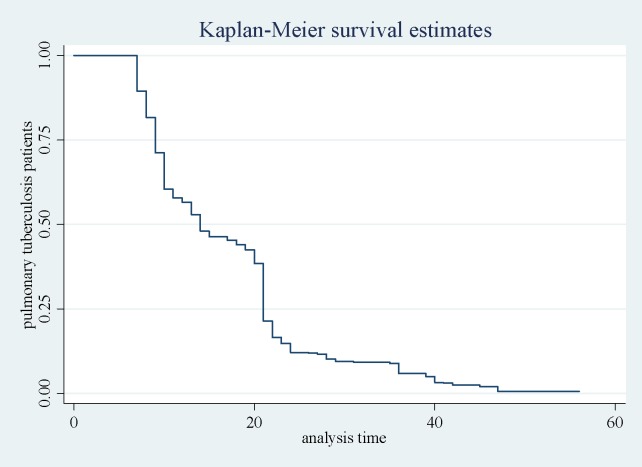
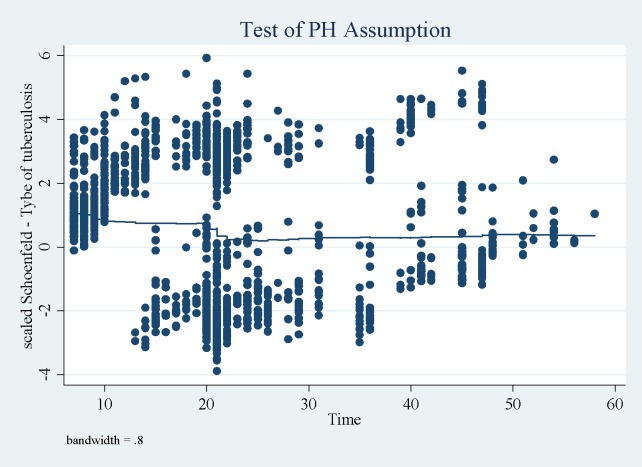
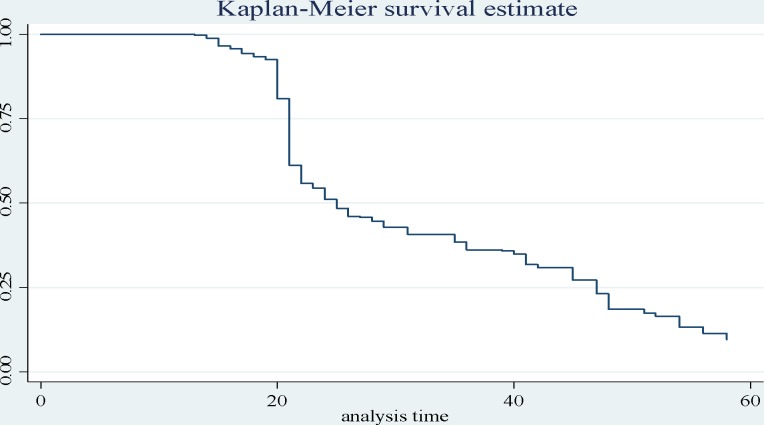
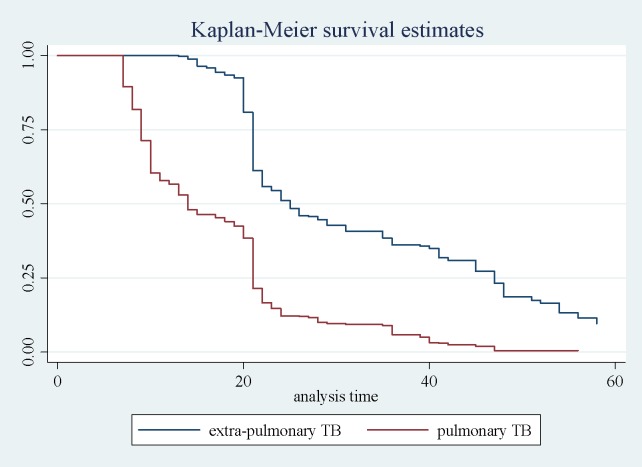
Clinical response means a response to drug intake that can be detected and appreciated by a change in signs and symptoms. The objectives of this study were to assess time to clinical response, the incidence density for clinical response and determinants of clinical response of tuberculosis (TB) patients in the intensive phases of TB treatment. Prospective cohort study design was implemented. The target population for this study was all patients following the directly observed therapy. Baseline data has been collected during the start of the directly observed TB treatment strategy. We have been collected updated data after the seven days of the baseline data collection, then after every seven days updated data has been collected from each pulmonary and extra pulmonary TB patients. Kaplan Meier curve was used to estimate time to clinical response. Incidence density using person days was used to estimate incidence of clinical response. Cox proportional hazard model was used to identify the predictors of clinical responses. A total of 1608 TB patients were included with a response rate at 99.5%. The mean age of the respondents was 24.5 years [standard deviation (SD) 14.34 years]. The incidence density for clinical response was 1429/38529 person days. One fourth of the TB patients showed clinical response at day 14, 25% of at day 21 and 75% o at day 31. Predictors of clinical response for TB patients includes: age (AHR 1.007 [95% CI 1.003-1.011]), type of TB (AOR 2.3[95% CI 2.04-2.59]), Previous history of TB (AHR 0.18 [95% CI 0.11-0 .30]), Intestinal parasitic infection (AOR 0.22[95% CI 0.19-0.26]), hemoglobin (AOR 2.35 [95% CI 2.18-2.54]), weight gain (AOR 1.11 [95% CI 1.05-1.17]), Micronutrient supplementation (AOR 9.71 [95% CI 8.28-11.38]), male sex (AOR 0.87 [95% CI 0.79-0.97]).The clinical responses for extra-pulmonary TB patients were slower than pulmonary TB. Deworming and micronutrient supplementation should be considered as the additional TB treatment strategy for TB patients.
临床反应是指对药物摄入的反应,可通过体征和症状的变化来检测和评估。本研究的目的是评估结核病(TB)患者在强化治疗阶段达到临床反应的时间、临床反应的发病密度以及临床反应的决定因素。采用前瞻性队列研究设计。本研究的目标人群是所有接受直接观察治疗的患者。在直接观察结核病治疗策略开始时收集基线数据。在基线数据收集7天后收集更新数据,然后每7天从每位肺结核和肺外结核患者收集更新数据。采用Kaplan-Meier曲线估计达到临床反应的时间。使用人天数的发病密度来估计临床反应的发生率。采用Cox比例风险模型确定临床反应的预测因素。共纳入1608例结核病患者,反应率为99.5%。受访者的平均年龄为24.5岁[标准差(SD)14.34岁]。临床反应的发病密度为1429/38529人天。四分之一的结核病患者在第14天出现临床反应,25%在第21天出现,75%在第31天出现。结核病患者临床反应的预测因素包括:年龄(风险比1.007[95%可信区间1.003-1.011])、结核病类型(比值比2.3[95%可信区间2.04-2.59])、既往结核病病史(风险比0.18[95%可信区间0.11-0.30])、肠道寄生虫感染(比值比0.22[95%可信区间0.19-0.26])、血红蛋白(比值比2.35[95%可信区间2.18-2.54])、体重增加(比值比1.11[95%可信区间1.05-1.17])、微量营养素补充(比值比9.71[95%可信区间8.28-11.38])、男性(比值比0.87[95%可信区间0.79-0.97])。肺外结核患者的临床反应比肺结核患者慢。驱虫和微量营养素补充应被视为结核病患者额外的结核病治疗策略。