Dessie Getenet, Negesse Ayenew, Wagnew Fasil, Amare Desalegne, Tiruneh Balew Zeleke, Mulugeta Henok, Mekonen Berhanu Abebaw, Haile Dessalegn, Ayalew Tilksew, Habtewold Tesfa Dejenie
Department of Nursing, School of Health Science, College of Medicine and Health Science, Bahr Dar University, Bahir Dar, Ethiopia.
Department of Human Nutrition and Food Science, College of Health Science, Debre Markos University, Debre Markos, Ethiopia.
Curr Ther Res Clin Exp. 2020 Aug 26;93:100603. doi: 10.1016/j.curtheres.2020.100603. eCollection 2020.
The distribution of intestinal parasites among patients with tuberculosis in Ethiopia is not well understood.
This systematic review and meta-analysis was designed to determine the pooled national prevalence of intestinal parasites and its association with HIV among patients with tuberculosis in Ethiopia.
Original articles were searched in PubMed, Google Scholar, EMBASE, World Health Organization's HINARI portal, and supplemented by the hand searching of cross-references. Data were extracted using a standard data extraction checklist. Random-effects model was used to estimate the pooled prevalence of intestinal parasites and odds ratio of the association. The statistic was utilized to quantify statistical heterogeneity across studies. Funnel plot asymmetry and Egger regression tests were used to check for publication bias. The analysis was done by STATA version 14 for Windows.
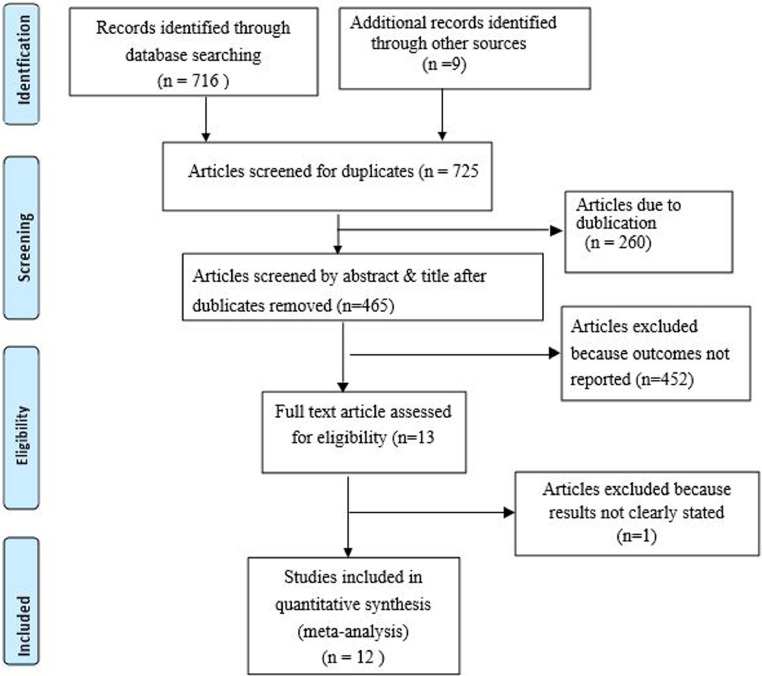
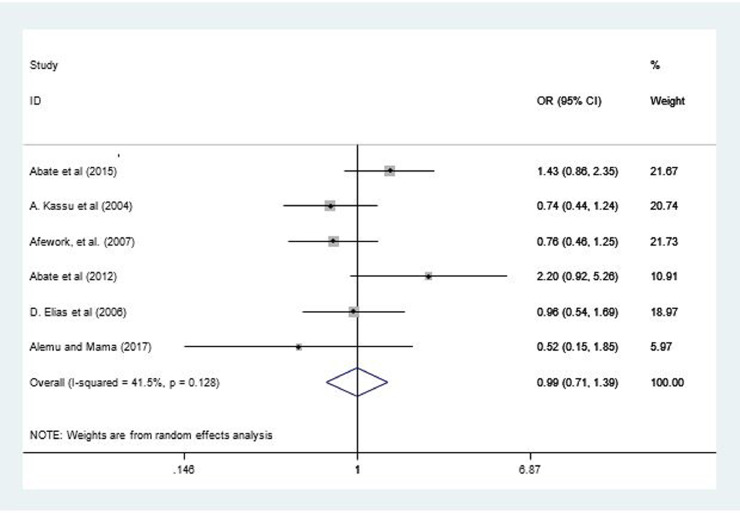
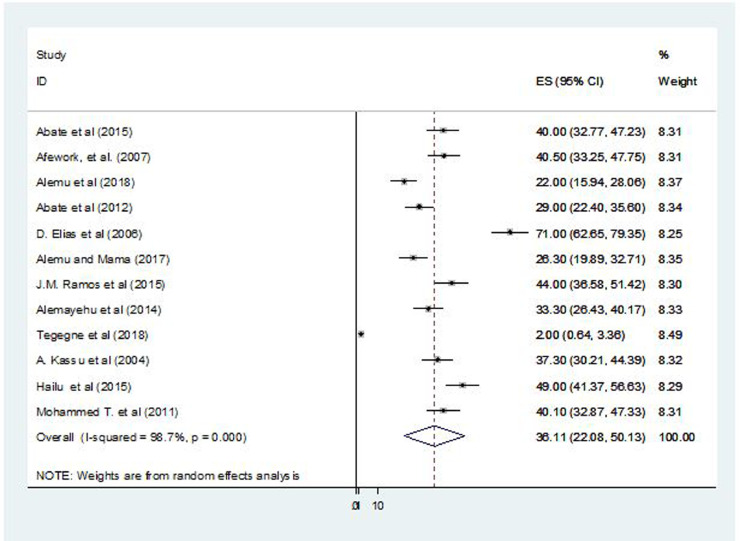
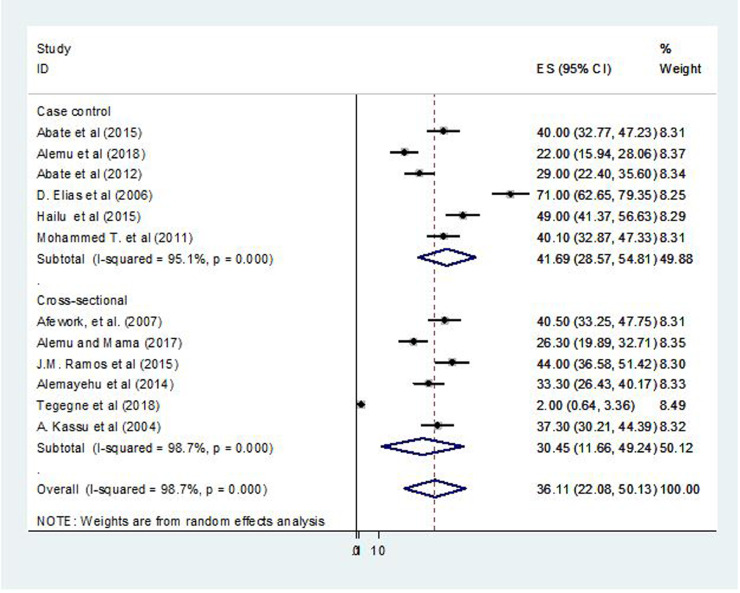
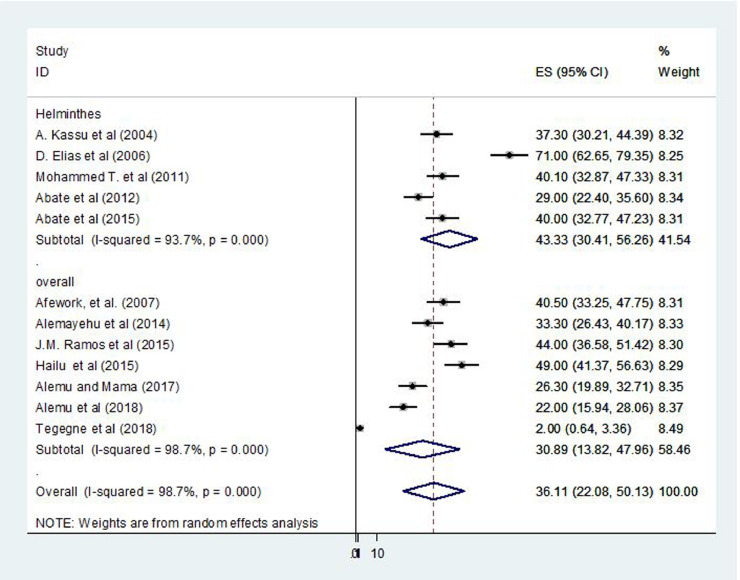
Of 725 identified studies, 12 articles were eligible for inclusion in the final analysis. The pooled national prevalence of intestinal parasites among patients with tuberculosis in Ethiopia was 36.1% (95% CI, 22.1-50.1; = 98.7%). Subgroup analysis based on study design indicated that the prevalence of intestinal parasite among case-control studies was 41.69% (95% CI, 28.6-54.8; = 95.1%). The odds of intestinal parasites among patients with tuberculosis-HIV coinfection was not significantly different compared with patients with tuberculosis without HIV/AIDS (odds ratio = 0.99; 95% CI, 0.7-4.7; = 0.96).
In Ethiopia, at least 1 out of 3 patients with tuberculosis have an intestinal parasite. These findings suggest a need of more attention on increasing screening tuberculosis patients for intestinal parasites and deworming interventions. (. 2020; 81:XXX-XXX).
埃塞俄比亚结核病患者肠道寄生虫的分布情况尚未得到充分了解。
本系统评价和荟萃分析旨在确定埃塞俄比亚结核病患者肠道寄生虫的全国合并患病率及其与艾滋病毒的关联。
在PubMed、谷歌学术、EMBASE、世界卫生组织的HINARI平台上检索原始文章,并通过手工检索参考文献进行补充。使用标准数据提取清单提取数据。采用随机效应模型估计肠道寄生虫的合并患病率和关联的优势比。运用统计量来量化各研究间的统计异质性。采用漏斗图不对称性检验和Egger回归检验来检查发表偏倚。分析使用Windows版STATA 14完成。
在725项已识别的研究中,有12篇文章符合纳入最终分析的条件。埃塞俄比亚结核病患者肠道寄生虫的全国合并患病率为36.1%(95%可信区间,22.1 - 50.1;I² = 98.7%)。基于研究设计的亚组分析表明,病例对照研究中肠道寄生虫的患病率为41.69%(95%可信区间,28.6 - 54.8;I² = 95.1%)。与未感染艾滋病毒/艾滋病的结核病患者相比,结核病合并艾滋病毒感染患者肠道寄生虫感染的几率无显著差异(优势比 = 0.99;95%可信区间,0.7 - 4.7;I² = 0.96)。
在埃塞俄比亚,每3名结核病患者中至少有1人感染肠道寄生虫。这些发现表明需要更加关注增加对结核病患者肠道寄生虫的筛查和驱虫干预措施。(. 2020;81:XXX - XXX)