Department of Mathematical Demography & Statistics, International Institute for Population Sciences, Mumbai, Maharashtra, 400088, India.
Department of Development Studies, International Institute for Population Sciences, Mumbai, Maharashtra, 400088, India.
BMC Public Health. 2021 Jul 7;21(1):1345. doi: 10.1186/s12889-021-11393-5.
Undernutrition is a serious matter of public health concern in India. Existing studies, policies and programs focus on women and children thereby ignoring men in policymaking. This study examines the socio-economic inequality in anaemia levels among men in India and tries to decompose the factors behind it.
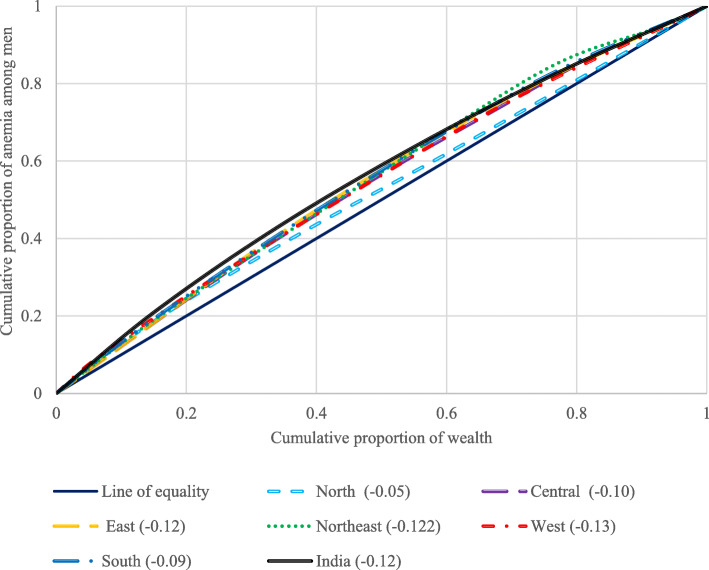
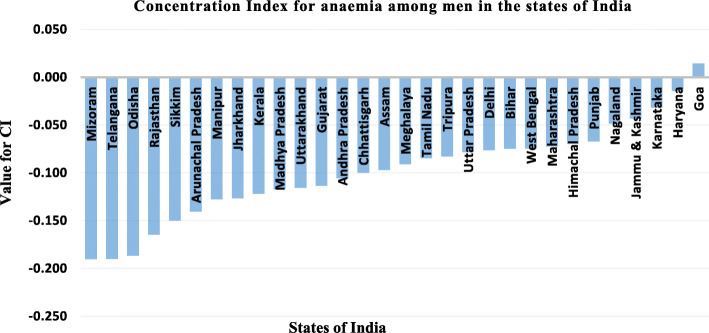
The fourth round of National Family Health Survey is used to fulfill the study objectives. The outcome variable of the study is men having anaemia or not. The study uses bivariate and multivariate techniques to identify the factors associated with the outcome variable. Further, concentration index and concentration curve are calculated to measure the socio-economic inequality in anaemia among men in India.
The results indicate that majority of the socio-economic related inequality is explained by wealth quintile followed by geographical regions of India, body mass index and educational attainment. The results also emphasize that older men belong to the high-risk groups. Moreover, the likelihood of anaemia is 40% more likely among men who belonged to East region and 25%, 13% and 7 % less likely among those who belonged to Northeast, West and South region compared to those who belonged in the North region of the country.
Existing policies on anaemia should include men to achieve an anaemia free India. Individual education and awareness should be encouraged to improve nutritional status.
在印度,营养不良是一个严重的公共卫生问题。现有研究、政策和方案侧重于妇女和儿童,从而在决策中忽视了男性。本研究考察了印度男性贫血水平的社会经济不平等,并试图分解背后的因素。
本研究使用了第四轮国家家庭健康调查来实现研究目标。研究的因变量是男性是否患有贫血。本研究使用双变量和多变量技术来确定与因变量相关的因素。此外,还计算了集中指数和集中曲线,以衡量印度男性贫血的社会经济不平等。
结果表明,大多数与社会经济相关的不平等是由财富五分位数解释的,其次是印度的地理区域、体重指数和教育程度。结果还强调,年龄较大的男性属于高风险群体。此外,与属于该国北部地区的男性相比,属于东部地区的男性患贫血的可能性高 40%,属于东北地区、西部地区和南部地区的男性患贫血的可能性分别低 25%、13%和 7%。
现有的贫血政策应包括男性,以实现无贫血的印度。应鼓励个人接受教育和提高认识,以改善营养状况。