GOS Institute of Child Health, University College London (UCL), 30 Guildford Street, London WC1 1EH, UK.
Institute of Environmental Medicine, Karolinska Institutet, 17177 Stockholm, Sweden.
Int J Environ Res Public Health. 2017 Dec 25;15(1):26. doi: 10.3390/ijerph15010026.
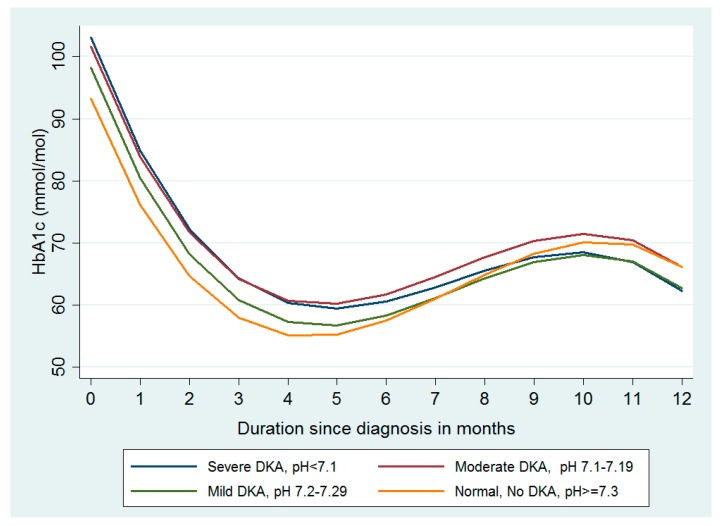
It is unclear whether diabetic ketoacidosis (DKA) severity at diagnosis affects the natural history of type 1 diabetes (T1D). We analysed associations between DKA severity at diagnosis and glycaemic control during the first year post-diagnosis. We followed 341 children with T1D, <19 years (64% non-white) attending paediatric diabetes clinics in East London. Data were extracted from routine medical registers. Subjects were categorized with normal, mild, moderate, or severe DKA. Linear mixed-effects modelling was used to assess differences in longitudinal HbA1 trajectories (glycaemic control) during 12 months post-diagnosis (1288 HbA1 data-points) based on DKA, adjusting for sex, age, ethnicity, SES (Socioeconomic Status) and treatment type. Females (OR 1.6, 95% CI 1.1-2.4) and younger age, 0-6 vs. 13-18 years (OR 2.9, 95% CI 1.5-5.6) had increased risk for DKA at diagnosis. Moderate or severe DKA was associated with higher HbA1 at diagnosis (adjusted estimates 8 mmol/mol, 2-14, and 10 mmol/mol, 4-15, respectively, compared to normal DKA). Differences in HbA1 trajectories by DKA were no longer apparent at six months post-diagnosis. All subjects experienced a steep decrease in HbA1 during the first three months followed by a gradual increase. While, DKA severity was not associated with glycaemic control at 12 months post-diagnosis, age at diagnosis, ethnicity, gender, and treatment type were significantly associated. For example, Black and mixed ethnicity children had increased risk for poor glycaemic control compared to White children (adjusted RRR 5.4, 95% CI 1.7-17.3 and RRR 2.5, 95% CI 1.2-6.0, respectively). DKA severity at diagnosis is associated with higher initial HbA1 but not glycaemic control from six months post-diagnosis. Age at diagnosis, ethnicity, gender, and insulin pump are associated with glycaemic control at one year post-diagnosis.
目前尚不清楚诊断时糖尿病酮症酸中毒(DKA)的严重程度是否会影响 1 型糖尿病(T1D)的自然病程。我们分析了诊断时 DKA 的严重程度与诊断后第一年血糖控制之间的关系。我们对 341 名年龄在 19 岁以下(64%为非白人)的东伦敦儿科糖尿病诊所的 T1D 患者进行了随访。数据从常规医疗记录中提取。根据 DKA 将患者分为正常、轻度、中度或重度 DKA。使用线性混合效应模型评估了诊断后 12 个月(1288 个 HbA1 数据点)纵向 HbA1 轨迹(血糖控制)的差异,调整了性别、年龄、种族、SES(社会经济地位)和治疗类型。女性(OR1.6,95%CI1.1-2.4)和年龄较小(0-6 岁与 13-18 岁相比,OR2.9,95%CI1.5-5.6)的患者 DKA 诊断风险增加。中度或重度 DKA 与较高的 HbA1 诊断相关(调整后的估计值分别为 8mmol/mol,2-14 和 10mmol/mol,4-15)与正常 DKA 相比)。在诊断后 6 个月时,DKA 对 HbA1 轨迹的影响不再明显。所有患者在最初的三个月内 HbA1 急剧下降,然后逐渐增加。尽管 DKA 严重程度与诊断后 12 个月的血糖控制无关,但年龄、种族、性别和治疗类型与血糖控制显著相关。例如,与白人儿童相比,黑人和混血儿儿童的血糖控制不良风险增加(调整后的 RR25,95%CI1.2-6.0)。诊断时 DKA 的严重程度与较高的初始 HbA1 相关,但与诊断后 6 个月后的血糖控制无关。诊断时的年龄、种族、性别和胰岛素泵与诊断后 1 年的血糖控制相关。