Department of Anesthesia, Division of Pain Management, Cincinnati Children's Hospital Medical Center, 3333 Burnet Ave MLC 6016, Cincinnati, OH, 45229, USA.
Department of Pediatrics, University of Cincinnati, Cincinnati, OH, 45229, USA.
Biol Sex Differ. 2018 Jan 3;9(1):2. doi: 10.1186/s13293-017-0163-5.
Chronic pain conditions are more prevalent in women, but most preclinical studies into mechanisms of pain generation are performed using male animals. Furthermore, whereas group III and IV nociceptive muscle afferents provoke central sensitization more effectively than their cutaneous counterparts, less is known about this critical population of muscle nociceptors. Here, we compare the physiology of individual muscle afferents in uninjured males and females. We then characterize the molecular, physiological, and behavioral effects of transient ischemia and reperfusion injury (I/R), a model we have extensively studied in males and in females.
Response properties and phenotypes to mechanical, thermal, and chemical stimulation were compared using an ex vivo muscle/nerve/dorsal root ganglia (DRG)/spinal cord recording preparation. Analyses of injury-related changes were also performed by assaying evoked and spontaneous pain-related behaviors, as well as mRNA expression of the affected muscle and DRGs. The appropriate analyses of variance and post hoc tests (with false discovery rate corrections when needed) were performed for each measure.
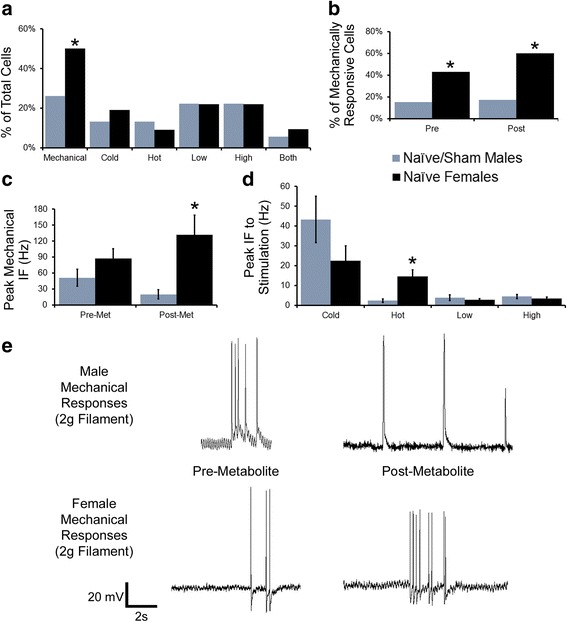
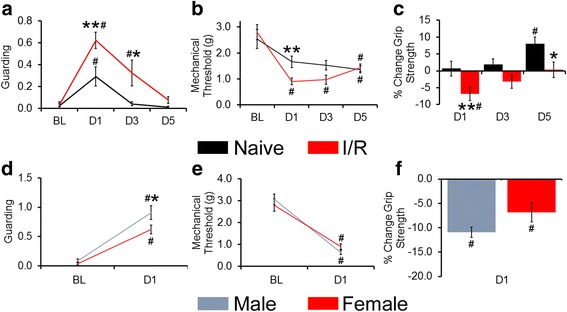
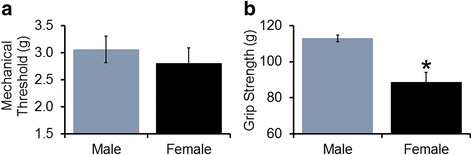
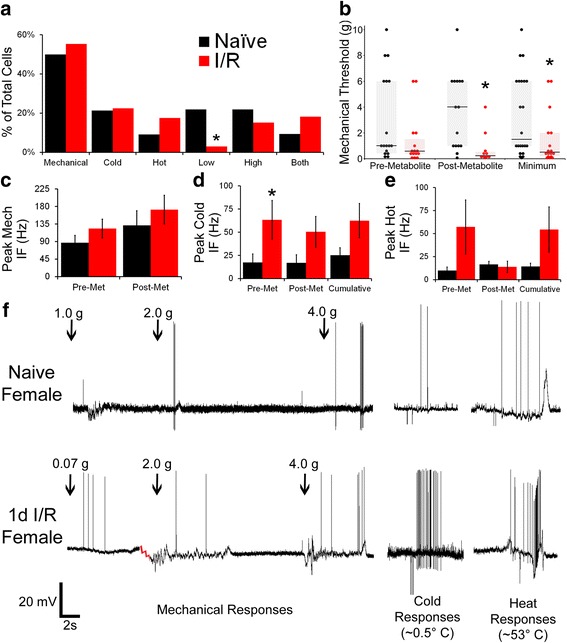
Females have more mechanically sensitive muscle afferents and show greater mechanical and thermal responsiveness than what is found in males. With I/R, both sexes show fewer cells responsive to an innocuous metabolite solution (ATP, lactic acid, and protons), and lower mechanical thresholds in individual afferents; however, females also possess altered thermal responsiveness, which may be related to sex-dependent changes in gene expression within the affected DRGs. Regardless, both sexes show similar increases in I/R-induced pain-like behaviors.
Here, we illustrate a unique phenomenon wherein discrete, sex-dependent mechanisms of primary muscle afferent sensitization after ischemic injury to the periphery may underlie similar behavioral changes between the sexes. Furthermore, although the group III and IV muscle afferents are fully developed functionally, the differential mechanisms of sensitization manifest prior to sexual maturity. Hence, this study illustrates the pressing need for further exploration of sex differences in afferent function throughout the lifespan for use in developing appropriately targeted pain therapies.
慢性疼痛病症在女性中更为普遍,但大多数有关疼痛产生机制的临床前研究都是使用雄性动物进行的。此外,虽然第三和第四类伤害感受性肌传入纤维比其皮肤对应物更有效地引发中枢敏化,但对于这一关键的肌伤害感受器群体,人们知之甚少。在这里,我们比较了未受伤雄性和雌性个体的肌肉传入纤维的生理学特性。然后,我们描述了短暂性缺血再灌注损伤(I/R)的分子、生理和行为效应,这是我们在雄性和雌性中都广泛研究过的模型。
使用离体肌肉/神经/背根神经节(DRG)/脊髓记录制备,比较了机械、热和化学刺激的反应特性和表型。还通过检测与损伤相关的疼痛相关行为,以及受影响肌肉和 DRG 的 mRNA 表达,分析了与损伤相关的变化。对每种测量值都进行了适当的方差分析和事后检验(需要时进行虚假发现率校正)。
与男性相比,女性具有更多的机械敏感性肌传入纤维,表现出更大的机械和热反应性。在 I/R 后,两种性别都显示出对无害代谢物溶液(ATP、乳酸和质子)的反应细胞减少,个体传入纤维的机械阈值降低;然而,女性还表现出热反应性改变,这可能与 DRG 内性别依赖性基因表达变化有关。无论如何,两种性别都表现出相似的 I/R 诱导的痛觉行为增加。
在这里,我们说明了一个独特的现象,即在周围组织缺血性损伤后,初级肌传入纤维敏化的离散的、性别依赖性机制可能是导致两性之间类似行为变化的基础。此外,尽管第三和第四类肌传入纤维在功能上已完全发育,但敏化的差异机制在性成熟之前就表现出来了。因此,这项研究说明了迫切需要在整个生命周期中进一步探索传入纤维功能的性别差异,以用于开发针对性疼痛治疗的适当靶向治疗。