School of Chinese Herbal Medicine, Guangzhou University of Chinese Medicine, Waihuang East Road No. 232, Guangzhou Higher Education Mega Center, Guangzhou, 510006 China.
Innovative Research & Development Laboratory of TCM, Guangzhou University of Chinese Medicine, Guangzhou, 510006 China.
Cell Mol Biol Lett. 2017 Dec 27;22:31. doi: 10.1186/s11658-017-0066-9. eCollection 2017.
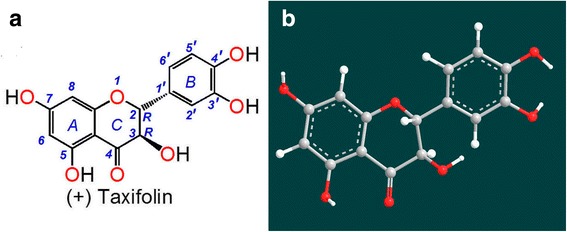
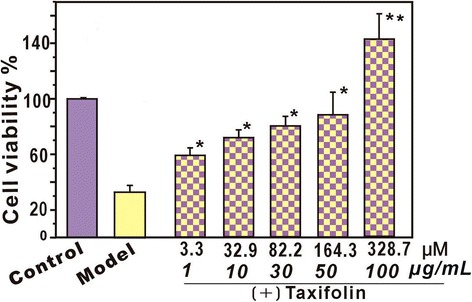
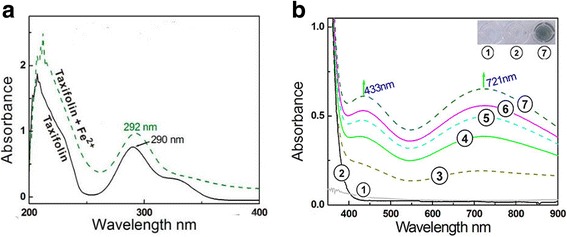
The natural dihydroflavonol (+) taxifolin was investigated for its protective effect on Fenton reagent-treated bone marrow-derived mesenchymal stem cells (bmMSCs). Various antioxidant assays were used to determine the possible mechanism. These included •OH-scavenging, 2-phenyl-4, 4, 5, 5-tetramethylimidazoline-1-oxyl-3-oxide radical-scavenging (PTIO•-scavenging), 1, 1-diphenyl-2-picryl-hydrazl radical-scavenging (DPPH•-scavenging), 2, 2'-azino-bis (3-ethylbenzo-thiazoline-6-sulfonic acid) radical-scavenging (ABTS•-scavenging), Fe-reducing, and Cu-reducing assays. The Fe-binding reaction was also investigated using UV-Vis spectra. The results revealed that cell viability was fully restored, even increasing to 142.9 ± 9.3% after treatment with (+) taxifolin. In the antioxidant assays, (+) taxifolin was observed to efficiently scavenge •OH, DPPH• and ABTS• radicals, and to increase the relative Cu- and Fe-reducing levels. In the PTIO•-scavenging assay, its IC values varied with pH. In the Fe-binding reaction, (+) taxifolin was found to yield a green solution with two UV-Vis absorbance peaks: λ = 433 nm (ε =5.2 × 10 L mol cm ) and λ = 721 nm (ε = 5.1 × 10 L mol cm ). These results indicate that (+) taxifolin can act as an effective •OH-scavenger, protecting bmMSCs from •OH-induced damage. Its •OH-scavenging action consists of direct and indirect antioxidant effects. Direct antioxidation occurs via multiple pathways, including ET, PCET or HAT. Indirect antioxidation involves binding to Fe.
天然二氢黄酮醇(+)taxifolin 被研究其对 Fenton 试剂处理的骨髓间充质干细胞(bmMSCs)的保护作用。使用各种抗氧化测定来确定可能的机制。这些包括·OH 清除,2-苯-4,4,5,5-四甲基咪唑啉-1-氧-3-氧化物自由基清除(PTIO·-清除),1,1-二苯基-2-苦基肼基自由基清除(DPPH·-清除),2,2'-联氮-双(3-乙基苯并噻唑啉-6-磺酸)自由基清除(ABTS·-清除),Fe 还原和 Cu 还原测定。还使用紫外可见光谱研究了 Fe 结合反应。结果表明,即使在用(+)taxifolin 处理后,细胞活力也完全恢复,甚至增加到 142.9±9.3%。在抗氧化测定中,观察到(+)taxifolin 能够有效地清除·OH,DPPH·和 ABTS·自由基,并增加相对的 Cu 和 Fe 还原水平。在 PTIO·-清除测定中,其 IC 值随 pH 而变化。在 Fe 结合反应中,发现(+)taxifolin 产生具有两个紫外可见吸收峰的绿色溶液:λ=433nm(ε=5.2×10 L mol cm)和λ=721nm(ε=5.1×10 L mol cm)。这些结果表明(+)taxifolin 可以作为有效的·OH 清除剂,保护 bmMSCs 免受·OH 诱导的损伤。其·OH 清除作用包括直接和间接抗氧化作用。直接抗氧化作用通过多种途径发生,包括 ET、PCET 或 HAT。间接抗氧化作用涉及与 Fe 的结合。