Bahbahani Hussain, Salim Bashir, Almathen Faisal, Al Enezi Fahad, Mwacharo Joram M, Hanotte Olivier
Department of Biological Sciences, Faculty of Science, Kuwait University, Kuwait city, Kuwait.
Department of Parasitology, Faculty of Veterinary Medicine, University of Khartoum Khartoum North, Sudan.
PLoS One. 2018 Jan 4;13(1):e0190446. doi: 10.1371/journal.pone.0190446. eCollection 2018.
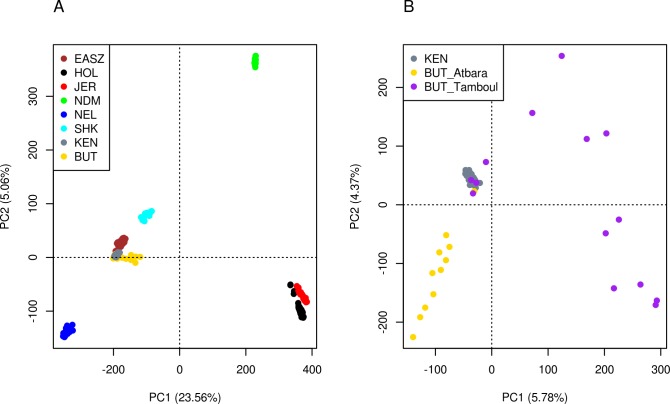
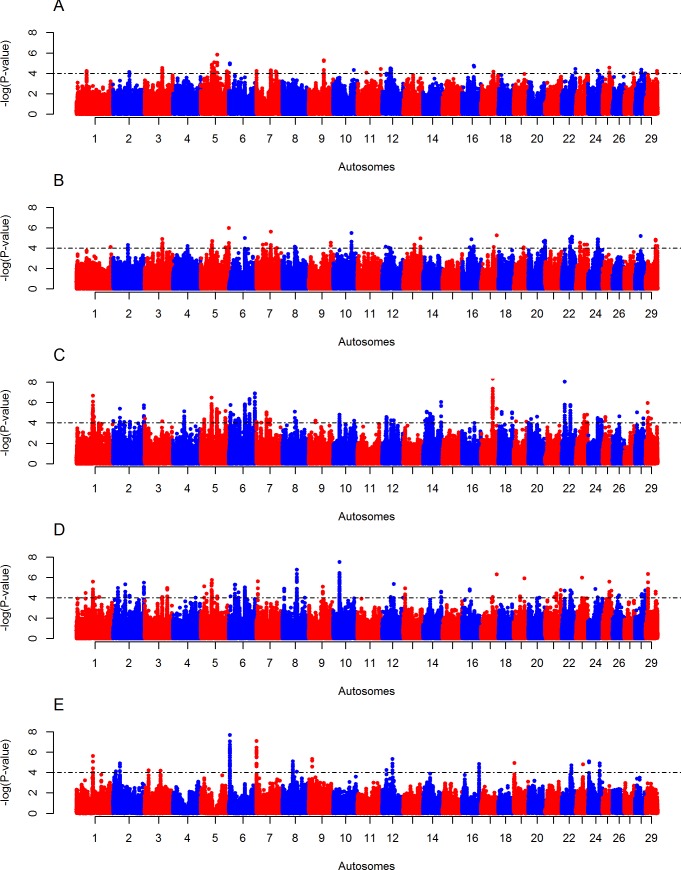
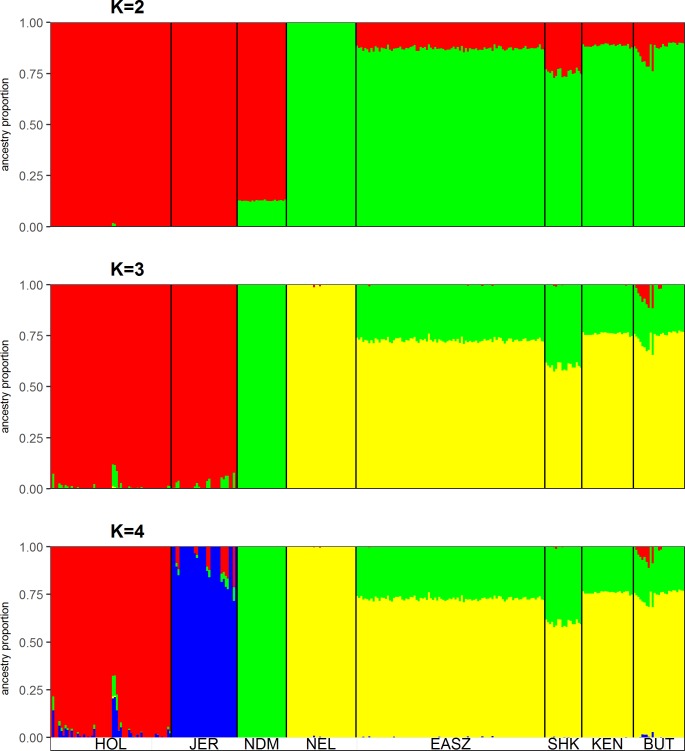
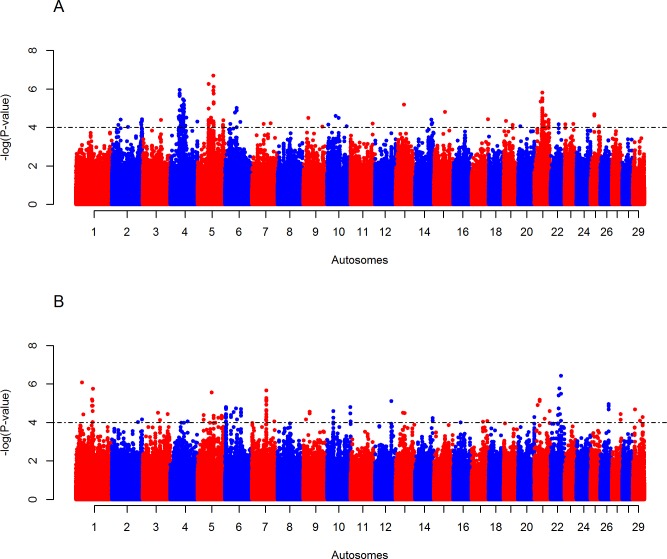
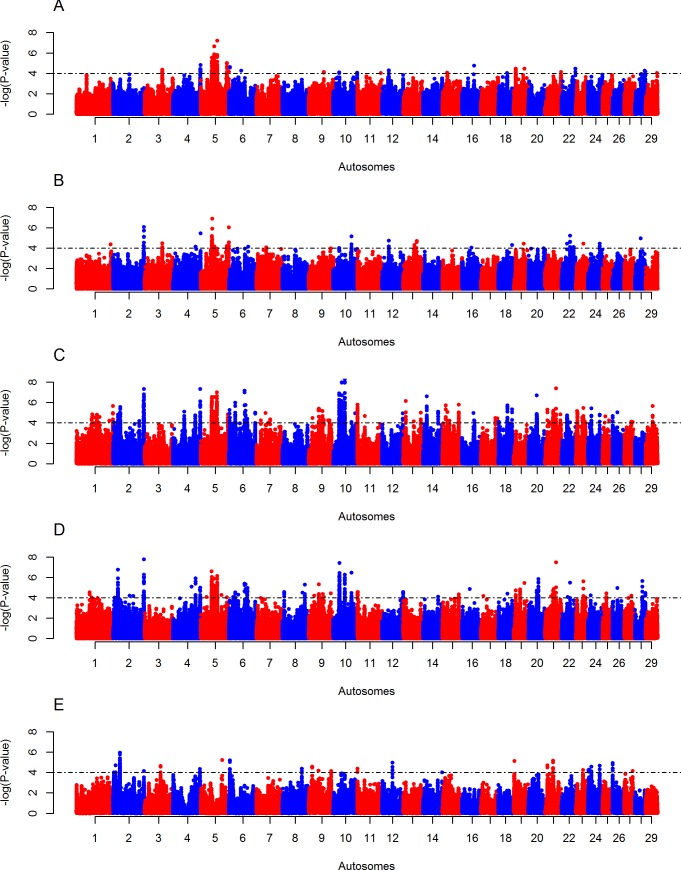
Butana and Kenana are two types of zebu cattle found in Sudan. They are unique amongst African indigenous zebu cattle because of their high milk production. Aiming to understand their genome structure, we genotyped 25 individuals from each breed using the Illumina BovineHD Genotyping BeadChip. Genetic structure analysis shows that both breeds have an admixed genome composed of an even proportion of indicine (0.75 ± 0.03 in Butana, 0.76 ± 0.006 in Kenana) and taurine (0.23 ± 0.009 in Butana, 0.24 ± 0.006 in Kenana) ancestries. We also observe a proportion of 0.02 to 0.12 of European taurine ancestry in ten individuals of Butana that were sampled from cattle herds in Tamboul area suggesting local crossbreeding with exotic breeds. Signatures of selection analyses (iHS and Rsb) reveal 87 and 61 candidate positive selection regions in Butana and Kenana, respectively. These regions span genes and quantitative trait loci (QTL) associated with biological pathways that are important for adaptation to marginal environments (e.g., immunity, reproduction and heat tolerance). Trypanotolerance QTL are intersecting candidate regions in Kenana cattle indicating selection pressure acting on them, which might be associated with an unexplored level of trypanotolerance in this cattle breed. Several dairy traits QTL are overlapping the identified candidate regions in these two zebu cattle breeds. Our findings underline the potential to improve dairy production in the semi-arid pastoral areas of Africa through breeding improvement strategy of indigenous local breeds.
布塔纳牛和凯纳纳牛是苏丹发现的两种瘤牛。它们在非洲本土瘤牛中独具特色,因为产奶量高。为了解它们的基因组结构,我们使用Illumina BovineHD基因分型芯片对每个品种的25头牛进行了基因分型。遗传结构分析表明,这两个品种都有一个混合基因组,由印度瘤牛血统(布塔纳牛为0.75±0.03,凯纳纳牛为0.76±0.006)和欧洲牛血统(布塔纳牛为0.23±0.009,凯纳纳牛为0.24±0.006)均匀混合而成。我们还在从坦布尔地区牛群中采样的10头布塔纳牛个体中观察到欧洲牛血统比例为0.02至0.12,这表明与外来品种存在本地杂交。选择分析(iHS和Rsb)的结果分别在布塔纳牛和凯纳纳牛中揭示了87个和61个候选正向选择区域。这些区域跨越了与适应边缘环境重要的生物学途径相关的基因和数量性状位点(QTL)(例如免疫、繁殖和耐热性)。抗锥虫病QTL是凯纳纳牛中的交叉候选区域,表明有选择压力作用于它们,这可能与该牛品种未被探索的抗锥虫病水平有关。几个奶牛性状QTL与这两个瘤牛品种中确定的候选区域重叠。我们的研究结果强调了通过改良本土地方品种的育种策略来提高非洲半干旱牧区奶牛生产的潜力。