Zhao Fuping, McParland Sinead, Kearney Francis, Du Lixin, Berry Donagh P
National Center for Molecular Genetics and Breeding of Animal, Institute of Animal Sciences, Chinese Academy of Agricultural Sciences, Beijing, 100193, China.
Animal and Grassland Research and Innovation Centre, Teagasc, Moorpark, Co., Cork, Ireland.
Genet Sel Evol. 2015 Jun 19;47(1):49. doi: 10.1186/s12711-015-0127-3.
Artificial selection for economically important traits in cattle is expected to have left distinctive selection signatures on the genome. Access to high-density genotypes facilitates the accurate identification of genomic regions that have undergone positive selection. These findings help to better elucidate the mechanisms of selection and to identify candidate genes of interest to breeding programs.
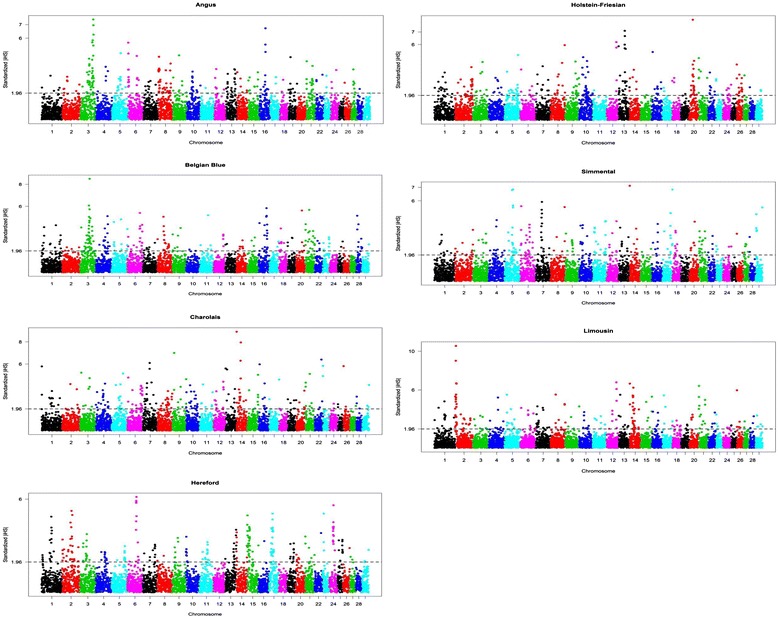
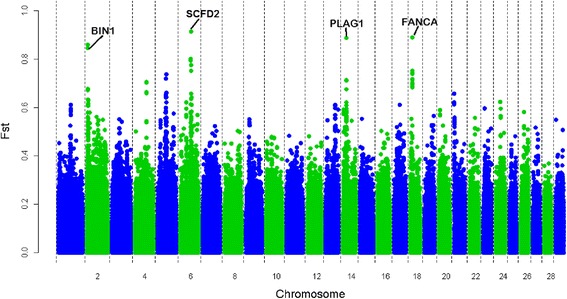
Information on 705 243 autosomal single nucleotide polymorphisms (SNPs) in 3122 dairy and beef male animals from seven cattle breeds (Angus, Belgian Blue, Charolais, Hereford, Holstein-Friesian, Limousin and Simmental) were used to detect selection signatures by applying two complementary methods, integrated haplotype score (iHS) and global fixation index (FST). To control for false positive results, we used false discovery rate (FDR) adjustment to calculate adjusted iHS within each breed and the genome-wide significance level was about 0.003. Using the iHS method, 83, 92, 91, 101, 85, 101 and 86 significant genomic regions were detected for Angus, Belgian Blue, Charolais, Hereford, Holstein-Friesian, Limousin and Simmental cattle, respectively. None of these regions was common to all seven breeds. Using the FST approach, 704 individual SNPs were detected across breeds. Annotation of the regions of the genome that showed selection signatures revealed several interesting candidate genes i.e. DGAT1, ABCG2, MSTN, CAPN3, FABP3, CHCHD7, PLAG1, JAZF1, PRKG2, ACTC1, TBC1D1, GHR, BMP2, TSG1, LYN, KIT and MC1R that play a role in milk production, reproduction, body size, muscle formation or coat color. Fifty-seven common candidate genes were found by both the iHS and global FST methods across the seven breeds. Moreover, many novel genomic regions and genes were detected within the regions that showed selection signatures; for some candidate genes, signatures of positive selection exist in the human genome. Multilevel bioinformatic analyses of the detected candidate genes suggested that the PPAR pathway may have been subjected to positive selection.
This study provides a high-resolution bovine genomic map of positive selection signatures that are either specific to one breed or common to a subset of the seven breeds analyzed. Our results will contribute to the detection of functional candidate genes that have undergone positive selection in future studies.
对牛的经济重要性状进行人工选择预计会在基因组上留下独特的选择印记。获取高密度基因型有助于准确识别经历正选择的基因组区域。这些发现有助于更好地阐明选择机制,并识别育种计划感兴趣的候选基因。
利用来自七个牛品种(安格斯牛、比利时蓝牛、夏洛莱牛、赫里福德牛、荷斯坦 - 弗里生牛、利木赞牛和西门塔尔牛)的3122头奶牛和肉牛雄性动物的705243个常染色体单核苷酸多态性(SNP)信息,通过应用两种互补方法,即整合单倍型分数(iHS)和全局固定指数(FST)来检测选择印记。为了控制假阳性结果,我们使用错误发现率(FDR)调整来计算每个品种内的调整后iHS,全基因组显著性水平约为0.003。使用iHS方法,分别在安格斯牛、比利时蓝牛、夏洛莱牛、赫里福德牛、荷斯坦 - 弗里生牛、利木赞牛和西门塔尔牛中检测到83、92、91、101、85、101和86个显著的基因组区域。这些区域在所有七个品种中没有一个是共同的。使用FST方法,在各品种间检测到704个个体SNP。对显示选择印记的基因组区域进行注释,发现了几个有趣的候选基因,即DGAT1、ABCG2、MSTN、CAPN3、FABP3、CHCHD7、PLAG1、JAZF1、PRKG2、ACTC1、TBC1D1、GHR、BMP2、TSG1、LYN、KIT和MC1R,它们在产奶、繁殖、体型、肌肉形成或毛色方面发挥作用。通过iHS和全局FST方法在七个品种中共同发现了57个候选基因。此外,在显示选择印记的区域内检测到许多新的基因组区域和基因;对于一些候选基因来说,在人类基因组中也存在正选择的印记。对检测到的候选基因进行的多层次生物信息学分析表明,PPAR途径可能受到了正选择。
本研究提供了一个高分辨率的牛基因组正选择印记图谱,这些印记要么特定于一个品种,要么在分析的七个品种的一个子集中是共同的。我们的结果将有助于在未来的研究中检测经历正选择的功能候选基因。