Li Cong, Cai Wentao, Zhou Chenghao, Yin Hongwei, Zhang Ziqi, Loor Juan J, Sun Dongxiao, Zhang Qin, Liu Jianfeng, Zhang Shengli
College of Animal Science and Technology, Key Laboratory of Animal Genetics and Breeding of Ministry of Agriculture, National Engineering Laboratory for Animal Breeding, China Agricultural University, Beijing 100193, China.
Department of Animal Sciences and Division of Nutritional Sciences, University of Illinois, Urbana, IL, 61801, USA.
Sci Rep. 2016 Jun 2;6:26813. doi: 10.1038/srep26813.
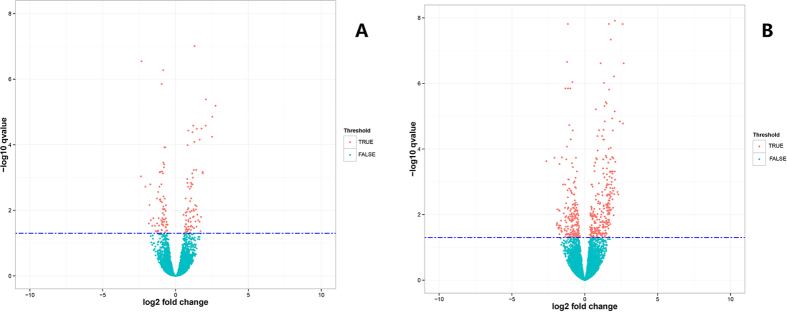
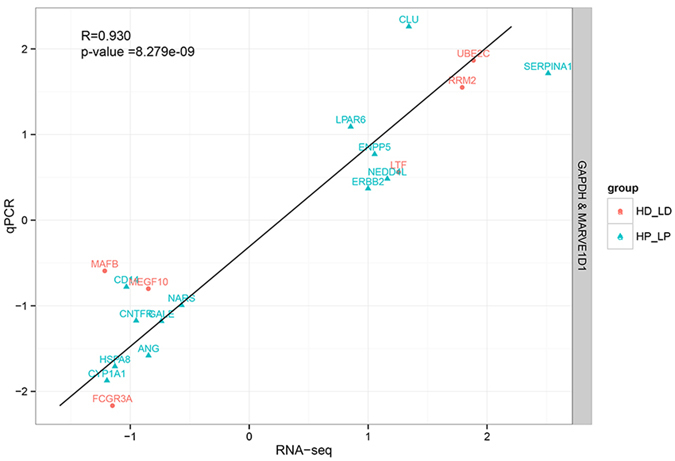
Paired-end RNA sequencing (RNA-Seq) was used to explore the bovine transcriptome from the mammary tissue of 12 Chinese Holstein cows with 6 extremely high and 6 low phenotypic values for milk protein percentage. We defined the differentially expressed transcripts between the two comparison groups, extremely high and low milk protein percentage during the peak lactation (HP vs LP) and during the non-lactating period (HD vs LD), respectively. Within the differentially expressed genes (DEGs), we detected 157 at peak lactation and 497 in the non-lactating period with a highly significant correlation with milk protein concentration. Integrated interpretation of differential gene expression indicated that SERPINA1, CLU, CNTFR, ERBB2, NEDD4L, ANG, GALE, HSPA8, LPAR6 and CD14 are the most promising candidate genes affecting milk protein concentration. Similarly, LTF, FCGR3A, MEGF10, RRM2 and UBE2C are the most promising candidates that in the non-lactating period could help the mammary tissue prevent issues with inflammation and udder disorders. Putative genes will be valuable resources for designing better breeding strategies to optimize the content of milk protein and also to provide new insights into regulation of lactogenesis.
采用双末端RNA测序(RNA-Seq)技术,对12头中国荷斯坦奶牛乳腺组织的转录组进行了研究,这些奶牛的乳蛋白率具有6个极高和6个极低的表型值。我们分别定义了两个比较组之间差异表达的转录本,即泌乳高峰期乳蛋白率极高和极低的组(HP vs LP)以及非泌乳期的组(HD vs LD)。在差异表达基因(DEG)中,我们在泌乳高峰期检测到157个,在非泌乳期检测到497个,它们与乳蛋白浓度高度相关。对差异基因表达的综合解读表明,丝氨酸蛋白酶抑制剂A1(SERPINA1)、簇集素(CLU)、睫状神经营养因子受体(CNTFR)、表皮生长因子受体2(ERBB2)、神经前体细胞表达发育下调蛋白4样蛋白(NEDD4L)、血管生成素(ANG)、半乳糖-3-表异构酶(GALE)、热休克蛋白家族A成员8(HSPA8)、溶血磷脂酸受体6(LPAR6)和脂多糖结合蛋白(CD14)是影响乳蛋白浓度最有前景的候选基因。同样,乳铁传递蛋白(LTF)、Fc段γ受体ⅢA(FCGR3A)、多表皮生长因子样蛋白10(MEGF10)、核糖核苷酸还原酶M2亚基(RRM2)和泛素结合酶E2C(UBE2C)是在非泌乳期最有前景的候选基因,它们可以帮助乳腺组织预防炎症和乳房疾病问题。推定基因将成为设计更好的育种策略以优化乳蛋白含量的宝贵资源,也为泌乳发生的调控提供新的见解。