• 文献检索
  • 文档翻译
  • 深度研究
  • 学术资讯
  • Suppr Zotero 插件Zotero 插件
  • 邀请有礼
  • 套餐&价格
  • 历史记录
应用&插件
Suppr Zotero 插件Zotero 插件浏览器插件Mac 客户端Windows 客户端微信小程序
定价
高级版会员购买积分包购买API积分包
服务
文献检索文档翻译深度研究API 文档MCP 服务
关于我们
关于 Suppr公司介绍联系我们用户协议隐私条款
关注我们

Suppr 超能文献

核心技术专利:CN118964589B侵权必究
粤ICP备2023148730 号-1Suppr @ 2026

文献检索

告别复杂PubMed语法,用中文像聊天一样搜索,搜遍4000万医学文献。AI智能推荐,让科研检索更轻松。

立即免费搜索

文件翻译

保留排版,准确专业,支持PDF/Word/PPT等文件格式,支持 12+语言互译。

免费翻译文档

深度研究

AI帮你快速写综述,25分钟生成高质量综述,智能提取关键信息,辅助科研写作。

立即免费体验

使用患者干细胞衍生神经元对精神障碍进行建模:一种前进的方法。

Modeling psychiatric disorders using patient stem cell-derived neurons: a way forward.

机构信息

Laboratory of Genetics, The Salk Institute for Biological Studies, 10010 North Torrey Pines Road, La Jolla, CA, 92037, USA.

出版信息

Genome Med. 2018 Jan 4;10(1):1. doi: 10.1186/s13073-017-0512-3.

DOI:10.1186/s13073-017-0512-3
PMID:29301565
原文链接:https://pmc.ncbi.nlm.nih.gov/articles/PMC5755287/
Abstract

Our understanding of the neurobiology of psychiatric disorders remains limited, and biomarker-based clinical management is yet to be developed. Induced pluripotent stem cell (iPSC) technology has revolutionized our capacity to generate patient-derived neurons to model psychiatric disorders. Here, we highlight advantages and caveats of iPSC disease modeling and outline strategies for addressing current challenges.

摘要

我们对精神疾病的神经生物学的理解仍然有限,基于生物标志物的临床管理尚待开发。诱导多能干细胞 (iPSC) 技术极大地提高了我们生成患者来源神经元以模拟精神疾病的能力。在这里,我们强调了 iPSC 疾病建模的优点和注意事项,并概述了应对当前挑战的策略。
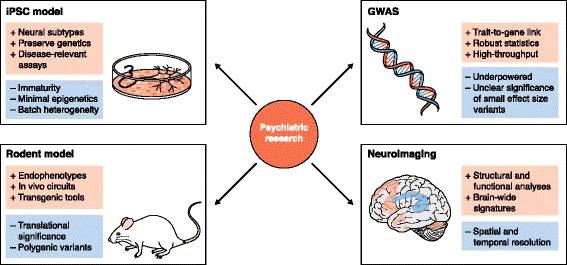
https://cdn.ncbi.nlm.nih.gov/pmc/blobs/2200/5755287/8bcab5864e8d/13073_2017_512_Fig1_HTML.jpg

相似文献

1
Modeling psychiatric disorders using patient stem cell-derived neurons: a way forward.使用患者干细胞衍生神经元对精神障碍进行建模:一种前进的方法。
Genome Med. 2018 Jan 4;10(1):1. doi: 10.1186/s13073-017-0512-3.
2
Modeling psychiatric disorders through reprogramming.通过重编程来模拟精神障碍。
Dis Model Mech. 2012 Jan;5(1):26-32. doi: 10.1242/dmm.008268. Epub 2011 Oct 4.
3
Transcriptomics analysis of iPSC-derived neurons and modeling of neuropsychiatric disorders.诱导多能干细胞衍生神经元的转录组学分析及神经精神疾病建模
Mol Cell Neurosci. 2016 Jun;73:32-42. doi: 10.1016/j.mcn.2015.11.009. Epub 2015 Nov 26.
4
Advancing drug discovery for neuropsychiatric disorders using patient-specific stem cell models.利用患者特异性干细胞模型推进神经精神疾病的药物研发。
Mol Cell Neurosci. 2016 Jun;73:104-15. doi: 10.1016/j.mcn.2016.01.011. Epub 2016 Jan 28.
5
Modeling psychiatric disorders: from genomic findings to cellular phenotypes.模拟精神疾病:从基因组发现到细胞表型
Mol Psychiatry. 2016 Sep;21(9):1167-79. doi: 10.1038/mp.2016.89. Epub 2016 May 31.
6
Modeling Psychiatric Diseases with Induced Pluripotent Stem Cells.诱导多能干细胞在精神疾病模型中的应用。
Adv Exp Med Biol. 2019;1192:297-312. doi: 10.1007/978-981-32-9721-0_15.
7
A new era of disease modeling and drug discovery using induced pluripotent stem cells.利用诱导多能干细胞进行疾病建模和药物发现的新时代。
Arch Pharm Res. 2017 Jan;40(1):1-12. doi: 10.1007/s12272-016-0871-0. Epub 2016 Dec 5.
8
Synaptic dysregulation in a human iPS cell model of mental disorders.精神疾病的人诱导多能干细胞模型中的突触失调。
Nature. 2014 Nov 20;515(7527):414-8. doi: 10.1038/nature13716. Epub 2014 Aug 17.
9
The human brain in a dish: the promise of iPSC-derived neurons.类器官中的人脑:诱导多能干细胞衍生神经元的前景。
Cell. 2011 Jun 10;145(6):831-4. doi: 10.1016/j.cell.2011.05.034.
10
Focus on Causality in ESC/iPSC-Based Modeling of Psychiatric Disorders.关注基于 ESC/iPSC 的精神疾病建模中的因果关系。
Cells. 2020 Feb 5;9(2):366. doi: 10.3390/cells9020366.

引用本文的文献

1
Tobacco smoke alters the trajectory of lung adenocarcinoma evolution via effects on somatic selection and epistasis.烟草烟雾通过对体细胞选择和上位性的影响改变肺腺癌的进化轨迹。
bioRxiv. 2025 Jul 25:2024.11.27.625765. doi: 10.1101/2024.11.27.625765.
2
Unfolded protein responses in T cell immunity.T细胞免疫中的未折叠蛋白反应。
Front Immunol. 2025 Jan 8;15:1515715. doi: 10.3389/fimmu.2024.1515715. eCollection 2024.
3
Induce Pluripotent Stem Cells (iPSC) Technology in Depression.诱导多能干细胞(iPSC)技术在抑郁症中的应用。

本文引用的文献

1
Microglia emerge as central players in brain disease.小胶质细胞成为大脑疾病的核心参与者。
Nat Med. 2017 Sep 8;23(9):1018-1027. doi: 10.1038/nm.4397.
2
The use of brain organoids to investigate neural development and disease.利用脑类器官研究神经发育与疾病。
Nat Rev Neurosci. 2017 Oct;18(10):573-584. doi: 10.1038/nrn.2017.107. Epub 2017 Sep 7.
3
An update on stem cell biology and engineering for brain development.脑发育的干细胞生物学和工程学研究进展。
Adv Exp Med Biol. 2024;1456:85-91. doi: 10.1007/978-981-97-4402-2_5.
4
Synaptic changes in psychiatric and neurological disorders: state-of-the art of in vivo imaging.精神神经疾病的突触变化:活体成像的最新技术。
Neuropsychopharmacology. 2024 Nov;50(1):164-183. doi: 10.1038/s41386-024-01943-x. Epub 2024 Aug 12.
5
Advances in current models on neurodegenerative diseases.当前神经退行性疾病模型的进展。
Front Bioeng Biotechnol. 2023 Nov 6;11:1260397. doi: 10.3389/fbioe.2023.1260397. eCollection 2023.
6
Morphological and transcriptomic analyses of stem cell-derived cortical neurons reveal mechanisms underlying synaptic dysfunction in schizophrenia.基于干细胞的皮质神经元的形态学和转录组学分析揭示了精神分裂症中突触功能障碍的潜在机制。
Genome Med. 2023 Jul 28;15(1):58. doi: 10.1186/s13073-023-01203-5.
7
Cross-Species Convergence of Brain Transcriptomic and Epigenomic Findings in Posttraumatic Stress Disorder: A Systematic Review.创伤后应激障碍中脑转录组学和表观基因组学研究结果的跨物种趋同:一项系统综述
Complex Psychiatry. 2023 Feb 3;9(1-4):100-118. doi: 10.1159/000529536. eCollection 2023 Jan-Dec.
8
Annotating functional effects of non-coding variants in neuropsychiatric cell types by deep transfer learning.通过深度迁移学习为神经精神细胞类型中的非编码变体的功能效应进行注释。
PLoS Comput Biol. 2022 May 16;18(5):e1010011. doi: 10.1371/journal.pcbi.1010011. eCollection 2022 May.
9
Mood Stabilizers in Psychiatric Disorders and Mechanisms Learnt from In Vitro Model Systems.精神障碍的心境稳定剂及体外模型系统研究中获得的机制
Int J Mol Sci. 2021 Aug 27;22(17):9315. doi: 10.3390/ijms22179315.
10
Altered Neuronal Support and Inflammatory Response in Bipolar Disorder Patient-Derived Astrocytes.双相情感障碍患者来源的星形胶质细胞中神经元支持和炎症反应的改变。
Stem Cell Reports. 2021 Apr 13;16(4):825-835. doi: 10.1016/j.stemcr.2021.02.004. Epub 2021 Mar 4.
Mol Psychiatry. 2017 Jun;22(6):808-819. doi: 10.1038/mp.2017.66. Epub 2017 Apr 4.
4
Pluripotent stem cells in neuropsychiatric disorders.神经精神疾病中的多能干细胞。
Mol Psychiatry. 2017 Sep;22(9):1241-1249. doi: 10.1038/mp.2017.40. Epub 2017 Mar 21.
5
Translating genome-wide association findings into new therapeutics for psychiatry.将全基因组关联研究结果转化为精神科的新疗法。
Nat Neurosci. 2016 Oct 26;19(11):1392-1396. doi: 10.1038/nn.4411.
6
Estimating the true global burden of mental illness.估算精神疾病的真实全球负担。
Lancet Psychiatry. 2016 Feb;3(2):171-8. doi: 10.1016/S2215-0366(15)00505-2.
7
Concise Review: Progress and Challenges in Using Human Stem Cells for Biological and Therapeutics Discovery: Neuropsychiatric Disorders.简要综述:利用人类干细胞进行生物学和治疗学发现(针对神经精神疾病)的进展与挑战
Stem Cells. 2016 Mar;34(3):523-36. doi: 10.1002/stem.2295. Epub 2016 Feb 11.
8
DSM-5 and RDoC: progress in psychiatry research?DSM-5 与 RDoC:精神病学研究的进展?
Nat Rev Neurosci. 2013 Nov;14(11):810-4. doi: 10.1038/nrn3621.