Ocean Biogeochemistry & Ecosystems Research Group, National Oceanography Centre, Southampton, United Kingdom.
Imaging and Analysis Centre, Science Facilities, Natural History Museum, London, United Kingdom.
PLoS Biol. 2018 Jan 5;16(1):e2003502. doi: 10.1371/journal.pbio.2003502. eCollection 2018 Jan.
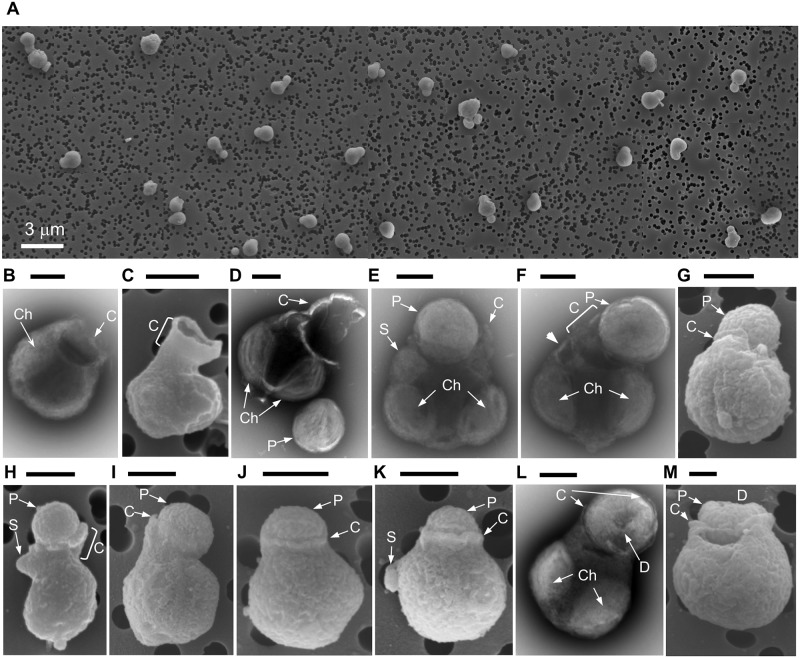
The smallest algae, less than 3 μm in diameter, are the most abundant eukaryotes of the World Ocean. Their feeding on planktonic bacteria of similar size is globally important but physically enigmatic. Tiny algal cells tightly packed with the voluminous chloroplasts, nucleus, and mitochondria appear to have insufficient organelle-free space for prey internalization. Here, we present the first direct observations of how the 1.3-μm algae, which are only 1.6 times bigger in diameter than their prey, hold individual Prochlorococcus cells in their open hemispheric cytostomes. We explain this semi-extracellular phagocytosis by the cell size limitation of the predatory alga, identified as the Braarudosphaera haptophyte with a nitrogen (N2)-fixing endosymbiont. Because the observed semi-extracellular phagocytosis differs from all other types of protistan phagocytosis, we propose to name it "pomacytosis" (from the Greek πώμα for "plug").
最小的藻类,直径小于 3μm,是世界海洋中最丰富的真核生物。它们以类似大小的浮游细菌为食,在全球范围内非常重要,但在物理上却很神秘。微小的藻类细胞与大量的叶绿体、细胞核和线粒体紧密堆积在一起,似乎没有足够的细胞器自由空间来进行猎物内化。在这里,我们首次直接观察到直径仅比猎物大 1.6 倍的 1.3μm 藻类如何在其开放的半球形胞口器中容纳单个聚球藻细胞。我们通过捕食藻类的细胞大小限制来解释这种半细胞外吞噬作用,这种藻类被确定为具有固氮内共生体的 Braarudosphaera 甲藻。因为观察到的半细胞外吞噬作用与所有其他类型的原生动物吞噬作用不同,所以我们提议将其命名为“pomacytosis”(来自希腊语 πώμα 意为“塞子”)。