Hu Menghan, Zhai Guangtao, Li Duo, Fan Yezhao, Duan Huiyu, Zhu Wenhan, Yang Xiaokang
Shanghai Institute for Advanced Communication and Data Science, Shanghai Key Laboratory of Digital Media Processing and Transmission, Shanghai Jiao Tong University, Shanghai, China.
PLoS One. 2018 Jan 5;13(1):e0190466. doi: 10.1371/journal.pone.0190466. eCollection 2018.
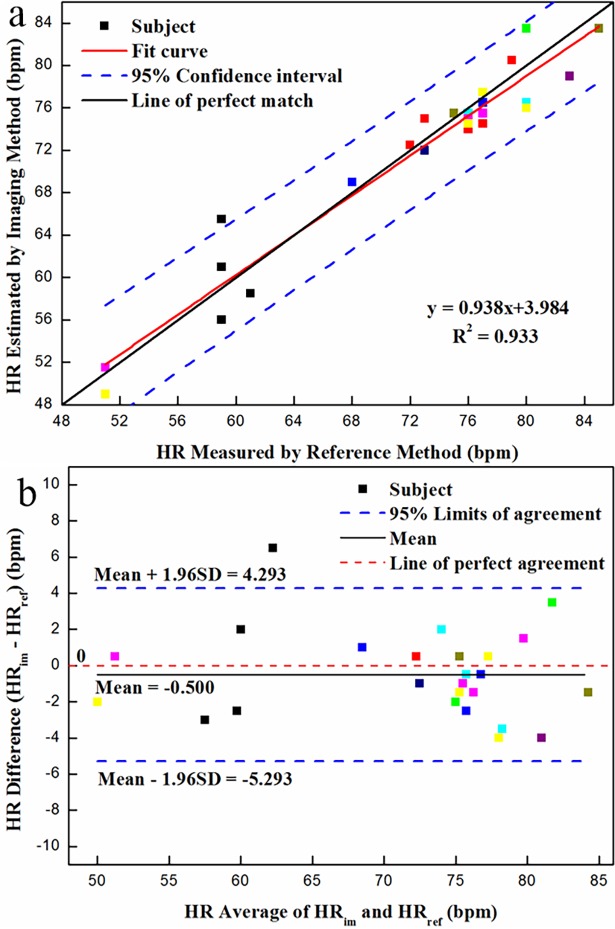
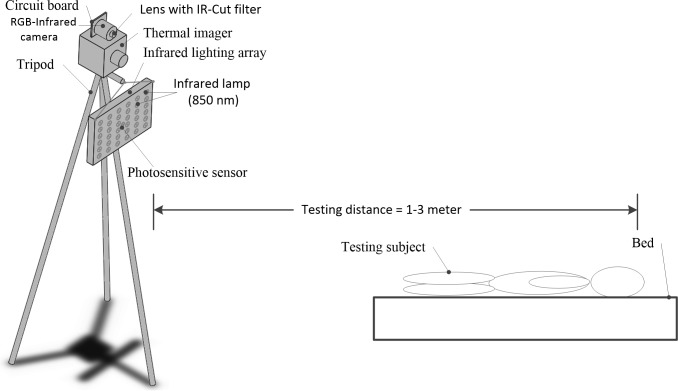
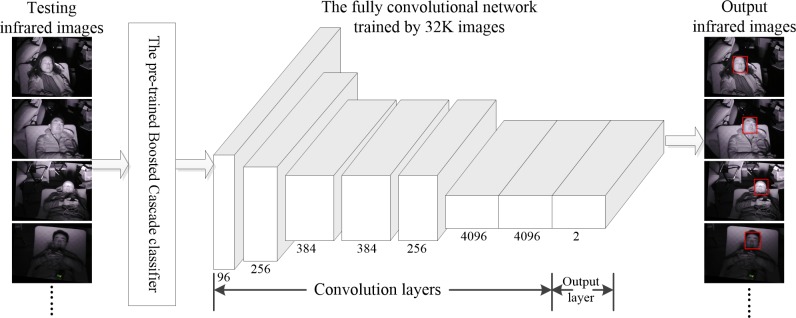
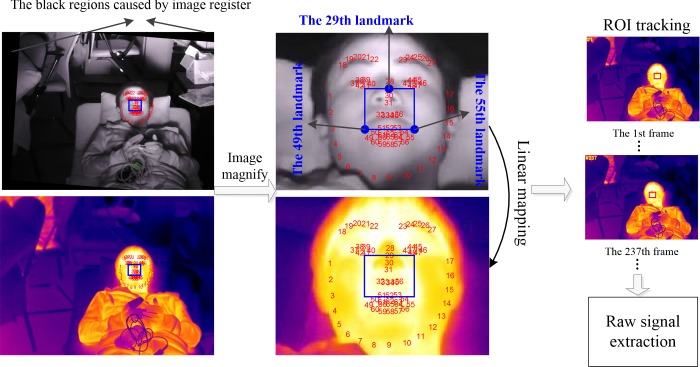
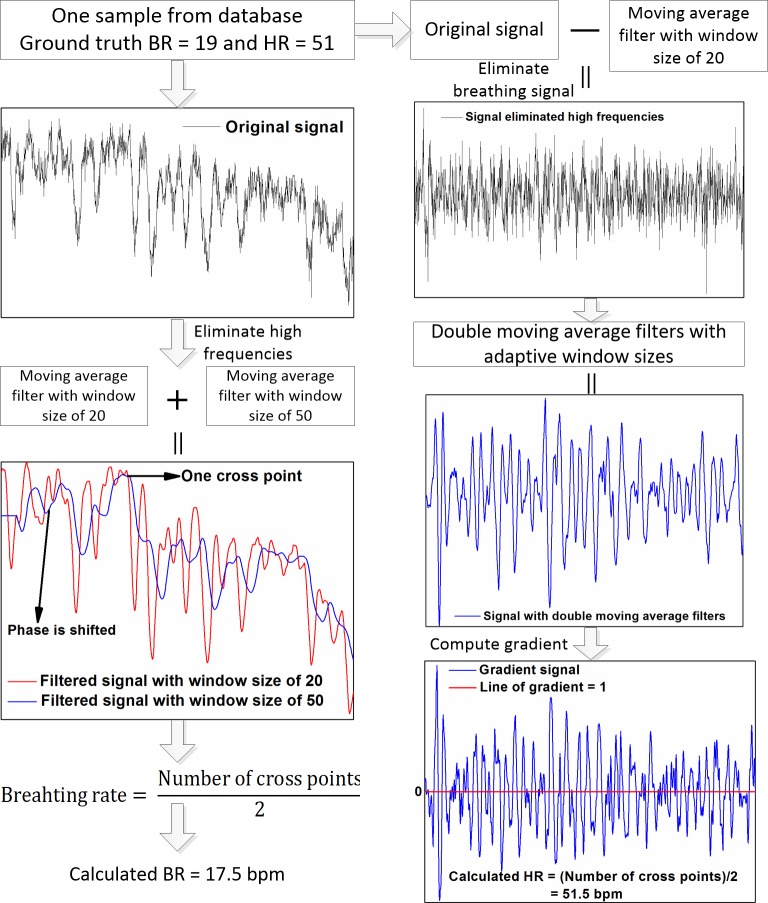
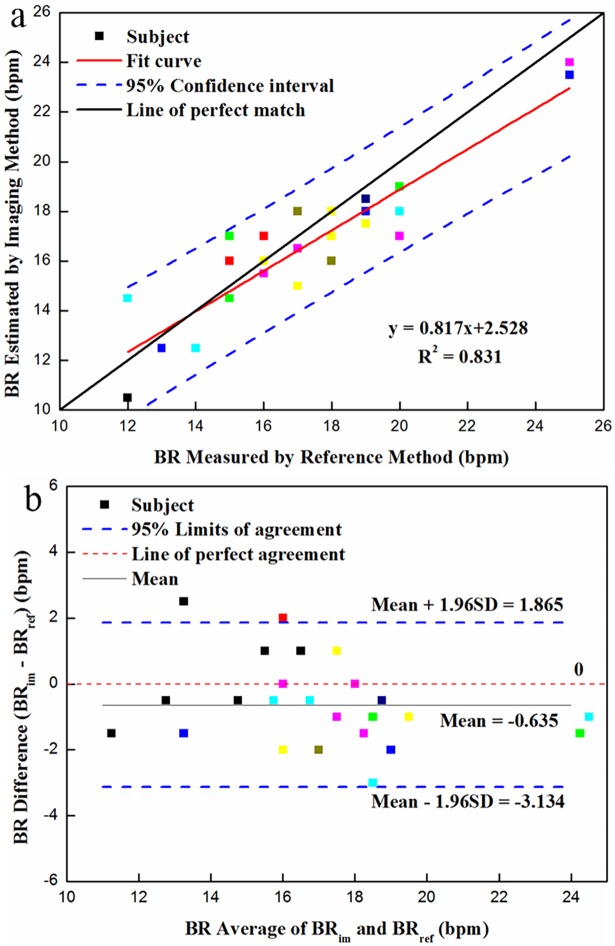
To achieve the simultaneous and unobtrusive breathing rate (BR) and heart rate (HR) measurements during nighttime, we leverage a far-infrared imager and an infrared camera equipped with IR-Cut lens and an infrared lighting array to develop a dual-camera imaging system. A custom-built cascade face classifier, containing the conventional Adaboost model and fully convolutional network trained by 32K images, was used to detect the face region in registered infrared images. The region of interest (ROI) inclusive of mouth and nose regions was afterwards confirmed by the discriminative regression and coordinate conversions of three selected landmarks. Subsequently, a tracking algorithm based on spatio-temporal context learning was applied for following the ROI in thermal video, and the raw signal was synchronously extracted. Finally, a custom-made time-domain signal analysis approach was developed for the determinations of BR and HR. A dual-mode sleep video database, including the videos obtained under environment where illumination intensity ranged from 0 to 3 Lux, was constructed to evaluate the effectiveness of the proposed system and algorithms. In linear regression analysis, the determination coefficient (R2) of 0.831 had been observed for the measured BR and reference BR, and this value was 0.933 for HR measurement. In addition, the Bland-Altman plots of BR and HR demonstrated that almost all the data points located within their own 95% limits of agreement. Consequently, the overall performance of the proposed technique is acceptable for BR and HR estimations during nighttime.
为了在夜间同时且不引人注意地测量呼吸率(BR)和心率(HR),我们利用一台远红外成像仪和一台配备红外截止镜头及红外照明阵列的红外摄像机,开发了一种双摄像机成像系统。使用一个定制的级联面部分类器,其包含传统的Adaboost模型和由32K图像训练的全卷积网络,来检测配准红外图像中的面部区域。随后,通过对三个选定地标进行判别回归和坐标转换,确认包含嘴巴和鼻子区域的感兴趣区域(ROI)。接着,应用基于时空上下文学习的跟踪算法在热视频中跟踪ROI,并同步提取原始信号。最后,开发了一种定制的时域信号分析方法来确定BR和HR。构建了一个双模睡眠视频数据库,包括在光照强度范围为0至3勒克斯的环境下获取的视频,以评估所提出系统和算法的有效性。在线性回归分析中,测量的BR与参考BR的决定系数(R2)为0.831,HR测量的该值为0.933。此外,BR和HR的布兰德 - 奥特曼图表明,几乎所有数据点都位于其各自的95%一致性界限内。因此,所提出技术的整体性能对于夜间BR和HR估计是可接受的。