Department of Cognitive Science and Artificial Intelligence, Tilburg University, Tilburg, The Netherlands.
Donor Medicine Research, Sanquin Research, Amsterdam, The Netherlands.
Sci Rep. 2023 Jun 14;13(1):9667. doi: 10.1038/s41598-023-36207-z.
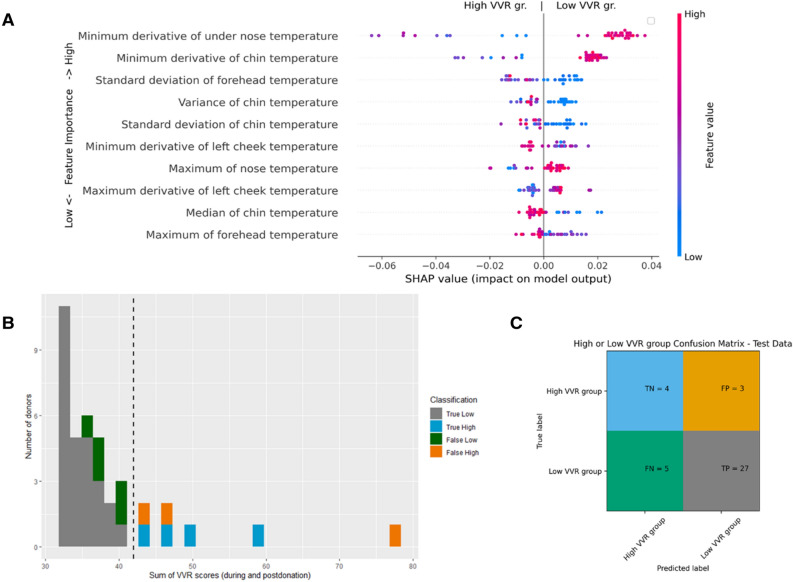
Around one-third of adults are scared of needles, which can result in adverse emotional and physical responses such as dizziness and fainting (e.g. vasovagal reactions; VVR) and consequently, avoidance of healthcare, treatments, and immunizations. Unfortunately, most people are not aware of vasovagal reactions until they escalate, at which time it is too late to intervene. This study aims to investigate whether facial temperature profiles measured in the waiting room, prior to a blood donation, can be used to classify who will and will not experience VVR during the donation. Average temperature profiles from six facial regions were extracted from pre-donation recordings of 193 blood donors, and machine learning was used to classify whether a donor would experience low or high levels of VVR during the donation. An XGBoost classifier was able to classify vasovagal groups from an adverse reaction during a blood donation based on this early facial temperature data, with a sensitivity of 0.87, specificity of 0.84, F1 score of 0.86, and PR-AUC of 0.93. Temperature fluctuations in the area under the nose, chin and forehead have the highest predictive value. This study is the first to demonstrate that it is possible to classify vasovagal responses during a blood donation using temperature profiles.
约三分之一的成年人害怕打针,这可能导致头晕和昏厥等不良的情绪和身体反应(例如,血管迷走性反应;VVR),进而导致他们回避医疗保健、治疗和免疫接种。不幸的是,大多数人直到反应升级时才意识到血管迷走性反应,此时为时已晚,无法进行干预。本研究旨在探讨在献血前的等候室中测量的面部温度谱是否可用于对献血期间是否会发生 VVR 进行分类。从 193 名献血者的献血前记录中提取了来自六个面部区域的平均温度谱,并使用机器学习来对献血过程中 VVR 发生的高低水平进行分类。XGBoost 分类器能够基于该早期面部温度数据对献血期间发生的血管迷走反应组进行分类,灵敏度为 0.87,特异性为 0.84,F1 得分为 0.86,PR-AUC 为 0.93。鼻子、下巴和前额下方区域的温度波动具有最高的预测价值。这项研究首次证明,使用温度谱可以对献血期间的血管迷走反应进行分类。