Department of Psychology, University of Pennsylvania, Philadelphia, PA 19104, USA.
Department of Psychology, Drexel University, Philadelphia, PA 19104, USA; Department of Neurology, Perelman School of Medicine, University of Pennsylvania, Philadelphia, PA 19104, USA.
Neuropsychologia. 2018 Sep;118(Pt A):79-90. doi: 10.1016/j.neuropsychologia.2018.01.001. Epub 2018 Jan 4.
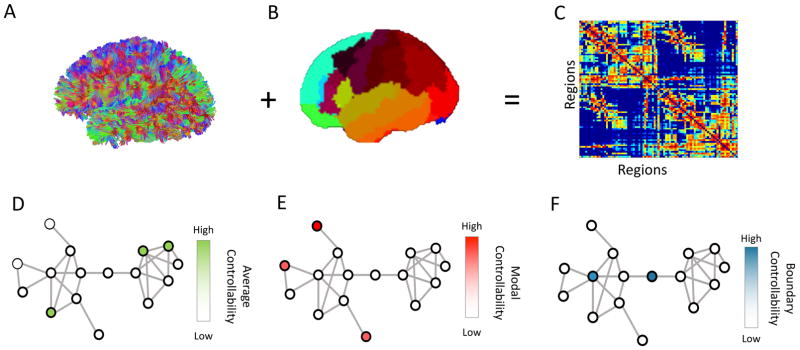
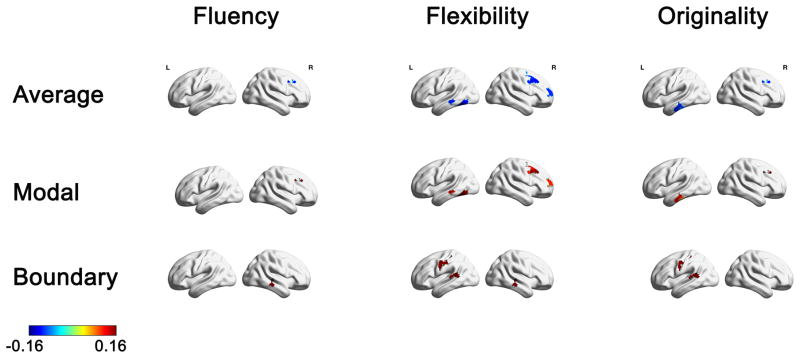
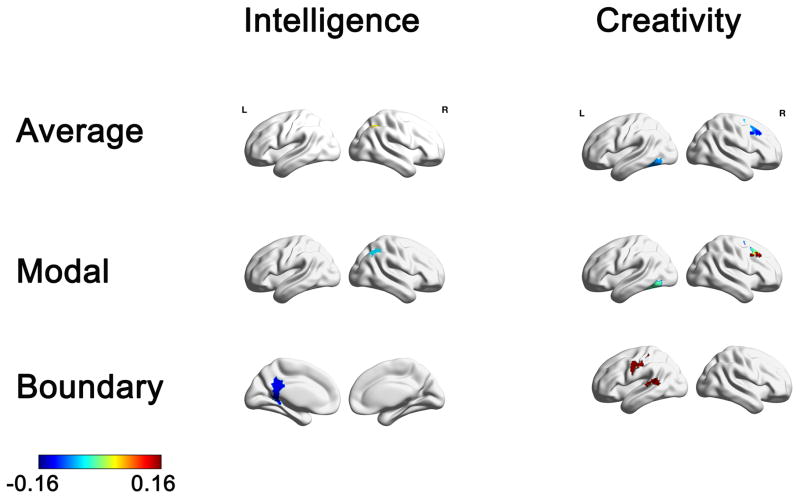
High-level cognitive constructs, such as creativity and intelligence, entail complex and multiple processes, including cognitive control processes. Recent neurocognitive research on these constructs highlight the importance of dynamic interaction across neural network systems and the role of cognitive control processes in guiding such a dynamic interaction. How can we quantitatively examine the extent and ways in which cognitive control contributes to creativity and intelligence? To address this question, we apply a computational network control theory (NCT) approach to structural brain imaging data acquired via diffusion tensor imaging in a large sample of participants, to examine how NCT relates to individual differences in distinct measures of creative ability and intelligence. Recent application of this theory at the neural level is built on a model of brain dynamics, which mathematically models patterns of inter-region activity propagated along the structure of an underlying network. The strength of this approach is its ability to characterize the potential role of each brain region in regulating whole-brain network function based on its anatomical fingerprint and a simplified model of node dynamics. We find that intelligence is related to the ability to "drive" the brain system into easy to reach neural states by the right inferior parietal lobe and lower integration abilities in the left retrosplenial cortex. We also find that creativity is related to the ability to "drive" the brain system into difficult to reach states by the right dorsolateral prefrontal cortex (inferior frontal junction) and higher integration abilities in sensorimotor areas. Furthermore, we found that different facets of creativity-fluency, flexibility, and originality-relate to generally similar but not identical network controllability processes. We relate our findings to general theories on intelligence and creativity.
高水平的认知结构,如创造力和智力,需要复杂和多种过程,包括认知控制过程。最近对这些结构的神经认知研究强调了神经网络系统之间动态相互作用的重要性,以及认知控制过程在指导这种动态相互作用中的作用。我们如何定量地检查认知控制对创造力和智力的贡献程度和方式?为了解决这个问题,我们应用计算网络控制理论(NCT)方法对通过扩散张量成像在大量参与者中获得的结构脑成像数据进行分析,以研究 NCT 如何与创造力和智力的不同测量指标的个体差异相关。该理论在神经水平的最新应用是基于大脑动力学模型,该模型数学模型了沿基础网络结构传播的区域间活动模式。这种方法的优点是能够根据大脑区域的解剖学指纹和简化的节点动力学模型来描述其在调节整个大脑网络功能中的潜在作用。我们发现,智力与通过右顶下小叶将大脑系统驱动到易于达到的神经状态的能力以及左后扣带回皮层的较低整合能力有关。我们还发现,创造力与通过右背外侧前额叶皮层(额下连接)将大脑系统驱动到难以达到的状态的能力以及感觉运动区域的较高整合能力有关。此外,我们发现创造力的不同方面——流畅性、灵活性和新颖性——与一般相似但不完全相同的网络可控性过程有关。我们将我们的发现与关于智力和创造力的一般理论联系起来。