University of Pennsylvania.
Moss Rehabilitation Research Institute, Elkins Park, PA.
J Cogn Neurosci. 2017 Nov;29(11):1791-1802. doi: 10.1162/jocn_a_01161. Epub 2017 Jun 27.
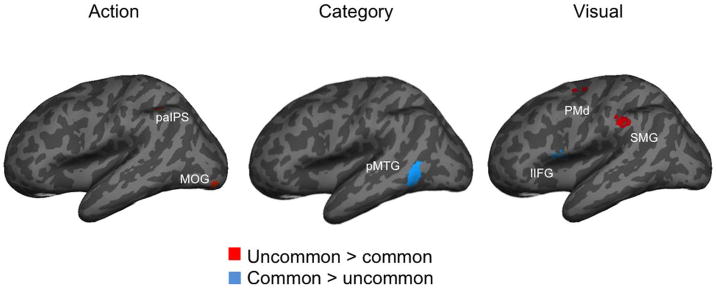
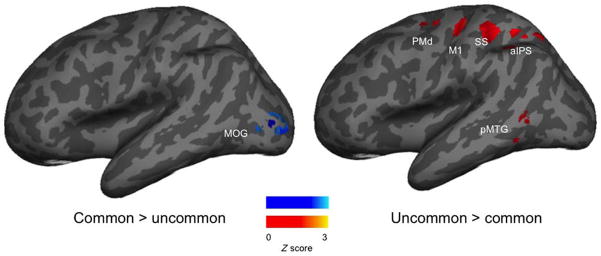
Our use of tools is situated in different contexts. Prior evidence suggests that diverse regions within the ventral and dorsal streams represent information supporting common tool use. However, given the flexibility of object concepts, these regions may be tuned to different types of information when generating novel or uncommon uses of tools. To investigate this, we collected fMRI data from participants who reported common or uncommon tool uses in response to visually presented familiar objects. We performed a pattern dissimilarity analysis in which we correlated cortical patterns with behavioral measures of visual, action, and category information. The results showed that evoked cortical patterns within the dorsal tool use network reflected action and visual information to a greater extent in the uncommon use group, whereas evoked neural patterns within the ventral tool use network reflected categorical information more strongly in the common use group. These results reveal the flexibility of cortical representations of tool use and the situated nature of cortical representations more generally.
我们对工具的使用处于不同的情境中。先前的证据表明,腹侧和背侧流中的不同区域代表了支持常见工具使用的信息。然而,鉴于物体概念的灵活性,当生成工具的新颖或不常见用途时,这些区域可能会针对不同类型的信息进行调整。为了研究这一点,我们从报告常见或不常见工具使用的参与者中收集了 fMRI 数据,以响应视觉呈现的熟悉物体。我们进行了模式相似性分析,我们将皮质模式与视觉、动作和类别信息的行为测量相关联。结果表明,在不常见使用组中,背侧工具使用网络内的诱发皮质模式在更大程度上反映了动作和视觉信息,而在常见使用组中,腹侧工具使用网络内的诱发神经模式更强烈地反映了类别信息。这些结果揭示了工具使用的皮质表示的灵活性以及皮质表示的情境性质。