Powers Donald R, Langland Kathleen M, Wethington Susan M, Powers Sean D, Graham Catherine H, Tobalske Bret W
Department of Biology, George Fox University, Newberg, OR, USA.
Hummingbird Monitoring Network, Patagonia, AZ, USA.
R Soc Open Sci. 2017 Dec 6;4(12):171056. doi: 10.1098/rsos.171056. eCollection 2017 Dec.
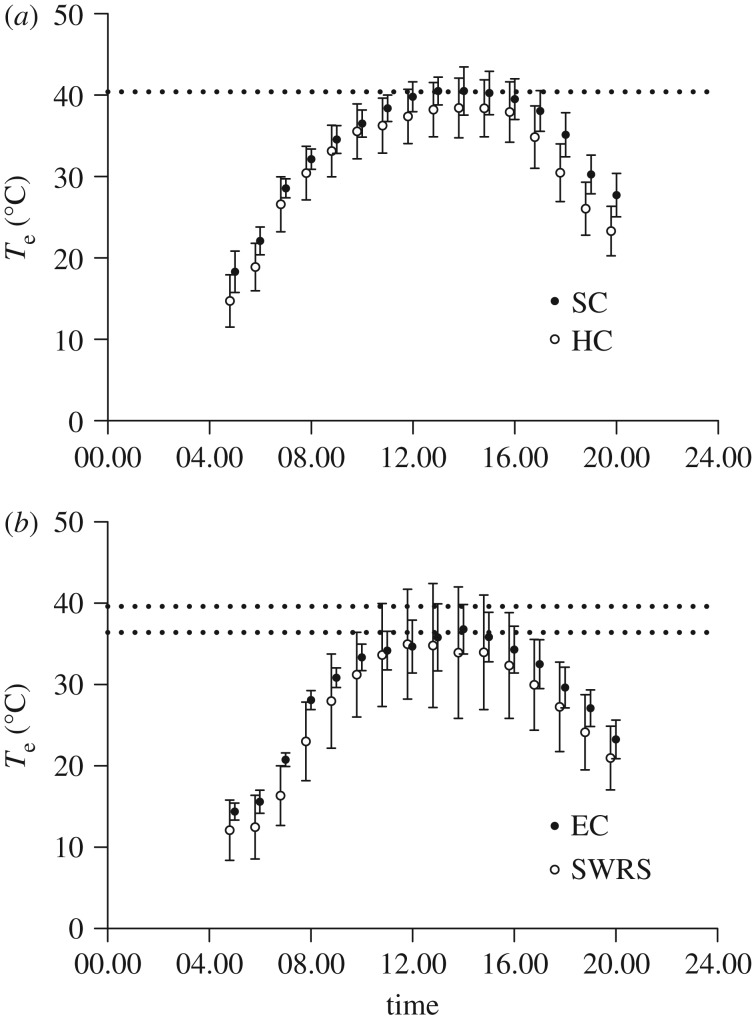
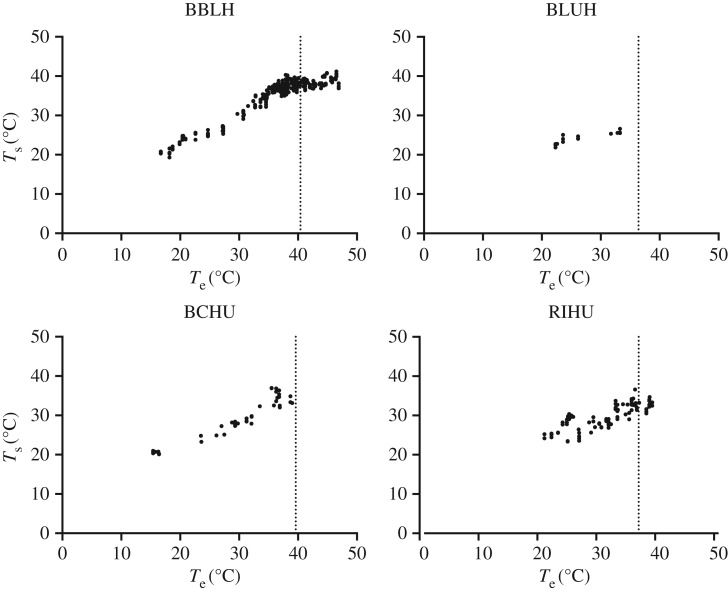
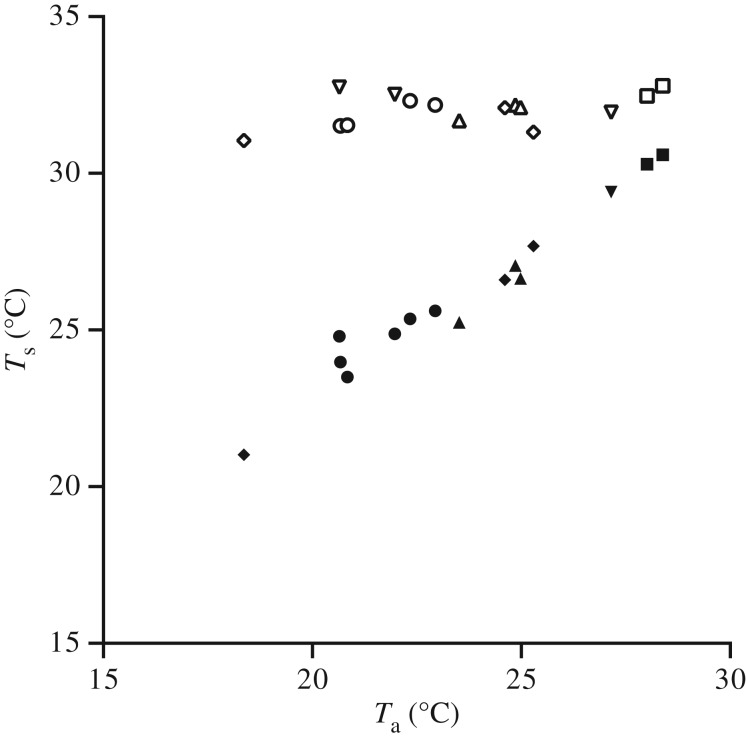
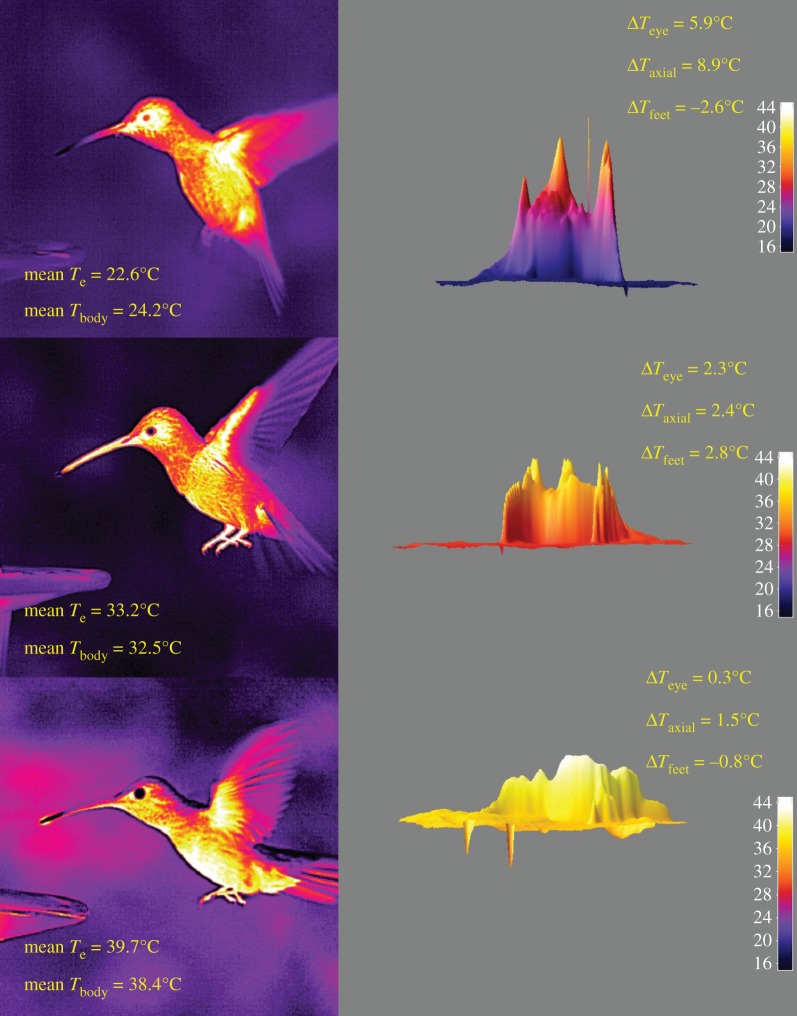
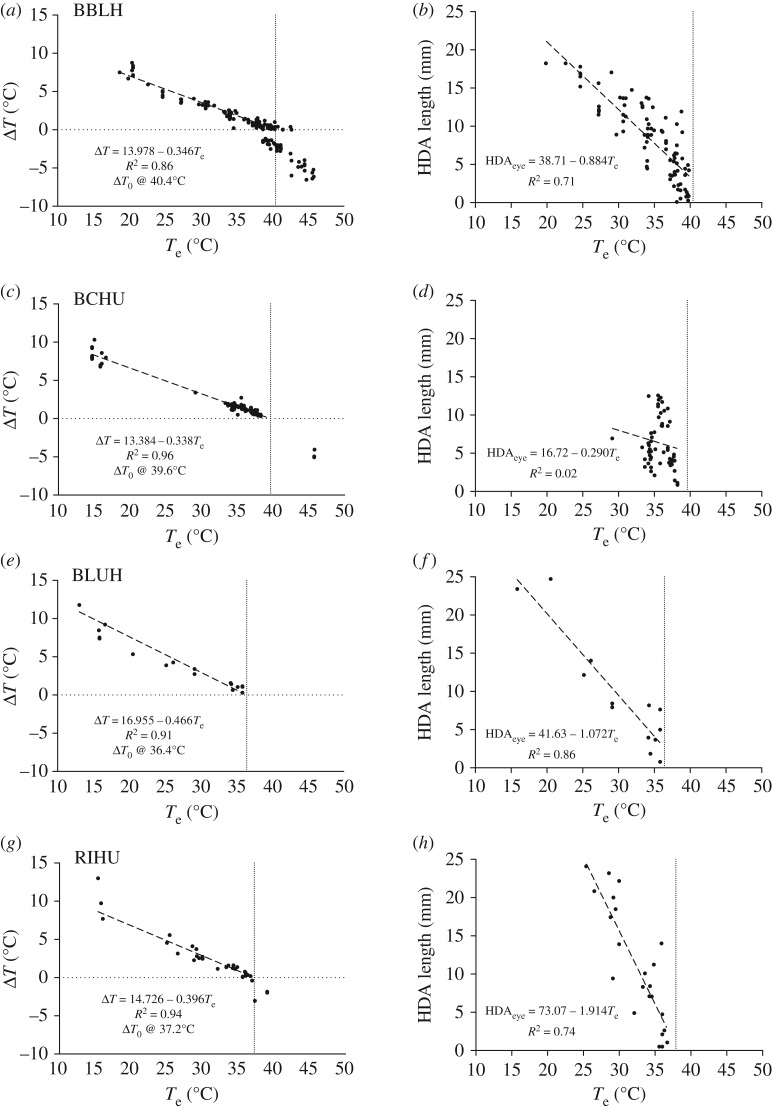
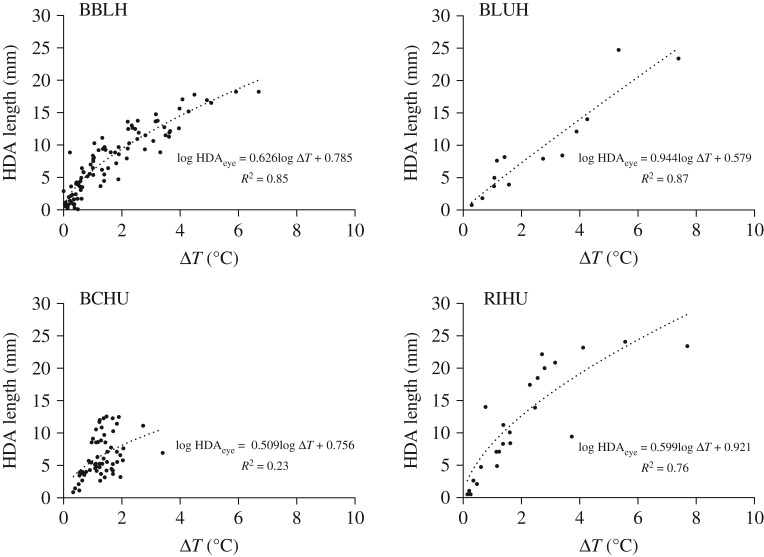
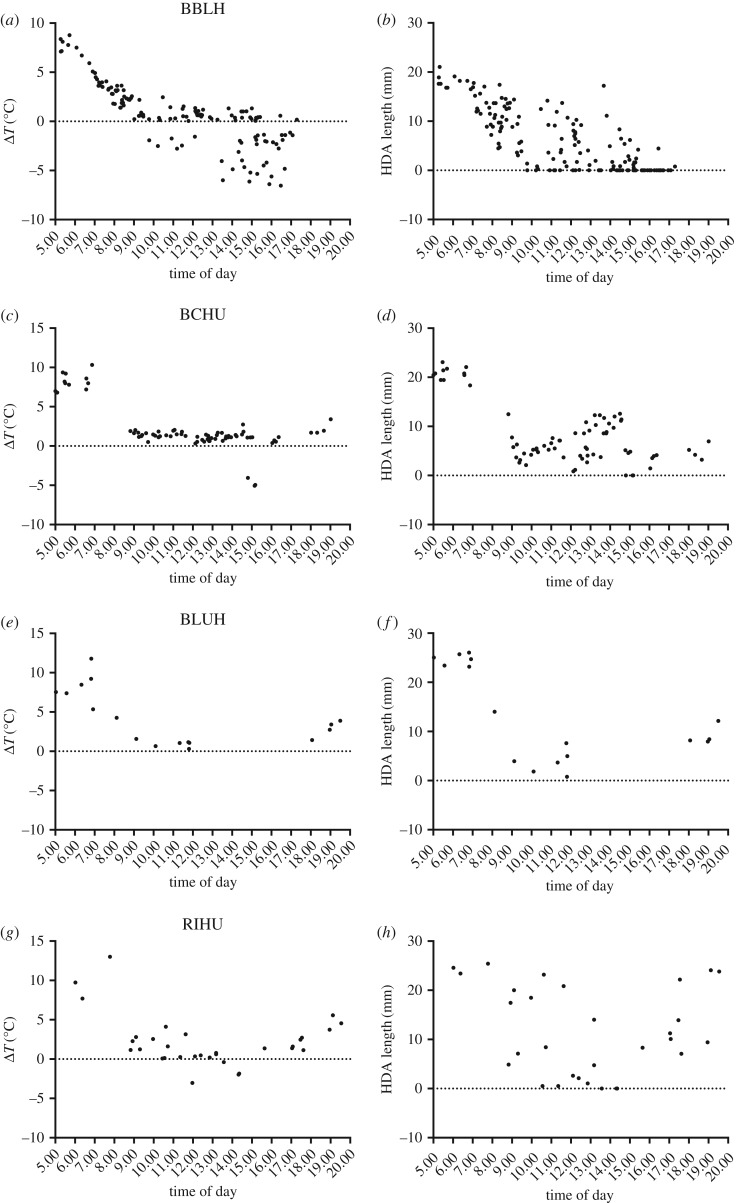
At high temperature (greater than 40°C) endotherms experience reduced passive heat dissipation (radiation, conduction and convection) and increased reliance on evaporative heat loss. High temperatures challenge flying birds due to heat produced by wing muscles. Hummingbirds depend on flight for foraging, yet inhabit hot regions. We used infrared thermography to explore how lower passive heat dissipation during flight impacts body-heat management in broad-billed (, 3.0 g), black-chinned (, 3.0 g), Rivoli's (, 7.5 g) and blue-throated (, 8.0 g) hummingbirds in southeastern Arizona and calliope hummingbirds (, 2.6 g) in Montana. Thermal gradients driving passive heat dissipation through eye, shoulder and feet dissipation areas are eliminated between 36 and 40°C. Thermal gradients persisted at higher temperatures in smaller species, possibly allowing them to inhabit warmer sites. All species experienced extended daytime periods lacking thermal gradients. Broad-billed hummingbirds lacking thermal gradients regulated the mean total-body surface temperature at approximately 38°C, suggesting behavioural thermoregulation. Blue-throated hummingbirds were inactive when lacking passive heat dissipation and hence might have the lowest temperature tolerance of the four species. Use of thermal refugia permitted hummingbirds to tolerate higher temperatures, but climate change could eliminate refugia, forcing distributional shifts in hummingbird populations.
在高温(高于40°C)下,恒温动物的被动散热(辐射、传导和对流)减少,对蒸发散热的依赖增加。高温对飞鸟构成挑战,因为翅膀肌肉会产生热量。蜂鸟依靠飞行觅食,但栖息在炎热地区。我们使用红外热成像技术,探究了在亚利桑那州东南部的阔嘴蜂鸟(体重约3.0克)、黑颏蜂鸟(体重约3.0克)、丽羽蜂鸟(体重约7.5克)和蓝喉蜂鸟(体重约8.0克)以及蒙大拿州的红玉喉北蜂鸟(体重约2.6克)飞行过程中较低的被动散热如何影响体温调节。在36至40°C之间,驱动通过眼睛、肩部和脚部散热区域进行被动散热的热梯度消失。在较高温度下,较小物种的热梯度持续存在,这可能使它们能够栖息在更温暖的地方。所有物种在白天都有较长时间不存在热梯度。没有热梯度时,阔嘴蜂鸟将全身平均体表温度调节在约38°C,这表明存在行为体温调节。缺乏被动散热时,蓝喉蜂鸟不活动,因此可能是这四个物种中温度耐受性最低的。利用热避难所使蜂鸟能够耐受更高的温度,但气候变化可能会消除避难所,迫使蜂鸟种群发生分布变化。