Roberto Michela, Falcone Rosa, Mazzuca Federica, Archibugi Livia, Castaldi Nadia, Botticelli Andrea, Osti Mattia Falchetto, Marchetti Paolo
Clinical and Molecular Medicine Department, Medical Oncology Unit, Sant'Andrea Hospital Medical-Surgical Department of Clinical Sciences and Translational Medicine, Digestive and Liver Disease Unit, Sant'Andrea Hospital, School of Medicine Medicine-Surgery and Translational Medicine Department, Radiotherapy Unit, Sant'Andrea Hospital, Sapienza University of Rome, Rome, Italy.
Medicine (Baltimore). 2017 Dec;96(48):e9023. doi: 10.1097/MD.0000000000009023.
Regorafenib is the new standard third-line therapy in metastatic colorectal cancer (mCRC). However, the reported 1-year overall survival rate does not exceed 25%.
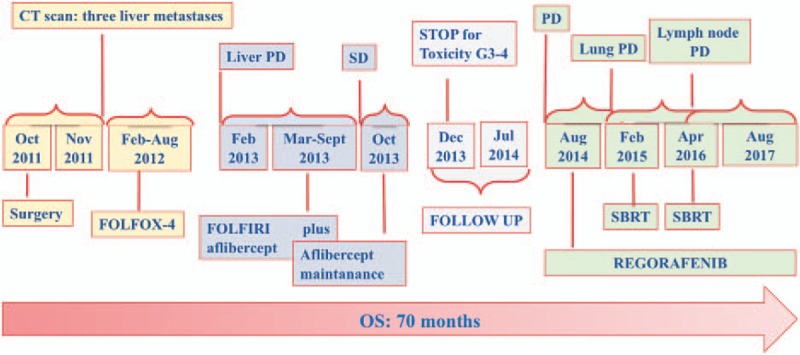
A 55-year-old man affected by mCRC, treated with regorafenib combined with stereotactic body radiotherapy (SBRT), showing a durable response.
After 6 months of regorafenib, a PET/CT scan revealed a focal uptake in a solid lung nodule which was treated with SBRT, whereas continuing regorafenib administration. Fourteen months later, the patient had further progression in a parasternal lymph node, but treatment with regorafenib was continued. The regorafenib-associated side effects, such us the hand-foot syndrome, were favorable managed by reducing the dose from 160 to 120 mg/day.
Patient-reported outcome was characterized by a progression-free survival of approximately 3 years.
in presence of oligometastatic progression, a local SBRT while retaining the same systemic therapy may be a better multidisciplinary approach. Moreover, disease progression is no longer an absolute contraindication for continuing the regorafenib treatment.
瑞戈非尼是转移性结直肠癌(mCRC)新的标准三线治疗药物。然而,报道的1年总生存率不超过25%。
一名55岁的mCRC男性患者,接受瑞戈非尼联合立体定向体部放疗(SBRT)治疗,显示出持久疗效。
使用瑞戈非尼6个月后,PET/CT扫描显示一个实性肺结节有局灶性摄取,对其进行了SBRT治疗,同时继续给予瑞戈非尼。14个月后,患者胸骨旁淋巴结出现进一步进展,但继续使用瑞戈非尼治疗。通过将剂量从160毫克/天减至120毫克/天,很好地控制了与瑞戈非尼相关的副作用,如手足综合征。
患者报告的结果显示无进展生存期约为3年。
在存在寡转移进展的情况下,在维持相同全身治疗的同时进行局部SBRT可能是一种更好的多学科治疗方法。此外,疾病进展不再是继续使用瑞戈非尼治疗的绝对禁忌证。