Dane Faysal, Ozgurdal Kirhan, Yalçın Şuayib, Benekli Mustafa, Aykan Nuri Faruk, Yücel İdris, Özkan Metin, Evrensel Turkkan, Sevinç Alper, Coskun Hasan Şenol, Sanli Ulus Ali, Kara Ismail Oguz, Yumuk Perran Fulden
Division of Medical Oncology, Department of Internal Medicine, Marmara University Medical Faculty, Istanbul, Turkey
Global Medical Affairs, Bayer HealthCare, Istanbul, Turkey.
BMJ Open. 2020 Mar 26;10(3):e027665. doi: 10.1136/bmjopen-2018-027665.
Regorafenib improved overall survival in patients with metastatic colorectal cancer (mCRC) refractory to standard therapies in two randomised, phase III trials, but has not been evaluated in Turkey. REGARD evaluated the safety and efficacy of regorafenib in Turkish patients with treatment-refractory mCRC.
Open-label, single-arm, phase IIIb study conducted between July 2013 and April 2015.
11 tertiary centres in Turkey.
Eligible patients were adults with mCRC who had disease progression within 3 months after receiving their last dose of approved standard therapies and who had an Eastern Cooperative Oncology Group performance status ≤1. Patients were excluded if they had previously received regorafenib. Of 139 patients screened, 100 were treated and completed the study, and all 100 were analysed. Fifty-eight per cent were male.
Patients received oral regorafenib, 160 mg once daily, for the first 3 weeks of each 4-week cycle until disease progression, death or unacceptable toxicity.
The primary endpoint was safety, assessed by incidence of treatment-emergent adverse events (TEAEs). Progression-free survival (PFS) per investigator was the primary efficacy endpoint. There were no secondary endpoints.
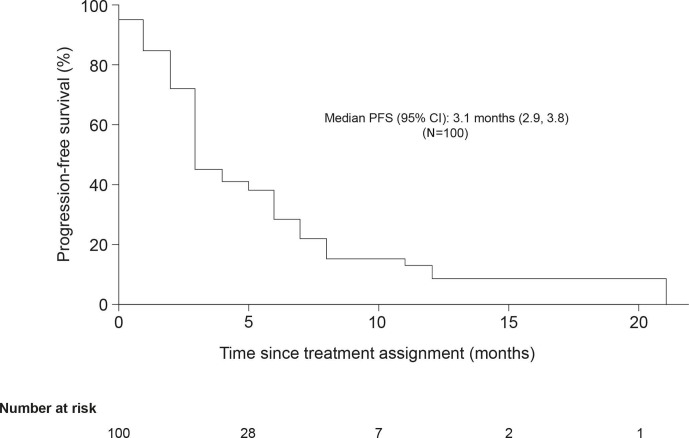
The median treatment duration was 2.5 months (range 0.1 to 20.6). Ninety-six per cent of patients had at least one TEAE and 77% had a grade ≥3 TEAE. The most common grade ≥3 regorafenib-related TEAEs were hypophosphataemia (11%), fatigue (8%), hyperbilirubinaemia (6%), hand-foot skin reaction (5%), hypertension (5%), anorexia (5%) and increased alanine aminotransferase (5%). TEAEs led to dose reduction in 30% of patients. Regorafenib-related TEAEs led to treatment discontinuation in 17% of patients. Median PFS was 3.1 months (95% CI 2.9 to 3.8).
The regorafenib safety profile and PFS in REGARD were consistent with the results of previous trials of regorafenib in mCRC. Regorafenib is an option for patients in Turkey with treatment-refractory mCRC.
NCT01853319, ClinicalTrials.gov.
在两项随机III期试验中,瑞戈非尼改善了对标准疗法难治的转移性结直肠癌(mCRC)患者的总生存期,但尚未在土耳其进行评估。REGARD研究评估了瑞戈非尼在土耳其治疗难治性mCRC患者中的安全性和疗效。
2013年7月至2015年4月进行的开放标签、单臂IIIb期研究。
土耳其的11个三级中心。
符合条件的患者为患有mCRC的成年人,他们在接受最后一剂批准的标准疗法后3个月内出现疾病进展,且东部肿瘤协作组体能状态≤1。曾接受过瑞戈非尼治疗的患者被排除。在139名筛查的患者中,100名接受了治疗并完成了研究,所有100名患者均进行了分析。58%为男性。
患者接受口服瑞戈非尼,每次4周周期的前3周每天一次,剂量为160mg,直至疾病进展、死亡或出现不可接受的毒性。
主要终点为安全性,通过治疗中出现的不良事件(TEAE)发生率进行评估。每位研究者评估的无进展生存期(PFS)是主要疗效终点。无次要终点。
中位治疗持续时间为2.5个月(范围0.1至20.6个月)。96%的患者至少出现一次TEAE,77%的患者出现≥3级TEAE。最常见的≥3级与瑞戈非尼相关的TEAE为低磷血症(11%)、疲劳(8%)、高胆红素血症(6%)、手足皮肤反应(5%)、高血压(5%)、厌食(5%)和丙氨酸转氨酶升高(5%)。TEAE导致30%的患者剂量减少。与瑞戈非尼相关的TEAE导致17%的患者停药。中位PFS为3.1个月(95%CI 2.9至3.8)。
REGARD研究中瑞戈非尼的安全性和PFS与之前瑞戈非尼治疗mCRC的试验结果一致。瑞戈非尼是土耳其治疗难治性mCRC患者的一种选择。
NCT01853319,ClinicalTrials.gov。