International Center of Excellence in Research, Faculty of Medicine and Odontostomatology, Point G, Bamako, Mali.
National Institutes of Health, Bethesda, MD, 20892, USA.
Parasit Vectors. 2018 Jan 8;11(1):18. doi: 10.1186/s13071-017-2531-8.
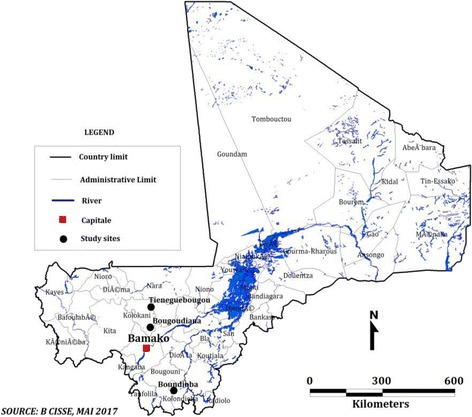
Filariasis and leishmaniasis are two neglected tropical diseases in Mali. Due to distribution and associated clinical features, both diseases are of concern to public health. The goal of this study was to determine the prevalence of co-infection with filarial (Wuchereria bancrofti and Mansonella perstans) and Leishmania major parasites in two ecologically distinct areas of Mali, the Kolokani district (villages of Tieneguebougou and Bougoudiana) in North Sudan Savanna area, and the district of Kolondieba (village of Boundioba) in the South Sudan Savanna area.
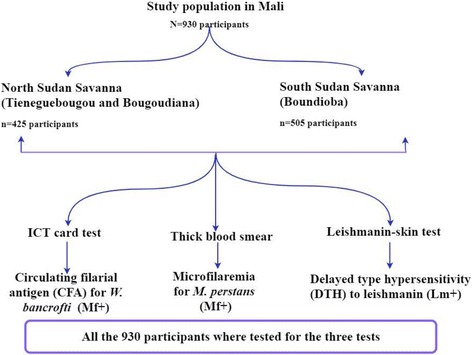
The prevalence of co-infection (filarial and Leishmania) was measured based on (i) Mansonella perstans microfilaremia count and/or filariasis immunochromatographic test (ICT) for Wuchereria bancrofti-specific circulating antigen, and (ii) the prevalence of delayed type hypersensitivity (DTH) responses to Leishmania measured by leishmanin skin test (LST).
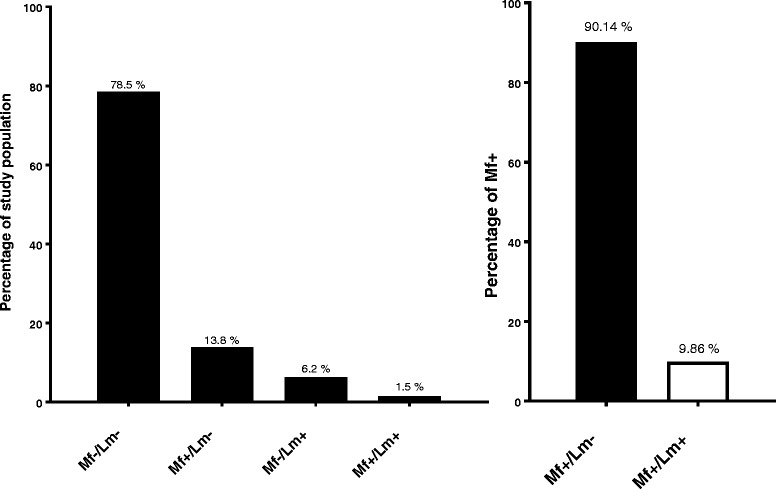
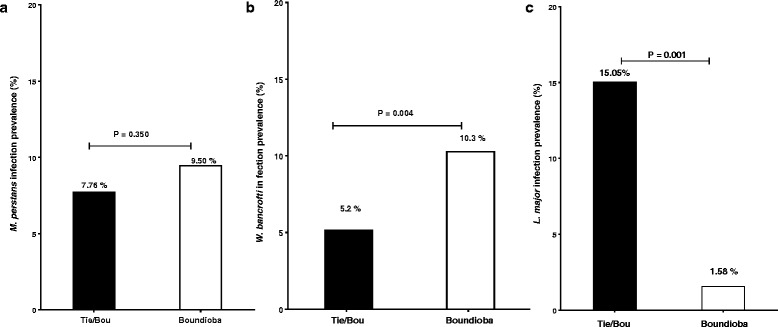
In this study, a total of 930 volunteers between the age of 18 and 65 were included from the two endemic areas of Kolokani and Kolondieba. In general, in both areas, filarial infection was more prevalent than Leishmania infection with an overall prevalence of 15.27% (142/930) including 8.7% (81/930) for Mansonella perstans and 8% (74/930) for Wuchereria bancrofti-specific circulating antigen. The prevalence of Leishmania major infection was 7.7% (72/930) and was significantly higher in Tieneguebougou and Bougoudiana (15.05%; 64/425) than in Boundioba (2.04%; 8/505) (χ = 58.66, P < 0.0001). Among the filarial infected population, nearly 10% (14/142) were also positive for Leishmania with an overall prevalence of co-infection of 1.50% (14/930) varying from 2.82% (12/425) in Tieneguebougou and Bougoudiana to 0.39% (2/505) in Boundioba (P = 0.0048).
This study established the existence of co-endemicity of filarial and Leishmania infections in specific regions of Mali. Since both filarial and Leishmania infections are vector-borne with mosquitoes and sand flies as respective vectors, an integrated vector control approach should be considered in co-endemic areas. The effect of potential interaction between filarial and Leishmania parasites on the disease outcomes may be further studied.
在马里,丝虫病和利什曼病是两种被忽视的热带病。由于分布和相关的临床特征,这两种疾病都与公共卫生有关。本研究的目的是确定在马里两个生态区(北苏丹萨凡纳地区的科洛卡尼区(蒂内盖布古和布戈迪安纳村)和南苏丹萨凡纳地区的科洛迪巴区(布恩迪奥巴村))中,携带丝状(班氏吴策线虫和曼森氏线虫)和利什曼原虫寄生虫的合并感染的流行率。
根据(i)曼森氏线虫微丝蚴计数和/或班氏吴策线虫特异性循环抗原的丝虫病免疫层析试验(ICT),以及(ii)利什曼原虫皮肤试验(LST)测量的对利什曼原虫的迟发型超敏反应(DTH)反应的流行率,来衡量合并感染(丝状和利什曼原虫)的流行率。
本研究共纳入来自科洛卡尼和科洛迪巴两个流行地区的 930 名年龄在 18 至 65 岁之间的志愿者。一般来说,在这两个地区,丝虫感染比利什曼原虫感染更为普遍,总流行率为 15.27%(142/930),其中曼森氏线虫感染率为 8.7%(81/930),班氏吴策线虫特异性循环抗原感染率为 8%(74/930)。利什曼原虫感染的流行率为 7.7%(72/930),在蒂内盖布古和布戈迪安纳(15.05%;64/425)显著高于布恩迪奥巴(2.04%;8/505)(χ²=58.66,P<0.0001)。在感染丝虫的人群中,近 10%(14/142)也对利什曼原虫呈阳性,总合并感染率为 1.50%(14/930),在蒂内盖布古和布戈迪安纳为 2.82%(12/425),在布恩迪奥巴为 0.39%(2/505)(P=0.0048)。
本研究在马里的特定地区证实了丝状和利什曼原虫感染的共同流行。由于丝虫和利什曼原虫感染都是通过蚊子和沙蝇作为各自的媒介传播的,因此在共同流行地区应考虑采用综合的媒介控制方法。丝虫和利什曼原虫寄生虫之间潜在相互作用对疾病结果的影响可能进一步研究。