Division of Pediatric Neurology, Department of Pediatrics, Boston Medical Center, Boston, Massachusetts.
Division of Pediatric Neurology, Department of Pediatrics, Boston Medical Center, Boston, Massachusetts.
Pediatr Neurol. 2018 Feb;79:45-52. doi: 10.1016/j.pediatrneurol.2017.11.002. Epub 2017 Nov 13.
This study aims to determine the prevalence of neurodevelopmental impairments at age ten years among children born extremely preterm (less than 28 weeks gestational age) and to offer a framework for categorizing neurological limitations.
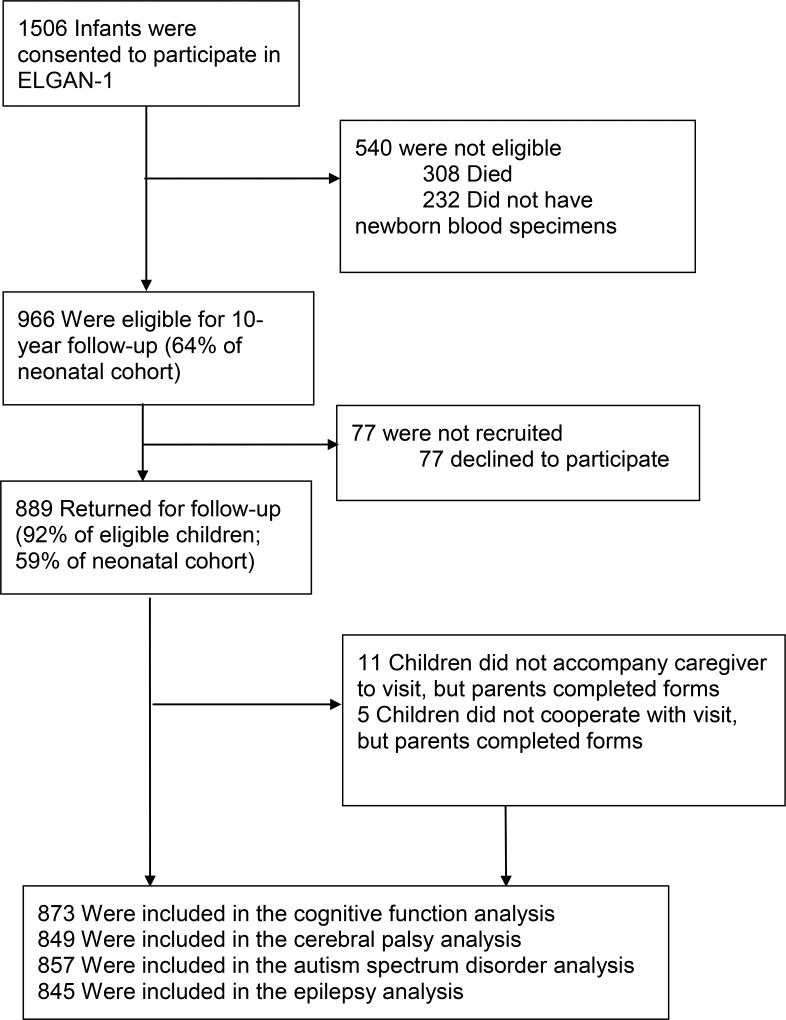
A multicenter, prospective cohort follow-up study recruited 889 ten-year-old children born from 2002 to 2004. We assessed prevalence of cognitive impairment, measured by intelligent quotient and tests of executive function, cerebral palsy (CP), autism spectrum disorder (ASD), and epilepsy singly and in combination. The three levels of impairment severity were: category I-no major neurodevelopmental impairment; category II-normal cognitive ability with CP, ASD, and/or epilepsy; and category III-children with cognitive impairment.
A total 214 of 873 children (25%) had cognitive impairment, 93 of 849 children (11%) had CP, 61 of 857 children (7%) had ASD, and 66 of 888 children (7%) had epilepsy. Further, 19% of all children had one diagnosis, 10% had two diagnoses, and 3% had three diagnoses. Decreasing gestational age was associated with increasing number of impairments (P < 0.001). Half the children with cognitive impairment and one third of children with CP, ASD, or epilepsy had a single impairment. Six hundred one (68% [95% CI, 64.5%-70.7%]) children were in category I, 74 (8% [95% CI, 6.6%-10.3%]) were in category II, and 214 (24% [95% CI 21.7%-27.4%]) were in category III.
Three quarters of children had normal intellect at age ten years; nearly 70% were free of neurodevelopmental impairment. Forty percent of children with impairments had multiple diagnoses.
本研究旨在确定在 10 岁时患有极早产(妊娠龄小于 28 周)的儿童的神经发育障碍的流行率,并提供一种分类神经局限性的框架。
一项多中心、前瞻性队列随访研究招募了 889 名 2002 年至 2004 年出生的 10 岁儿童。我们单独和联合评估了认知障碍的患病率,通过智商和执行功能测试来衡量脑瘫(CP)、自闭症谱系障碍(ASD)和癫痫。损害严重程度分为三个级别:I 级-无主要神经发育障碍;II 级-认知能力正常,但有 CP、ASD 和/或癫痫;III 级-认知障碍患儿。
873 名儿童中有 214 名(25%)存在认知障碍,849 名儿童中有 93 名(11%)存在 CP,857 名儿童中有 61 名(7%)存在 ASD,888 名儿童中有 66 名(7%)存在癫痫。此外,19%的儿童有一个诊断,10%的儿童有两个诊断,3%的儿童有三个诊断。胎龄越小,损伤的数量越多(P<0.001)。一半有认知障碍的儿童和三分之一有 CP、ASD 或癫痫的儿童只有单一损伤。601 名(68%[95%CI,64.5%-70.7%])儿童属于 I 类,74 名(8%[95%CI,6.6%-10.3%])属于 II 类,214 名(24%[95%CI 21.7%-27.4%])属于 III 类。
四分之三的儿童在 10 岁时智力正常;近 70%的儿童没有神经发育障碍。40%有损伤的儿童有多种诊断。