Florey Institute of Neuroscience and Mental Health, University of Melbourne, Parkville, VIC 3010, Australia.
Monash Biomedical Imaging, Monash University, VIC 3800, Australia;
Proc Natl Acad Sci U S A. 2018 Jan 23;115(4):786-791. doi: 10.1073/pnas.1717646115. Epub 2018 Jan 8.
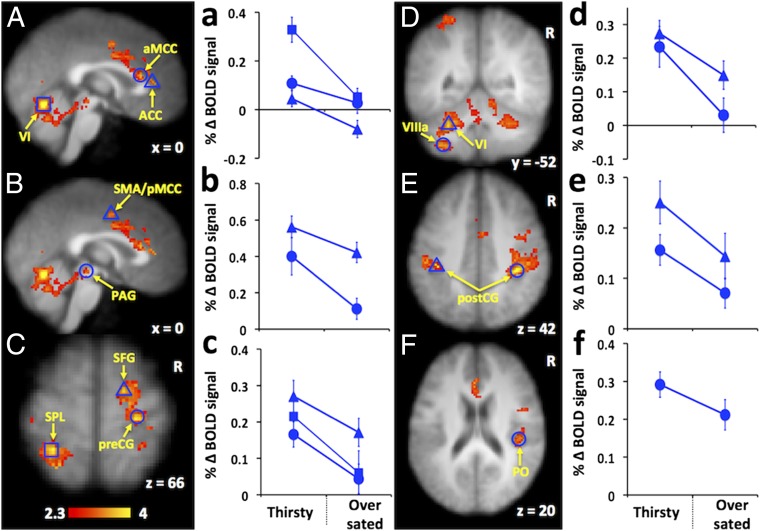
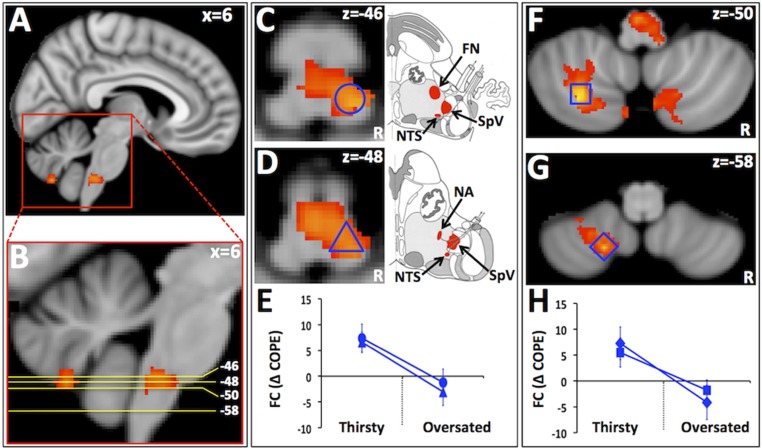
In humans, activity in the anterior midcingulate cortex (aMCC) is associated with both subjective thirst and swallowing. This region is therefore likely to play a prominent role in the regulation of drinking in response to dehydration. Using functional MRI, we investigated this possibility during a period of "drinking behavior" represented by a conjunction of preswallow and swallowing events. These events were examined in the context of a thirsty condition and an "oversated" condition, the latter induced by compliant ingestion of excess fluid. Brain regions associated with swallowing showed increased activity for drinking behavior in the thirsty condition relative to the oversated condition. These regions included the cingulate cortex, premotor areas, primary sensorimotor cortices, the parietal operculum, and the supplementary motor area. Psychophysical interaction analyses revealed increased functional connectivity between the same regions and the aMCC during drinking behavior in the thirsty condition. Functional connectivity during drinking behavior was also greater for the thirsty condition relative to the oversated condition between the aMCC and two subcortical regions, the cerebellum and the rostroventral medulla, the latter containing nuclei responsible for the swallowing reflex. Finally, during drinking behavior in the oversated condition, ratings of swallowing effort showed a negative association with functional connectivity between the aMCC and two cortical regions, the sensorimotor cortex and the supramarginal gyrus. The results of this study provide evidence that the aMCC helps facilitate swallowing during a state of thirst and is therefore likely to contribute to the regulation of drinking after dehydration.
在人类中,前扣带皮层(aMCC)的活动与主观口渴和吞咽有关。因此,该区域可能在调节脱水后饮水方面发挥重要作用。我们使用功能磁共振成像(fMRI)在“吞咽行为”期间研究了这种可能性,“吞咽行为”由预吞咽和吞咽事件的结合来表示。在口渴和“过度饱和”两种条件下检查了这些事件,后者通过顺从性摄入过量液体来诱导。与吞咽相关的脑区在口渴条件下的吞咽行为中比在过度饱和条件下表现出更高的活动。这些区域包括扣带皮层、运动前区、初级感觉运动皮层、顶叶岛盖和辅助运动区。心理物理相互作用分析显示,在口渴条件下的吞咽行为期间,相同区域与 aMCC 之间的功能连接增加。与过度饱和条件相比,在口渴条件下,aMCC 与两个皮质下区域(小脑和腹侧延髓)之间的功能连接在吞咽行为期间也更大,后者包含负责吞咽反射的核。最后,在过度饱和条件下的吞咽行为期间,吞咽努力的评分与 aMCC 与两个皮质区域(感觉运动皮层和缘上回)之间的功能连接呈负相关。这项研究的结果提供了证据,表明 aMCC 有助于在口渴状态下促进吞咽,因此可能有助于调节脱水后的饮水。